
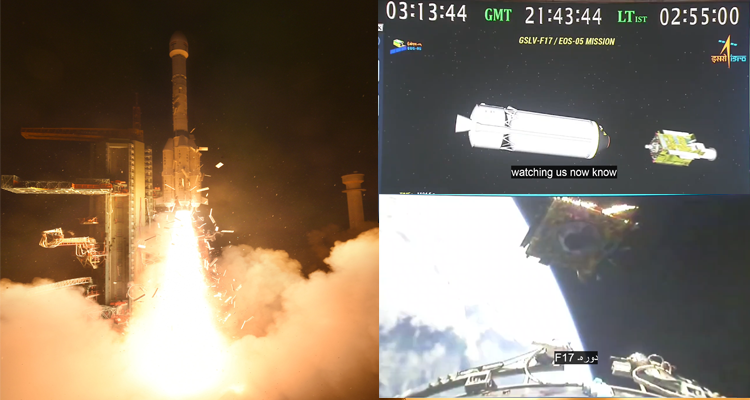
Sriharikota: The Indian Space Research Organisation (ISRO) on Friday successfully launched EOS-05, India’s first dedicated imaging satellite designed to operate from a geosynchronous orbit, marking a significant milestone in the country’s Earth-observation capabilities.
The GSLV-F17 rocket lifted off at 2:55 am on September 4, 2026, from the Second Launch Pad at the Satish Dhawan Space Centre in Sriharikota. After a smooth countdown of about 27 hours, the three-stage launch vehicle precisely injected the 2,367-kg EOS-05 into its intended Sub-Geosynchronous Transfer Orbit (Sub-GTO) roughly 18 minutes after liftoff. ISRO officially confirmed that the mission had successfully accomplished its objective.
🇮🇳 India Gets A New Eye In Space As ISRO Launches First-Ever Geosynchronous Imaging Satellite
EOS-05 lifted off aboard GSLV-F17 from Sriharikota at 2:55 AM IST, with ISRO successfully placing it on course for its final high-altitude orbit.
Designed to watch large areas of Earth… pic.twitter.com/By8xuRYcZP
— RT_India (@RT_India_news) September 4, 2026
Better-than-expected orbital performance
The mission delivered an especially encouraging result in terms of the rocket’s orbital performance. According to ISRO Chairman V. Narayanan, the vehicle achieved an apogee significantly above the nominal target while maintaining the required perigee and inclination. Reports from the launch site said the vehicle achieved an apogee of around 31,260 km against a planned 29,000 km, while the perigee was about 171 km and inclination 19.28 degrees.
Narayanan said ISRO had improved the GSLV’s performance through structural-mass optimisation and propulsion-system improvements, allowing the rocket to carry its heaviest-ever payload into a geosynchronous transfer orbit. The 2,367-kg EOS-05 is also the heaviest satellite launched by the GSLV so far.
I am very happy to announce that the GSLV-F17 vehicle has successfully and precisely injected the Advanced Earth Observation Satellite 05, the geo-imaging star satellite, in the intended and required orbit
Once the Earth Observation Satellite 05 is operationalized in the orbit,… pic.twitter.com/6iR6tlTiKG
— PIB India (@PIB_India) September 4, 2026
India gets a new ‘eye in the sky’
EOS-05 is a state-of-the-art Earth observation spacecraft and represents a major advance because it is designed to provide imaging from a geosynchronous orbit roughly 36,000 km above Earth. Unlike satellites in lower polar or sun-synchronous orbits, its geosynchronous positioning will enable more persistent observation of large regions.
The satellite is expected to strengthen applications including agriculture, disaster management, water-resource monitoring, environmental surveillance, forestry, urban planning and natural-resource management. Its imaging capabilities are also expected to provide more frequent information for rapidly changing situations such as floods, forest fires and severe weather events.
Mission Success!
GSLV-F17 has successfully accomplished its mission, placing EOS-05 into the intended orbit.
Sharing a few memorable moments from the lift-off.
For more information:https://t.co/VneB2jgZoY#GSLVF17 #EOS05 #ISRO pic.twitter.com/kv0zB6V5Vi
— ISRO (@isro) September 3, 2026
Major achievement for GSLV
Friday’s mission was the 19th flight of the GSLV and the 107th launch from Sriharikota. The GSLV-F17 uses a solid core stage, four liquid strap-ons, a liquid second stage and an indigenous cryogenic upper stage. The successful performance of the cryogenic stage was a particularly important moment during the mission.
The achievement also comes after a period in which ISRO faced setbacks in some missions. The successful GSLV-F17 flight therefore provides an important boost to confidence in the launcher and demonstrates India’s growing ability to handle heavier and more complex spacecraft.
ISRO’s own mission record confirms that GSLV-F17 successfully accomplished its mission and placed EOS-05 into the intended Sub-GTO. The agency describes EOS-05 as India’s first-ever imaging satellite from geosynchronous orbit, making the mission an important addition to the country’s Earth-observation programme.
Boost to India’s Earth-observation capability
The EOS-05 mission is significant not simply because of a successful launch, but because of the type of observation capability it is designed to provide. Persistent imaging from geosynchronous orbit could allow India to obtain timely information over large areas, complementing data from its existing fleet of lower-orbit Earth-observation satellites.
With the satellite successfully injected into its transfer orbit, EOS-05 will now undergo the necessary orbital manoeuvres before reaching its operational position. The mission marks another step in ISRO’s effort to expand India’s indigenous space-based capabilities for civilian applications, strategic situational awareness and disaster-response planning.
In short, EOS-05 has given ISRO a double achievement: a successful deployment of India’s first geosynchronous imaging satellite and a strong performance from the GSLV-F17, with the launcher exceeding the nominal apogee target while carrying its heaviest-ever GSLV payload.