
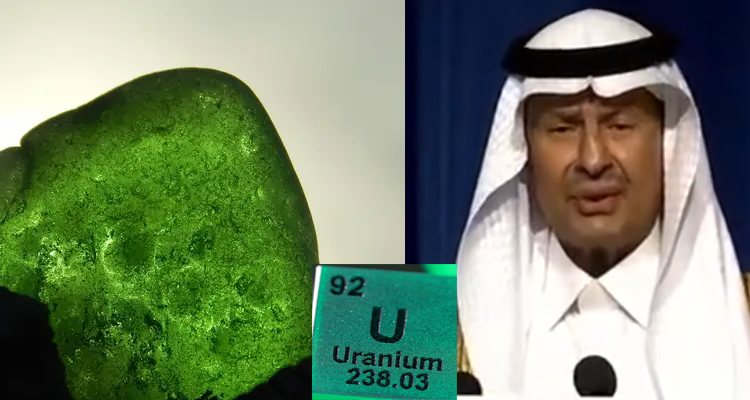
Riyadh: Saudi Arabia has identified an estimated 110 million tonnes of ore containing uranium concentrations in the Madinah region, marking a potentially significant development in the Kingdom’s plans to build a domestic nuclear-energy industry and expand the use of its mineral resources.
The announcement was made by Saudi Energy Minister Prince Abdulaziz bin Salman during the International Atomic Energy Agency (IAEA) General Conference in Vienna on Monday. According to Saudi state media and Reuters, geological exploration at the Jabal Sayid area in Madinah identified around 110 million tonnes of ore containing promising uranium deposits as well as significant concentrations of rare-earth minerals, particularly heavy rare earth elements.
110 million tonnes is ore, not uranium
The figure needs to be understood carefully. Saudi Arabia has not announced the discovery of 110 million tonnes of pure uranium. The figure refers to the estimated quantity of ore in which uranium and rare-earth mineralisation has been identified. The Saudi government has not yet disclosed the uranium grade, the recoverable uranium content or whether the entire resource would be economically viable to mine.
🇸🇦 Saudi Arabia may have just added a very different kind of resource story to its oil economy.
Energy Minister Prince Abdulaziz bin Salman says the Kingdom has discovered around 110 million tonnes of ore containing high concentrations of RARE EARTH ELEMENTS, especially heavy… pic.twitter.com/1EXeUnyY3V
— Mario Nawfal (@MarioNawfal) September 14, 2026
Earlier international resource assessments provide useful context. The OECD Nuclear Energy Agency and IAEA’s Uranium 2024: Resources, Production and Demand reported that the Jabal Sayid uranium-thorium prospect had 19 million tonnes of indicated ore grading 424 parts per million uranium, containing about 8,056 tonnes of uranium, while a further 10 million tonnes of inferred resources graded about 437 ppm, containing around 4,370 tonnes of uranium.
The earlier Uranium 2022 assessment had estimated 34 million tonnes of inferred ore at Jabal Sayid containing about 14,135 tonnes of uranium, illustrating that resource estimates can change as exploration advances and geological information improves.
Saudi Arabia discovers 110 million tonnes of Uranium-rich ore in Madinah region
READ: https://t.co/RpQaQqdbfThttps://t.co/RpQaQqdbfT
— WION (@WIONews) September 14, 2026
Nuclear ambitions gaining momentum
The latest announcement comes as Riyadh accelerates its plans for a domestic civil nuclear sector. Saudi Arabia’s National Atomic Energy Project envisages nuclear power as part of a broader energy mix aimed at reducing dependence on hydrocarbons, producing electricity and supporting desalination and industrial applications. The Kingdom’s official energy ministry identifies uranium resources and the nuclear fuel cycle as components of the programme.
Prince Abdulaziz said Saudi Arabia was pursuing uranium exploration and assessing opportunities for its economic utilisation, including recovery of uranium associated with fertilizer production. He also stressed that the country’s nuclear programme was being developed transparently and in cooperation with international partners and the IAEA.
Strategic significance
The discovery could become important for Saudi Arabia’s long-term ambition to develop a domestic nuclear fuel supply chain. Possessing uranium-bearing resources could potentially reduce reliance on imported nuclear fuel if the deposits prove technically and commercially recoverable.
The development also follows a major shift in Saudi-US nuclear cooperation. In July 2026, Washington and Riyadh signed a civil nuclear cooperation agreement that could allow Saudi Arabia to pursue uranium enrichment for its civilian nuclear programme. The agreement has attracted international attention because of concerns surrounding nuclear proliferation and safeguards.
Saudi Arabia, however, has yet to produce uranium commercially. The latest OECD-NEA assessment noted that the Kingdom had no uranium production, although preliminary studies and economic assessments had been undertaken for deposits including Ghurrayyah and Jabal Sayid.
A potentially valuable mineral resource
The Jabal Sayid area may also be important beyond uranium. Saudi officials said exploration had identified substantial concentrations of heavy rare-earth elements, minerals increasingly important for advanced manufacturing, electronics, defence technologies and clean-energy industries.
The IAEA’s geological resources database also classifies Jabal Sayid and Ghurayyah among Saudi Arabia’s uranium-related deposits, while noting that resource estimates do not automatically imply that extraction is commercially or economically viable.
For Riyadh, therefore, the 110-million-tonne estimate represents more than a uranium story. It fits into the Kingdom’s wider effort under Vision 2030 to develop mining, rare-earth resources and nuclear energy while diversifying an economy historically dominated by oil.
The key question now will be how much uranium can actually be recovered economically from the newly identified ore — and at what cost. Until detailed grades, recoverable resources and feasibility studies are released, the 110-million-tonne figure should be regarded as an ore-resource estimate rather than 110 million tonnes of uranium reserves.