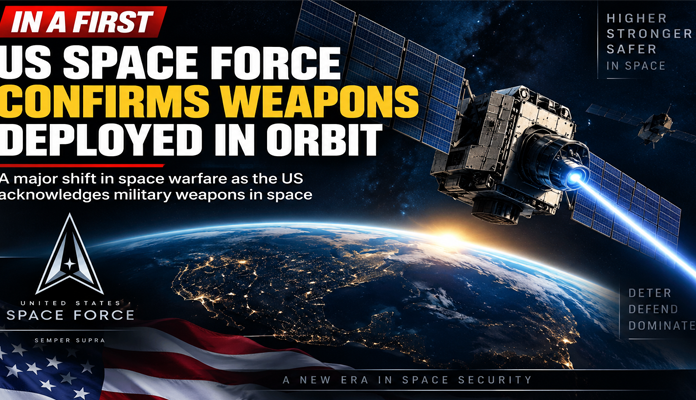
News Desk: China has urged the United States to stop expanding its military presence and preparing for war in outer space, after Washington publicly confirmed for the first time that the US Space Force has “space-control weapons” deployed in orbit.
Chinese Foreign Ministry spokesperson Guo Jiakun said Beijing opposes the weaponisation of outer space and warned Washington against turning space into a battlefield.
“We urge the US to stop expanding its military presence and preparing for war in outer space, and to take concrete actions to uphold global strategic stability,” Guo said.
He added that China has consistently advocated the peaceful use of outer space, worked to safeguard space security and opposed the weaponisation of space, its transformation into a battlefield and an arms race in outer space.
The Chinese warning came a day after US Secretary of the Air Force Troy Meink made the unprecedented disclosure at the Air & Space Forces Association’s Air, Space & Cyber Conference in National Harbor, Maryland.
“Today, we continue to ensure we remain ready to meet the challenge of evolving threats wherever they exist. This is why the Space Force now has on-orbit space-control weapons capable of defending the joint force against hostile adversary action,” Meink said.
🚀🇨🇳 La Chine a pressé les États-Unis mardi de “cesser de se préparer à une guerre dans l’espace” après que l’armée américaine a confirmé pour la première fois que les États-Unis disposaient d’armes déployées en orbite. pic.twitter.com/KmCEM8ts7t
— Agence France-Presse (@afpfr) September 15, 2026
US keeps weapons’ details secret
Meink did not identify the weapons, disclose how many are deployed, reveal their locations or explain their precise capabilities. He also declined to say whether the systems are kinetic or non-kinetic or whether they have already been tested.
He said the wording of his announcement was deliberate and that revealing further details could undermine the deterrent value of the disclosure.
The announcement has been described as the Pentagon’s most direct public acknowledgement to date that the United States is operating offensive capabilities in space.
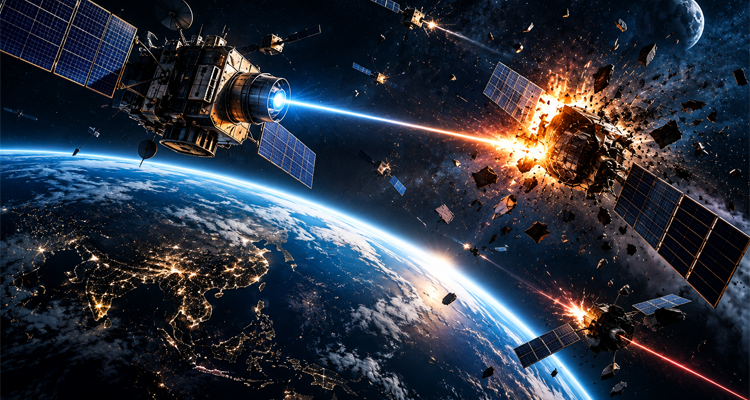
The term “space control weapons” can cover capabilities intended to protect US spacecraft as well as systems designed to disrupt, disable or otherwise counter an adversary’s space assets. The exact nature of the weapons acknowledged by Meink remains classified.
Why China is alarmed
Beijing’s response reflects growing concern over the transformation of outer space into a potential military battleground.
China and Russia have been developing and demonstrating counter-space capabilities, while the United States has increasingly focused on protecting its satellite networks and developing systems capable of responding to attacks on space assets.
The latest US disclosure comes alongside the Trump administration’s push for Golden Dome, a planned missile-defence architecture that includes space-based capabilities.
Meink said the Space Force’s Space-Based Interceptor programme has moved from an initial contract to flight-ready hardware in less than a year. He also highlighted a planned Space-Based Air-Moving Target Indication constellation intended to track airborne threats from orbit.
From anti-satellite missiles to weapons in orbit
The latest development needs to be distinguished from the anti-satellite capabilities already demonstrated by several major powers.
China, Russia, India and the United States have demonstrated capabilities to attack or destroy satellites from Earth or other platforms. However, that is fundamentally different from publicly confirming that dedicated weapons are physically deployed in orbit.
India demonstrated its anti-satellite capability through Mission Shakti on March 27, 2019. A DRDO-developed ballistic missile-defence interceptor successfully engaged and destroyed an Indian satellite in low-Earth orbit in a “hit-to-kill” engagement. The Indian government said the test demonstrated the country’s capability to defend its space assets and made India the fourth country to acquire such a capability.
China had earlier demonstrated an anti-satellite capability by destroying a satellite with a direct-ascent interceptor, while the United States used a modified SM-3 missile to destroy the malfunctioning USA-193 satellite in 2008. Russia also demonstrated a direct-ascent anti-satellite capability in 2021.
These are generally described as counter-space or anti-satellite capabilities, rather than weapons permanently stationed in orbit.
That distinction makes the latest US announcement particularly significant.
What makes the US disclosure different?
Until now, major powers had publicly demonstrated the ability to strike satellites in orbit from Earth or other platforms, but the United States had not publicly acknowledged that it had dedicated weapons physically deployed in orbit.
Meink’s statement changes that public record.
It does not, however, establish that the US is the first country ever to secretly deploy such a system. The nature and history of classified space programmes in other countries cannot be independently established from public information.
What can be established is that Washington has now publicly confirmed the existence of its own on-orbit space-control weapons.
Space arms race fears grow
The disclosure could intensify concerns about a new space arms race.
Modern militaries depend heavily on satellites for communications, navigation, intelligence, surveillance, missile warning and targeting. Disabling an adversary’s space infrastructure could therefore have consequences far beyond space itself.
The danger is also not limited to direct attacks. Electronic warfare, cyber operations, jamming and close-proximity manoeuvres by spacecraft can potentially interfere with satellite operations without physically destroying them.
The US Space Force has increasingly described space as a contested military domain, while US officials have pointed to Chinese and Russian activities as evidence that Washington needs stronger counter-space capabilities.
China, however, argues that such developments risk creating a cycle in which each major power expands its military capabilities in space on the grounds of responding to the others.
Outer Space Treaty and the legal question
The US disclosure does not automatically mean Washington has violated international space law.
The 1967 Outer Space Treaty prohibits placing nuclear weapons and other weapons of mass destruction in orbit or stationing them in outer space. It does not impose a blanket prohibition on every conventional military capability in orbit.
Consequently, the legal implications of the US announcement depend heavily on the precise nature and intended use of the weapons—details Washington has not disclosed.
A new phase in space competition
China’s warning and the US disclosure together highlight how rapidly the strategic environment above Earth is changing.
For years, the world’s major powers have developed systems capable of targeting satellites. The latest US announcement goes a step further in the public domain by acknowledging that Washington already has space-control weapons operating in orbit.
China’s message is clear: Beijing wants Washington to stop what it sees as the militarisation and weaponisation of outer space.
Washington’s message is equally clear: it wants the ability to protect its military forces and space infrastructure against hostile action.
The result could be a new strategic contest in which satellites are no longer merely military support assets but potential targets—and weapons themselves become part of the orbital battlefield.
For now, the biggest unanswered question remains what exactly the United States has placed in orbit. Meink has confirmed the weapons exist, but their type, number, location, deployment date and operational capabilities remain undisclosed.