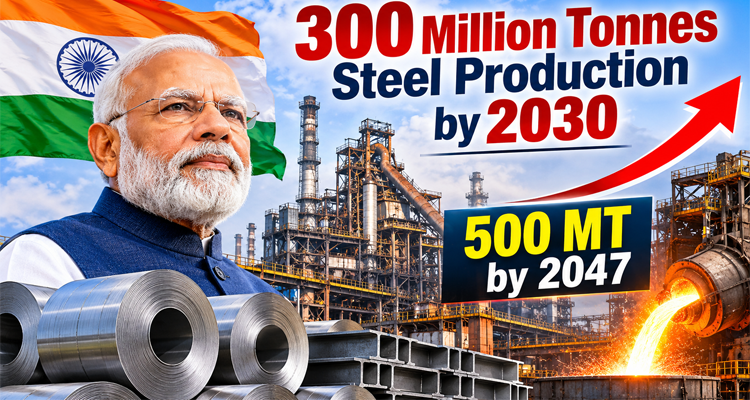
New Delhi: India has set an ambitious target of raising its annual steel production to 300 million tonnes by 2030, with a long-term vision of achieving 500 million tonnes by 2047. The government is stepping up efforts to expand domestic steel manufacturing, strengthen mineral availability and reduce dependence on imported raw materials to support the country’s growing industrial and infrastructure requirements.
Coal and Mines Minister G. Kishan Reddy recently reiterated the ambitious targets while addressing a press conference following the two-day Fourth Conference of Mining Ministers in Goa. He said India currently produces around 168 million tonnes of steel annually and is taking measures to improve the availability of iron ore and other essential minerals to support future expansion.
The minister emphasised that increasing domestic mineral production would help strengthen the steel industry, reduce manufacturing costs and improve the availability of steel for infrastructure, construction and housing projects.
Infrastructure to Drive Steel Demand
India’s expanding infrastructure programme is expected to play a major role in achieving the production target. Investments in highways, railways, metro networks, airports, ports, industrial corridors and urban development projects are generating growing demand for steel.
The construction and infrastructure sectors remain the biggest consumers of steel. At the same time, the automobile, engineering, defence, shipbuilding and renewable energy industries are creating additional demand for specialised and high-quality steel products.
The government’s emphasis on domestic manufacturing and infrastructure development is expected to provide a sustained market for Indian steel producers over the coming years.
भारत ने 2030 तक 300 मिलियन टन और 2047 तक 500 मिलियन टन इस्पात उत्पादन का लक्ष्य निर्धारित किया है।
केंद्रीय कोयला एवं खान मंत्री जी. किशन रेड्डी ने गोवा में चौथे खनन मंत्रियों के सम्मेलन के समापन पर यह जानकारी दी। उन्होंने बताया कि भारत वर्तमान में सालाना करीब 168 मिलियन टन इस्पात का उत्पादन करता है।
कॉपीराइट-फ्री कंटेंट पाएँ केवल #PBSHABD पर। अभी रजिस्टर करें: https://t.co/0uMyeVb8Eq
#SteelProduction #MiningSector #IndianEconomy #ViksitBharat #India2047
— PB-SHABD (@PBSHABD) November 7, 2026
Mining Reforms and Raw Material Security
Ensuring an uninterrupted supply of iron ore, coking coal and other essential minerals remains crucial to achieving the ambitious target.
The government is focusing on expanding mineral exploration, accelerating mining operations, improving the utilisation of existing resources and bringing greater efficiency to the mining sector.
Better utilisation of iron ore recovered from mining dumps and previously extracted material could also increase domestic availability and reduce pressure on fresh mining operations.
However, India’s heavy dependence on imported coking coal remains a major challenge. A substantial proportion of the country’s coking coal requirements is met through imports, exposing steel manufacturers to international price fluctuations and supply disruptions.
Strengthening domestic coal production, diversifying import sources and adopting alternative steelmaking technologies will therefore be important for the industry’s long-term competitiveness.
Push for Speciality and Green Steel
Alongside increasing overall production, the government is encouraging investment in speciality steel manufacturing. These high-value products are essential for automobiles, defence equipment, electrical machinery, infrastructure and other strategic industries.
The Production Linked Incentive (PLI) scheme for speciality steel is intended to attract investment, promote advanced manufacturing and reduce dependence on imported high-grade steel.
Another priority is the transition towards environmentally sustainable steel production. The government is promoting energy-efficient technologies, renewable energy, steel recycling and cleaner manufacturing processes to reduce carbon emissions.
India’s Green Steel Taxonomy, introduced in 2024, is an important step towards establishing a framework for identifying and promoting steel manufactured with lower carbon emissions.
Challenges Before the Industry
Despite strong growth prospects, achieving the 2030 target will require substantial investment in steel plants, mining infrastructure, transportation networks and modern production technologies.
High dependence on imported coking coal, logistics expenses, fluctuating raw material prices and global competition remain major concerns for domestic manufacturers.
The industry must also prepare for increasingly stringent environmental standards in international markets. Greater investment in research, innovation and low-carbon production technologies will be necessary to maintain India’s competitiveness in the global steel market.
A Roadmap Towards 2047
India’s steel ambitions extend well beyond 2030. The government is working towards building an annual steel production capacity of 500 million tonnes by 2047, coinciding with the centenary of the country’s Independence.
Achieving these targets would strengthen India’s manufacturing base, generate employment, attract investment and support its ambition of becoming a developed economy.
However, the challenge will not simply be to expand production capacity. Securing raw materials, improving logistics, adopting cleaner technologies and ensuring cost competitiveness will be equally important.
With infrastructure investment and industrial demand expected to remain strong, the steel sector is poised to become one of the key pillars of India’s economic growth over the next two decades.