
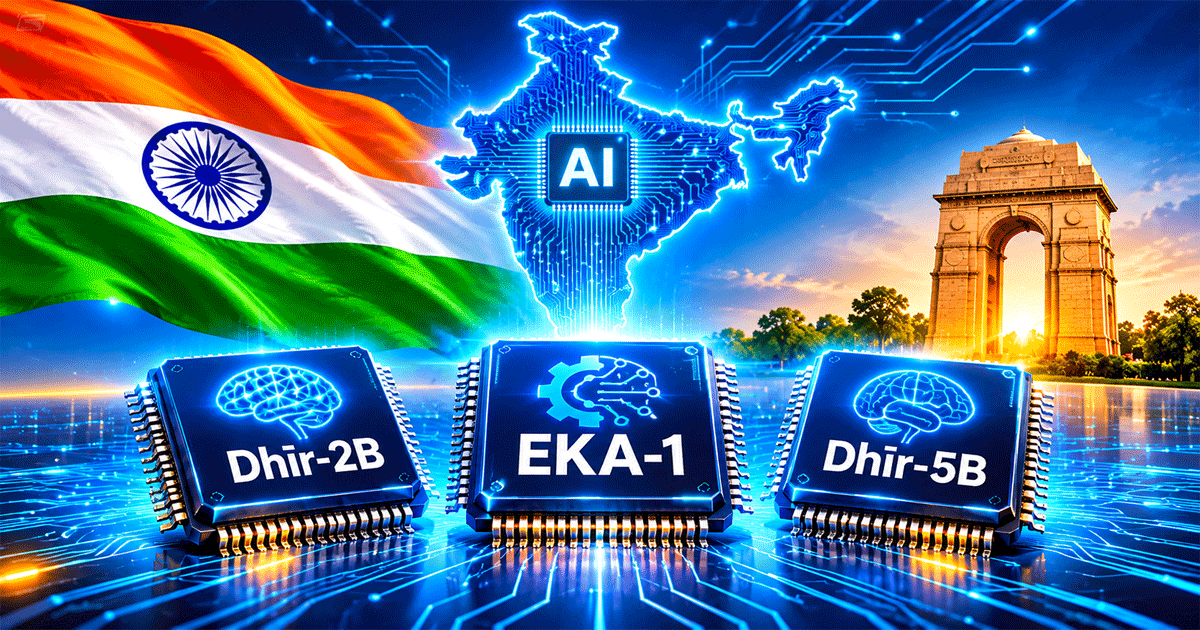
EKA-1 targets advanced reasoning, mathematics and coding, while Dhīr 2B and Dhīr 5B offer offline AI capabilities in 10 Indian languages
- India’s AI Breakthrough: EKA-1, Dhīr 2B and Dhīr 5B Unveiled
New Delhi: India has taken a significant step towards technological self-reliance with the release of three indigenous artificial intelligence (AI) foundation models under the government’s IndiaAI Mission. The new models are designed for applications ranging from advanced reasoning, mathematics and coding to multilingual assistance, document processing and enterprise automation.
The most striking feature is the offline capability of the two Dhīr models, which can operate on compatible devices without continuous internet connectivity. This could bring AI-powered services to remote and rural areas while offering organisations greater control over sensitive data.
The three models – EKA-1, Dhīr 2B and Dhīr 5B – were released by the Ministry of Electronics and Information Technology (MeitY) on November 3 in New Delhi. They have been developed by Bengaluru-based Soket Labs Technology and Research and ZenteiQ AiTech Innovations under the IndiaAI Innovation Centre’s Foundation Models initiative.
EKA-1: Advanced AI for reasoning, mathematics and coding
Developed by Soket Labs, EKA-1 is a large foundation model featuring 26.3 billion parameters and trained on approximately 7.5 trillion tokens.
The open, sparse hybrid language model supports all 22 scheduled Indian languages, besides English. It is designed to perform complex mathematical tasks, software coding, logical reasoning and agentic AI applications, in which AI systems can undertake multi-step tasks.
The model is also tailored to India’s banking, financial services and cybersecurity sectors, with a focus on addressing specialised industry requirements.
It can be deployed on private cloud infrastructure and in on-premise and air-gapped environments, where computer systems remain isolated from the public internet. This makes it relevant for institutions handling sensitive information.
Notably, PTI has also reported that EKA-1 can perform certain AI inference tasks locally without mobile data or Wi-Fi, although its principal positioning is as an advanced foundation model.
🤖 AI Without The Cloud: India Unveils THREE Homegrown AI Models, Two Can Run Without Internet!
These are not competing ChatGPT-style consumer chatbots.
EKA-1 is a foundation model built for complex reasoning and enterprise applications, supporting all 22 scheduled Indian languages.
The two open-source Dhīr models are designed for offline deployment, with applications in document searches, information retrieval and task automation across government, education and industry.
📸 AI Generated
— RT_India (@RT_India_news) November 5, 2026
Dhīr 2B: Lightweight AI assistant for offline applications
Developed by ZenteiQ AiTech Innovations, Dhīr 2B is a compact, open-source AI model designed for multilingual assistance and local deployment.
It supports English and 10 Indian languages – Hindi, Bengali, Tamil, Telugu, Marathi, Gujarati, Kannada, Malayalam, Punjabi and Odia.
The model is designed for document-based automation, knowledge retrieval and information processing. Its lightweight architecture allows deployment on compatible mobile devices and computing platforms, including GPUs and TPUs.
Unlike conventional cloud-based AI assistants, Dhīr 2B can function locally without continuous internet connectivity. This could prove useful for educational institutions, government offices and organisations operating in areas with limited network access.
Dhīr 5B: Multilingual AI for government and industry
The second model from ZenteiQ, Dhīr 5B, offers another locally deployable AI solution for more demanding multilingual assistance and enterprise applications.
Like Dhīr 2B, it supports English and 10 Indian languages and is designed for secure, on-premise deployment.
Its applications include document-grounded automation, knowledge retrieval and citizen-facing services across government, defence, education and industrial sectors.
The model can operate on compatible computing infrastructure without depending on continuous cloud connectivity. Local processing also allows organisations to retain greater control over their information and reduce exposure associated with transferring sensitive data to external servers.
Both Dhīr models are being released as open-source models, creating opportunities for developers, researchers and enterprises to explore their applications.
Vaishnaw: India aims to become world’s AI application capital
The release of the indigenous models comes amid the government’s wider ambition to establish India as a global centre for practical AI applications.
Union Electronics and Information Technology Minister Ashwini Vaishnaw recently said India remained focused on becoming the world’s AI application capital.
Speaking to the media in New Delhi on November 6, he said the government was working to expand AI adoption across agriculture, healthcare, education and other important sectors. He also highlighted the progress being made by Indian industries in developing AI-based applications.
Commenting on the recent global decline in technology stocks amid concerns over AI investments, Vaishnaw said the industry was undergoing rapid changes and uncertainty. He emphasised India’s focus on developing applications capable of bringing large-scale transformation across sectors.
Semiconductor push to strengthen AI ecosystem
Vaishnaw also announced developments in India’s semiconductor programme while launching the Semicon 2.0 Web Application Portal.
He said the roadmap for developing an indigenous Graphics Processing Unit (GPU) chip was being finalised. The government is also opening applications under the second, third and fourth pillars of the semiconductor programme to strengthen domestic manufacturing and the electronics ecosystem.
The development of indigenous GPUs is particularly important for AI, as these processors play a crucial role in training and running advanced AI systems.
A step towards India’s AI self-reliance
The IndiaAI Mission, approved by the Union Cabinet in March 2024, aims to develop domestic AI capabilities through computing infrastructure, research, innovation, talent development and responsible AI applications.
The three new models reflect different dimensions of this strategy: EKA-1 focuses on advanced reasoning and specialised applications, while Dhīr 2B and Dhīr 5B target lightweight, multilingual and offline-capable AI services.
Their wider success, however, will depend on real-world performance, hardware compatibility, developer adoption and commercial deployment.
By developing indigenous AI models alongside domestic semiconductor capabilities, India is seeking to move beyond simply adopting foreign technologies towards building its own artificial intelligence ecosystem.