New Delhi: The Lok Sabha on Thursday cleared the government’s flagship Viksit Bharat – Guarantee for Rural Ajeevika and Mazdoor Growth (G RAM G) Bill amid noisy protests and repeated disruptions by opposition members, setting the stage for a high-stakes debate in the Rajya Sabha, which has taken up the legislation for consideration and passage.
The bill was passed during a stormy sitting marked by sloganeering, protests near the Speaker’s podium and sharp exchanges between treasury and opposition benches. Despite the uproar, the government pushed the legislation through, arguing that the new framework marks a decisive step towards strengthening rural livelihoods under the broader vision of Viksit Bharat.
लोकसभा में आज ‘VB G RAM G’ — विकसित भारत: रोजगार और आजीविका मिशन (ग्रामीण) जैसे दूरदर्शी और ग्रामीण भारत के भविष्य से जुड़े ऐतिहासिक बिल को पारित किया गया। यह बिल गांव, गरीब, किसान और युवाओं के लिए नए अवसर, रोजगार और आत्मनिर्भरता की एक मजबूत नींव रखेगा।
लेकिन यह बेहद दुखद है कि… pic.twitter.com/fMVbMRMQaw
— BJP Himachal Pradesh (@BJP4Himachal) December 18, 2025
What the Bill Proposes
The G RAM G Bill seeks to replace the two-decade-old Mahatma Gandhi National Rural Employment Guarantee Act (MGNREGA) with a restructured rural employment and livelihood guarantee law. A key provision of the bill is the enhancement of guaranteed wage employment for rural households from 100 days to 125 days annually, a move the government says will provide greater income security in villages and small habitations.
The Centre has maintained that adequate financial support will be ensured for the expanded guarantee and that the new framework will integrate employment generation with long-term asset creation and skill-linked rural development.
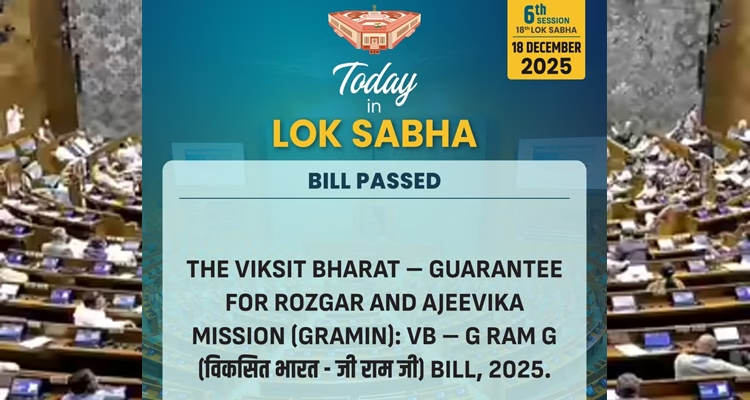
‘The Viksit Bharat – Guarantee for Rozgar and Ajeevika Mission (Gramin): VB – G RAM G (विकसित भारत – जी राम जी) Bill, 2025’ passed in Lok Sabha.@OfficeofSSC @ChouhanShivraj#WinterSession #parliamentsession2025 #LokSabha pic.twitter.com/e4LTtCVjCt
— LOK SABHA (@LokSabhaSectt) December 18, 2025
Opposition Protests and Objections
Opposition parties mounted a strong protest, accusing the government of undermining the spirit of MGNREGA and weakening statutory protections for rural workers. Several MPs objected to the replacement of the existing law and raised concerns over implementation, wage safeguards and accountability mechanisms under the proposed system.
The renaming of the programme also emerged as a flashpoint, with opposition leaders alleging that the government was attempting to erase the legacy of Mahatma Gandhi from one of India’s most significant social welfare legislations. The ruling side rejected the charge, insisting that Gandhian principles of dignity of labour and rural self-reliance remain central to the new law.
Government’s Defence
Introducing and defending the bill, Rural Development Minister Shivraj Singh Chouhan described the legislation as a modernised and future-ready reform aimed at empowering rural India. He said the enhanced guarantee of workdays reflects the government’s commitment to inclusive growth and employment security, especially for vulnerable rural households.
The minister underlined that the bill aligns with the long-term national goal of transforming India into a developed nation while retaining the core objective of providing assured work and livelihood support in rural areas.
Rajya Sabha Takes Charge
Following its passage in the Lok Sabha, the G RAM G Bill has been taken up by the Rajya Sabha, where detailed scrutiny and intense debate are expected. Opposition parties have indicated they will press for amendments and clearer assurances on funding, wage payments and grievance redressal.
If cleared by the Upper House without changes, the bill will be sent to the President for assent. Any amendments, however, would require the legislation to return to the Lok Sabha for approval.
Why It Matters
The proposed overhaul of India’s rural employment guarantee law represents one of the most significant changes to the country’s social welfare architecture in recent years. With millions of rural families dependent on guaranteed employment, the bill’s final shape and implementation framework will have far-reaching economic and political implications.
As the Rajya Sabha debate unfolds, all eyes will be on whether the new law strengthens rural security or deepens the fault lines that surfaced so dramatically in the Lok Sabha on Thursday.