 Dr. Vinod Chandrashekhar Dixit
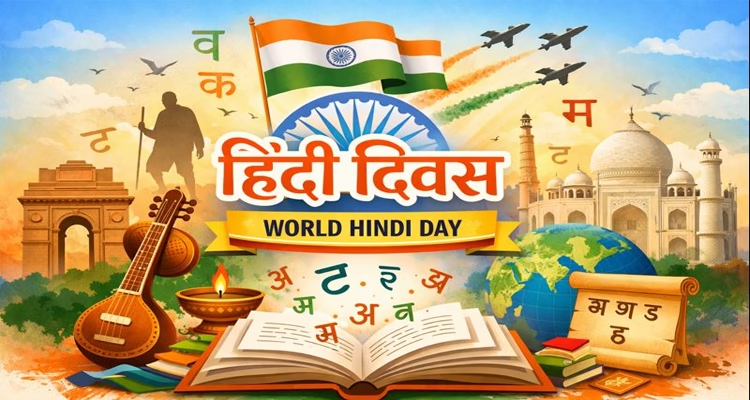
10 January is observed every year as World Hindi Day (Vishwa Hindi Diwas) to promote awareness of Hindi as a global language. On this day, Hindi speakers across the world celebrate the richness, reach, and relevance of Hindi, which is widely regarded as the cultural and linguistic backbone of India.
Hindi is often described as the mother tongue of India and remains the most widely spoken language in the country. It is a powerful medium of expression, a carrier of cultural heritage, and a unifying force that connects people across regions. As a historical language with deep civilisational roots, Hindi is also among the most spoken languages globally. Today, nearly 500 million people speak Hindi worldwide, placing it third among the most spoken languages in the world.
The observance of World Hindi Day also commemorates the first World Hindi Conference, held on 10 January 1975 in Nagpur, Maharashtra. The conference was inaugurated by then Prime Minister Indira Gandhi and witnessed participation from representatives of over 30 countries, marking a significant step in promoting Hindi at the international level.
The word Hindi is derived from the Persian term ‘Hind’, meaning the land of the Indus. Over time, the language spread beyond India and is now spoken in countries such as Nepal, Trinidad and Tobago, Guyana, Mauritius, and several others. Hindi has played a vital role in India’s freedom movement and has served as a link language connecting North and South India.
Modern Hindi literature and journalism owe much to Bhartendu Harishchandra, who is widely regarded as the Father of Modern Hindi. Hindi was officially adopted as the official language of the Union of India in 1950, after the Constitution came into force. Since then, it has steadily progressed as a national link language.
The modern Hindi script, Devanagari, evolved from the ancient Brahmi script and shares similarities with Sanskrit and Gujarati scripts. Devanagari provided Hindi with a standardized written form, especially after the publication of early printed editions in the 19th century. Today, Hindi stands out as a language that is both ancient and dynamic, simple yet expressive, deeply rooted yet globally expanding.
India is a linguistically diverse nation with 22 languages recognised in the Eighth Schedule of the Constitution. Among them, Hindi remains the most widely spoken. While English serves as an important global language facilitating international communication, Hindi continues to anchor Indian identity and cultural continuity. Educationists also emphasize that foundational learning in numeracy and literacy is most effective when imparted in a language familiar to the child—making Hindi crucial in early education.
The national language debate dates back to the freedom struggle. In 1919, Mahatma Gandhi advocated Hindi as the national language at the Hindi Sahitya Sammelan. After independence, extensive deliberations in the Constituent Assembly led to the adoption of Hindi as the official language of the Union in 1949–50. Eminent writers and thinkers such as Kaka Kalelkar, Maithili Sharan Gupt, Hazari Prasad Dwivedi, and Seth Govind Das worked tirelessly to strengthen Hindi’s status.
Today, the global demand for Hindi speakers is steadily rising. Several governments and international institutions now offer scholarships and academic programmes for students eager to learn Hindi, reflecting its growing global relevance.
As Mahatma Gandhi rightly said, “A nation is dumb without a national language.”
Preserving, promoting, and respecting Hindi is not merely a linguistic duty—it is a cultural responsibility.