 Vinod Chandrashekhar Dixit
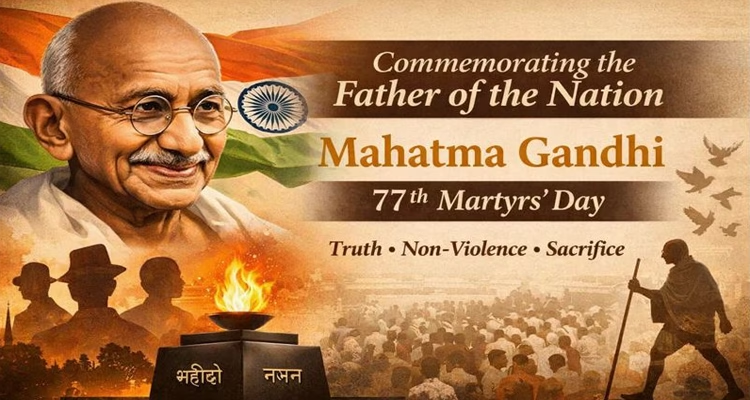
Martyrs’ Day is observed on January 30 to mark the death anniversary of Mahatma Gandhi, who was assassinated on this day in 1948 by Nathuram Godse. His death was followed by an unprecedented outpouring of grief across the nation. This year, the entire country is commemorating the 77th death anniversary of the Father of the Nation.
India is among the few countries in the world that observe Martyrs’ Day every year to pay homage to freedom fighters who sacrificed their lives for the nation. Mahatma Gandhi was one such extraordinary leader who regarded humanity as his true religion. The day marks one of the most sorrowful moments in India’s freedom struggle.
Martyrs’ Day also signifies the supreme sacrifice of three great revolutionaries—Bhagat Singh, Shivaram Rajguru, and Sukhdev Thapar—who were executed by the British for their role in the freedom movement, including their protest against the death of Lala Lajpat Rai and the bombing of the Central Legislative Assembly in April 1929.
There is no greater sacrifice than laying down one’s life for the integrity and sovereignty of the nation. This day reminds us of the immense contribution of Mahatma Gandhi to India’s independence. Under his leadership, India finally attained freedom from British rule on August 15, 1947.
Even after independence, Gandhi continued to promote peace, communal harmony, and brotherhood across the nation. He preached non-violence as the most powerful means of achieving political and social change. Through peaceful resistance and moral courage, he transformed the freedom struggle into a mass movement.
On January 13, 1948, Gandhi began his final fast in Calcutta to restore Hindu–Muslim unity and end communal violence. It was the last fast of his life. He ended the fast on January 18, 1948, and was assassinated just eleven days later, on January 30.
At the start of that fast, he declared:
“Death for me would be a glorious deliverance rather than that I should be a helpless witness of the destruction of India, Hinduism, Sikhism, and Islam.”
His dream was for Hindus, Sikhs, Parsis, Christians, and Muslims to live together in peace and harmony.
Mahatma Gandhi was a visionary leader, social reformer, champion of the oppressed, and a voice for rural India. His struggle for freedom and peace inspired landmark movements in both India and South Africa. Millions across the world continue to follow his ideals of truth, compassion, and non-violence.
By adopting non-violent methods against British rule, Gandhi inspired nationalist and civil rights movements globally. He instilled in Indians the spirit of Swadeshi, Swabhasha, and Swaraj. His life and teachings earned him the title “Father of the Nation” and global respect.
Let us pledge to walk on the path of truth and non-violence, to honour his legacy. Let us also pay our heartfelt tribute to all martyrs who sacrificed their lives for our freedom and thank them for the nation we live in today.