A new advancement in cardiac care is steadily transforming the way blocked coronary arteries are treated. Drug-eluting balloon (DEB) angioplasty—often described as a “stent-free angioplasty”—is emerging as an effective option for selected heart patients, offering the benefits of angioplasty without leaving a permanent metal implant inside the artery.
What Is Drug-Eluting Balloon Angioplasty?
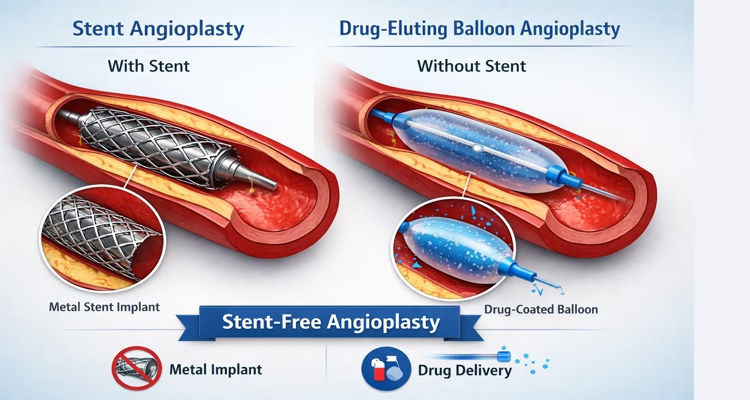
Drug-eluting balloon angioplasty is a minimally invasive procedure in which a specially medicated balloon is used to open narrowed or blocked arteries. The balloon is coated with anti-proliferative drugs such as paclitaxel or sirolimus. When the balloon is inflated at the site of blockage, it not only widens the artery but also delivers the drug directly into the vessel wall to prevent re-narrowing.
Unlike conventional angioplasty, which often requires placing a stent to keep the artery open, the DEB technique removes the balloon after drug delivery, leaving the artery free of any permanent implant.
Why Doctors Are Exploring Stent-Free Options
Drug-eluting stents have been the gold standard for years, but they are not without limitations. Some patients develop in-stent restenosis—where the artery narrows again inside the stent. There is also a small but persistent risk of late stent thrombosis, and many patients must remain on dual antiplatelet therapy for prolonged periods.
Drug-eluting balloons aim to address these concerns by combining vessel dilation and drug delivery without placing a metal scaffold, thereby preserving the artery’s natural flexibility.
How the Procedure Works
During DEB angioplasty, a catheter carrying the drug-coated balloon is guided through the blood vessels to the blocked coronary artery. The balloon is inflated for a short duration, allowing the drug to transfer rapidly into the arterial wall. Afterward, the balloon is deflated and removed.
Because nothing is left behind, the approach is often referred to as part of the “leave-nothing-behind” strategy in interventional cardiology.
Key Advantages
No permanent implant:
The absence of a metal stent reduces long-term foreign-body presence in the artery.
Lower thrombosis concerns:
Without a stent, the risk of late stent clot formation may be reduced.
Potentially shorter blood-thinner duration:
In selected patients—especially those with high bleeding risk—the duration of dual antiplatelet therapy may be shorter.
Useful in complex scenarios:
Drug-eluting balloons have shown strong results in treating in-stent restenosis and small vessel disease.
Where It Is Most Effective
Cardiologists currently find DEB therapy particularly useful in:
-
In-stent restenosis
-
Small coronary arteries
-
Certain bifurcation lesions
-
Patients with high bleeding risk
-
Situations where avoiding a permanent implant is desirable
European clinical guidelines already recommend drug-coated balloons as a preferred treatment for in-stent restenosis.
Limitations and Caution
Despite promising results, experts emphasize that drug-eluting balloon angioplasty is not suitable for every patient. Evidence in large, heavily calcified, or very complex coronary lesions is still evolving. In many acute heart attack situations, modern drug-eluting stents continue to remain the primary therapy due to their well-established long-term outcomes.
Careful patient selection and operator expertise remain critical for optimal results.
Growing Adoption in India
With cardiovascular disease rising sharply and interventional cardiology advancing rapidly, drug-eluting balloon technology is gaining traction in India. Several cardiac centers are increasingly adopting the technique, particularly for restenosis cases and high-bleeding-risk patients.
Bottom Line
Drug-eluting balloon angioplasty marks an important step toward stent-free coronary intervention. While it does not replace stents in all situations, it provides a valuable new tool for cardiologists and offers selected patients a safer, implant-free alternative. As long-term data continue to accumulate, this “leave-nothing-behind” approach could play a growing role in the future of heart care.
Drug-Eluting Balloon Cost in India & Angioplasty Surgery Cost- Explained
Here is a clear, practical cost guide for Drug-Eluting Balloon (DEB) angioplasty in India, based on recent hospital and market data.
Cost of Drug-Eluting Balloon (DEB) in India
-
Typical price of one drug-eluting balloon: ₹30,000 – ₹40,000 (device cost)
-
In many hospitals, the DEB price is roughly comparable to a stent (~₹32,000) due to Indian manufacturing.
✅ Important: Patients usually pay for the full angioplasty package—not just the balloon.
Total Cost of Drug-Eluting Balloon Angioplasty in India
Estimated package cost
-
Drug-coated balloon angioplasty: ₹2,00,000 – ₹3,50,000
-
Basic balloon angioplasty (no stent): ₹80,000 – ₹1,50,000
-
Overall angioplasty range (all types): ₹1,50,000 – ₹4,50,000
A Quick Comparison (India)
| Procedure Type | Typical Cost |
|---|---|
| Basic balloon angioplasty | ₹80,000 – ₹1.5 lakh |
| Drug-eluting balloon angioplasty | ₹2 – ₹3.5 lakh |
| Angioplasty with drug-eluting stent | ₹2 – ₹4.5 lakh |
| Plain balloon angioplasty (hospital estimates) | ₹75,000 – ₹1.25 lakh |
(Costs vary by city and hospital)
City-Wise Rough Range
-
Tier-2 cities: ₹1.5 – ₹2.5 lakh
-
Metro hospitals: ₹2.5 – ₹4 lakh
-
Emergency cases: may reach ₹5 lakh+
These variations depend on hospital category and case complexity.
What the Package Usually Includes
✔ Cath lab charges
✔ Cardiologist fees
✔ Drug-eluting balloon device
✔ ICU stay (1 day usually)
✔ Medicines & disposables
✔ Basic investigations
❌ Usually NOT included:
-
Extended ICU stay
-
Complications management
-
Multiple balloons/stents
Factors That Affect Cost
The final bill may change based on:
-
Number of blockages
-
Number of balloons used
-
Hospital type (government vs private)
-
City (metro vs tier-2)
-
Emergency vs planned procedure
-
Patient risk profile
-
Insurance coverage
Is DEB Cheaper Than Stent Angioplasty?
In many Indian cases:
✅ Device cost — similar
✅ Total package — often slightly lower or similar
✅ Best value — in small vessels or restenosis cases
Doctors often choose DEB for clinical reasons, not just cost.
Drug-eluting balloon price: ~₹30k–₹40k
Total DEB angioplasty cost: ~₹2 lakh–₹3.5 lakh
Still case-dependent: final cost varies widely
Drug-eluting balloon angioplasty is becoming a competitive stent-free option, but patients should always take a personalized estimate from their hospital.