
 Dr. Vinod Chandrashekhar Dixit
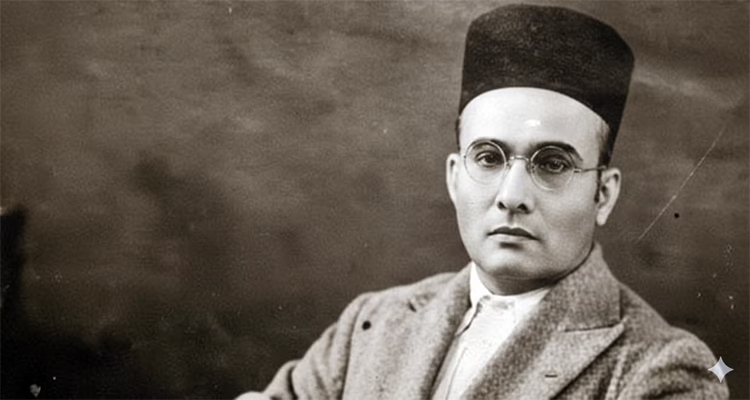
Veer Savarkar, a name that echoes through India’s history, was a remarkable figure in the country’s struggle for independence. Born on May 28, 1883, in Nashik, India, Vinayak Damodar Savarkar was a freedom fighter, poet, writer, and politician who played a crucial role in shaping India’s future. His life was a testament to the power of courage, conviction, and sacrifice. Veer Savarkar died on February 26, 1966, in Bombay.
Savarkar’s early years were marked by a thirst for knowledge and a passion for writing. He excelled in his studies and was known for his sharp intellect, inspiring others to join the fight for freedom. He was just 11 years old when he formed a group called ‘Mitra Mela’ with his friends, which later became a platform for discussing revolutionary ideas. This group eventually evolved into the Abhinav Bharat Society, a revolutionary organization that aimed to overthrow British rule in India.
As he grew older, Savarkar’s determination to free India from British rule only intensified. He was a strong advocate for Swaraj, or self-rule, and articulated his vision in his book The First War of Indian Independence. This seminal work highlighted the significance of the 1857 uprising and served as a source of inspiration for successive generations of freedom fighters. Savarkar’s writings were influenced by the works of Mazzini and other Italian revolutionaries, and he saw India’s struggle for independence as part of a broader global movement for freedom.
Savarkar’s writings were not limited to politics; he was a prolific writer, poet, and playwright. His poem Sagara Pran Talmalala stirred the emotions of countless patriots, and his literary works continue to inspire and educate. He believed in a united and strong India, where people of all backgrounds and religions coexisted harmoniously. He envisioned a future where India would be free from colonial rule and thrive as a self-reliant nation.
Despite facing immense hardships, including imprisonment in the Cellular Jail in the Andaman and Nicobar Islands, Savarkar’s spirit remained unbroken. His experiences in prison only strengthened his resolve to fight for India’s freedom. He was a true patriot, and his love for his country was unwavering.
Savarkar’s legacy extends beyond his contributions to India’s independence movement. He was a visionary who envisioned a modern, secular, and democratic India. His ideas of rationality, atheism, social reform, and the formulation of the Hindutva philosophy are among his most significant contributions to India.
Savarkar’s concept of Hindutva was not about narrow communalism but about a broad cultural and national identity. He believed that India’s strength lay in its diversity and that all Indians, regardless of their religion or background, should work together to build a strong and prosperous nation.
As former Prime Minister Atal Bihari Vajpayee said, “सावरकर माने तेज, सावरकर माने त्याग, सावरकर माने तप” — Savarkar means speed, sacrifice, and meditation. These words aptly capture the essence of Savarkar’s life and legacy.
Today, Veer Savarkar is remembered as one of India’s foremost freedom fighters — a poet, a writer, and a visionary. His life continues to inspire Indians to strive for a better future, to fight for what is right, and to never give up in the face of adversity.