Dr. Vinod Chandrashekhar Dixit
The Jallianwala Bagh massacre of April 13, 1919, marked a turning point in India’s freedom struggle. Explore how the brutal killing in Amritsar ignited nationwide resistance against British rule.

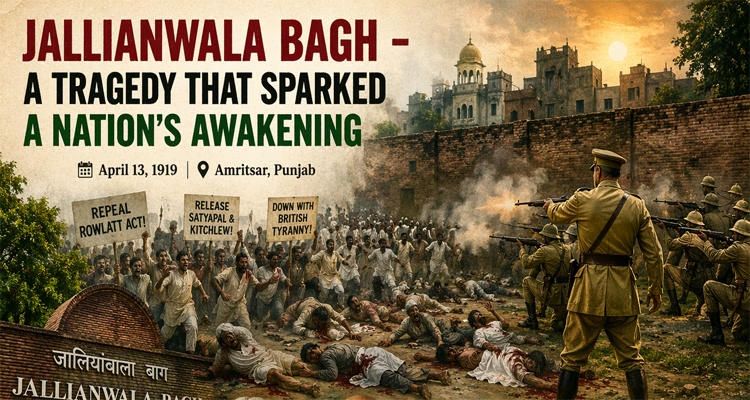
The Jallianwala Bagh massacre, a pivotal moment in India’s struggle for independence, occurred on April 13, 1919, in Amritsar, Punjab. On that fateful day, British troops led by Reginald Dyer opened fire on a gathering of unarmed Indians at Jallianwala Bagh, killing hundreds and injuring many more.
The crowd had assembled to protest the Rowlatt Act—a repressive law allowing arrest and detention without trial—and to demand the release of nationalist leaders Satyapal and Saifuddin Kitchlew. The backdrop to this unrest lay in earlier colonial measures such as the Defence of India Act, both aimed at curbing civil liberties and suppressing rising nationalist sentiment. Fearing another uprising like the Indian Rebellion of 1857, the British administration intensified its crackdown.
The Rowlatt Act triggered widespread protests across India, especially in Punjab. Mahatma Gandhi called for nationwide civil disobedience. Leaders like Kitchlew and Satyapal mobilized large gatherings in Lahore and Amritsar. Gandhi himself was prevented from entering Punjab and was sent back to Bombay.
Tensions escalated on April 10, 1919, when protests in Amritsar turned violent and an English missionary was attacked. In response, General Dyer imposed martial law on April 12. The next day, a large crowd—unaware of the ban on public gatherings—assembled at Jallianwala Bagh. Dyer arrived with troops, sealed the narrow exits, and ordered his men to fire without warning. Official estimates reported over 400 deaths and more than 1,000 injuries, though actual numbers are believed to be higher.
The massacre proved to be a turning point in India’s freedom struggle. Rabindranath Tagore renounced his knighthood in protest, and the Indian National Congress boycotted the inquiry conducted by the Hunter Commission. Gandhi intensified the movement against British rule, eventually launching the Non-Cooperation Movement.
Though the Hunter Commission termed Dyer’s actions “excessive and unjustified,” the lack of severe punishment fueled widespread anger. Decades later, Udham Singh assassinated Michael O’Dwyer in London on March 13, 1940, in retaliation for the massacre.
The tragedy of Jallianwala Bagh became a symbol of colonial brutality and Indian resistance. In 2019, Theresa May expressed regret over the incident, acknowledging the deep suffering it caused. Today, Jallianwala Bagh stands as a national memorial, embodying the sacrifices made in the quest for freedom.
The massacre had far-reaching consequences. It galvanized public opinion, strengthened the national movement, and deepened distrust toward British rule. It marked a decisive shift in India’s struggle for independence, ultimately contributing to the country’s freedom in 1947.
More than a historical tragedy, Jallianwala Bagh remains a powerful reminder of the cost of oppression and the enduring spirit of resistance. It continues to inspire generations to uphold the values of freedom, justice, and human dignity.