Great Nicobar Project is an example of how holistic development can balance economic growth, says Govt
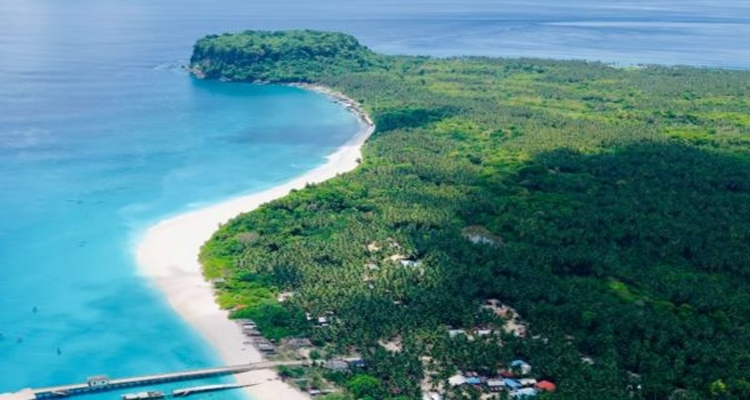
New Delhi: India’s ambitious Great Nicobar Project is fast emerging as a high-stakes blend of strategic assertion, economic expansion, and environmental balancing. Positioned just about 40 nautical miles from the crucial East–West global shipping route, the project aims to transform Great Nicobar into a major maritime and economic hub—while strengthening national security in the Indo-Pacific.
At its core, the mega plan seeks to reduce India’s dependence on foreign transshipment hubs like Colombo, Singapore, and Klang, while boosting its own port-led growth model.
Mega Infrastructure Push at the Core
The project is built around four key pillars:
- A 14.2 million TEU International Container Transshipment Terminal (ICTT) at Galathea Bay
- A Greenfield International Airport with capacity of 4,000 peak-hour passengers
- A 450 MVA gas and solar-based hybrid power plant
- A modern township spread across 16,610 hectares
Together, these components aim to create a self-sustaining economic ecosystem capable of handling global trade flows, tourism, and urban expansion.
Great Nicobar Project: Strategic Importance, Sustainable Development
✴️The Great Nicobar Project seeks to transform Great Nicobar into a strategic maritime and economic hub by leveraging its proximity (about 40 nautical miles) to the East–West shipping route and reducing… pic.twitter.com/qEI6BIRajf
— PIB India (@PIB_India) May 1, 2026
Why It Matters: Strategic and Economic Stakes
India currently loses significant revenue as large cargo ships rely on foreign ports due to lack of deep-draft facilities. The Great Nicobar port, with natural depths exceeding 20 metres, is expected to change that equation.
The project will be rolled out in three phases between 2025 and 2047, covering 166.10 sq. km. Officials say this phased approach ensures that development is synchronized with environmental safeguards and tribal welfare measures.
Beyond economics, the project holds immense strategic value, placing India in a stronger position in the Indian Ocean Region amid rising geopolitical competition.
Environmental Safeguards Under Scrutiny
The project has received environmental clearance under the EIA Notification, 2006, subject to 42 strict compliance conditions covering biodiversity, pollution, marine ecology, and disaster management.
Key highlights include:
- Only 1.82% of the island’s forest cover will be diverted
- Around 7.11 lakh trees may be felled in phases
- 65.99 sq. km designated as green zones with no deforestation
- Compensatory afforestation over 97.30 sq. km, primarily in Haryana
Top institutions like the Zoological Survey of India, Wildlife Institute of India, and IISc have backed the project with safeguards in place.
Three independent monitoring committees have also been set up to oversee pollution, biodiversity, and tribal welfare.
Tribal Concerns: No Displacement, Says Govt
The island is home to indigenous communities like the Shompen and Nicobarese tribes. Authorities maintain that no displacement is planned, and existing settlements at New Chingen and Rajiv Nagar will remain untouched.
In fact, through re-notification measures:
- 73.07 sq. km of tribal land will be de-notified
- 76.98 sq. km will be re-notified, resulting in a net gain in tribal reserve area
The project aligns with existing tribal protection policies and includes oversight by an independent committee to safeguard community interests.
Disaster Preparedness Built In
Located in a seismically active and cyclone-prone zone, the project incorporates a comprehensive disaster management plan covering tsunamis, earthquakes, and industrial risks.
The hybrid power model combining gas and solar energy is also designed to ensure uninterrupted and resilient power supply.
The Big Picture
The Great Nicobar Project represents one of India’s most ambitious attempts to balance strategic ambition with environmental responsibility.
While the government positions it as a model for sustainable, inclusive development, critics continue to raise concerns over ecological risks in a fragile island ecosystem.
As construction phases begin to roll out, the project will likely remain at the center of debate—a test case of whether economic growth and ecological preservation can truly go hand in hand.