
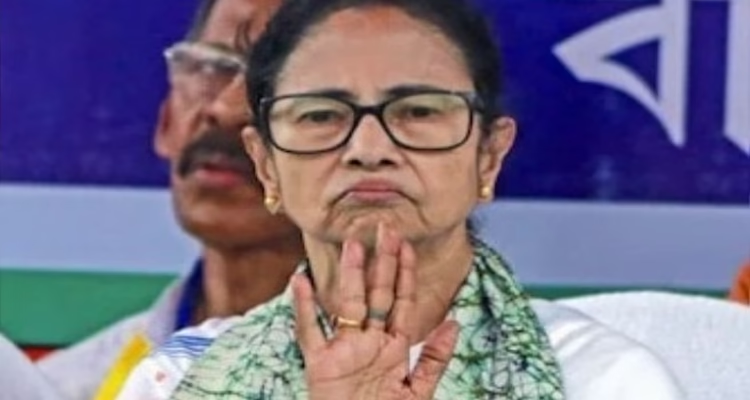
Kolkata: A day after a stunning electoral setback, Mamata Banerjee struck a defiant tone, refusing to resign and launching a sharp attack on the Election Commission of India, which she branded the “villain” of the 2026 Assembly polls.
Addressing the media, Banerjee dismissed the verdict as manipulated rather than a genuine public mandate. “We have not lost the election; attempts were made to defeat us,” she said, alleging irregularities in electronic voting and accusing the poll body of undermining democratic rights. She also claimed that detentions of party workers ahead of voting impacted the outcome.
🚨Big news:
Mamata Banerjee refuses to resign even after defeat, claiming, “I’ve not lost, hence there’s no question of resignation.”
She’s lost it completely 🤣 pic.twitter.com/9mxLFmZOtN
— BALA (@erbmjha) May 5, 2026
The Trinamool Congress chief further escalated her आरोप, accusing Prime Minister Narendra Modi and Union Home Minister Amit Shah of direct interference in the electoral process. According to her, the contest turned into a battle between the BJP and the Election Commission, leaving her party fighting the “entire system.”
BJP’s Historic Surge, TMC’s Collapse
The Bharatiya Janata Party delivered a record-breaking performance, sweeping 207 seats—its best-ever tally in West Bengal—while the All India Trinamool Congress was reduced to just 80 seats. In a symbolic blow, Banerjee lost her stronghold Bhabanipur to BJP leader Suvendu Adhikari by over 15,000 votes, marking one of the most dramatic upsets of the election.
Despite the defeat, Banerjee maintained that her party had achieved a “moral victory” and announced plans to challenge the results legally.
Bhabanipur Shock: A Fortress Falls
Bhabanipur, long regarded as Banerjee’s political bastion in Kolkata, witnessed a stunning turnaround. Adhikari’s victory not only ended her dominance in the constituency but also carried significant symbolic weight, signaling a major shift in Bengal’s political landscape.
Constitutional Question: Can a CM Refuse to Resign?
Banerjee’s refusal to step down has triggered a larger constitutional debate. Under Article 164 of the Constitution, a Chief Minister holds office at the pleasure of the Governor. If a leader loses majority support, the Governor can intervene.
Conventionally, the Governor directs the incumbent to prove majority through a floor test in the Assembly. Failure to secure numbers typically necessitates immediate resignation.
If a Chief Minister refuses even after losing majority, the situation may be deemed a constitutional breakdown. In such cases, the Governor can recommend action under Article 356 of the Indian Constitution, enabling the Centre to impose President’s Rule and assume control of the state administration.
Governance vs Mandate
Constitutional experts underline that continuing in office without majority support is untenable in a parliamentary democracy. The Governor’s role becomes crucial in ensuring that the electoral mandate is respected and governance remains constitutionally valid.
As the political standoff deepens, all eyes are now on Raj Bhavan and the next constitutional move in West Bengal’s rapidly evolving power equation.