Congress Decline Explained: From 206 Lok Sabha Seats to Just 4 States in Power
by Ashis Sinha
From winning 206 Lok Sabha seats in 2009 to ruling only 4 states in 2026, here’s a detailed look at the decline of Congress, leadership crisis, electoral setbacks, and BJP’s rise in Indian politics.

Once the unquestioned centre of Indian politics, the Indian National Congress today finds itself struggling to retain relevance in a rapidly changing political landscape. The party that led India’s freedom movement and dominated post-independence governance for decades has witnessed one of the sharpest political declines in modern Indian history.
From controlling the Centre and governing most Indian states to now leading governments in only a handful of regions, Congress’ shrinking political footprint reflects a dramatic transformation in India’s electoral landscape over the past two decades.
Congress’ Falling Numbers in Parliament
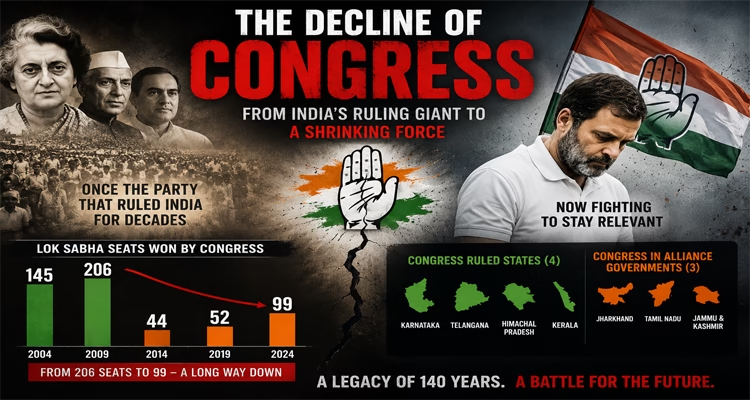
The decline of Congress becomes starkly visible when comparing its Lok Sabha performance over the years.
| Lok Sabha Election Year | Congress Seats Won |
|---|---|
| 2004 | 145 |
| 2009 | 206 |
| 2014 | 44 |
| 2019 | 52 |
| 2024 | 99 |
Congress reached its modern electoral peak in 2009 when the United Progressive Alliance (UPA) returned to power with 206 Congress MPs. At the time, the party appeared firmly entrenched at the national level.
But the collapse came swiftly.
In the 2014 Lok Sabha elections, Congress crashed to just 44 seats — its worst-ever tally since Independence — as the BJP, led by Prime Minister Narendra Modi, swept to power on the back of aggressive nationalism, development-focused messaging, and anti-corruption narratives.
Although Congress improved marginally in 2019 and made a stronger recovery in 2024 with 99 seats, the party still remains far from reclaiming its former national dominance.
Congress’ Current Political Position in India
As of May 2026, Congress directly leads governments in four states and remains part of alliance governments in several others.
Congress-Ruled States
| State | Chief Minister |
|---|---|
| Karnataka | Siddaramaiah |
| Telangana | A. Revanth Reddy |
| Himachal Pradesh | Sukhvinder Singh Sukhu |
| Kerala | V. D. Satheesan |
Congress is also part of alliance governments in several states and Union Territories.
Congress-Supported / Alliance Governments
| State / UT | Leading Party | Congress Role |
|---|---|---|
| Jharkhand | Jharkhand Mukti Morcha (JMM) | Coalition partner |
| Tamil Nadu | DMK-led alliance | Alliance partner |
| Jammu & Kashmir | JKNC-led alliance | Supporting ally |
This means Congress currently shares power in only a limited number of states and Union Territories — a striking contrast to the decades when the party governed most of India simultaneously.
How Congress Lost Its Grip
Political observers say Congress’ decline did not happen overnight. Several political, organisational, and leadership-related factors gradually weakened the party over the years.
The UPA-II government faced major corruption allegations, including the 2G spectrum and coal allocation controversies, damaging Congress’ credibility nationally. At the same time, the BJP under Narendra Modi built a highly centralised, technology-driven, and cadre-based political machinery capable of dominating elections at both national and state levels.
The BJP’s massive cadre network, strong financial resources, digital outreach machinery, and centralised election management model further widened the gap between the two parties.
Congress also struggled to counter the BJP’s nationalism-focused narrative and increasingly lost ground among young and aspirational voters.
Regional parties further eroded Congress’ base in states such as Uttar Pradesh, West Bengal, Bihar, Odisha, Andhra Pradesh, and Telangana.
Ideological Confusion and Narrative Challenges
Many political observers argue that Congress has struggled to present a clear and consistent ideological narrative in recent years. While the party continues to position itself around secularism, social justice, welfare politics, and constitutional values, critics say its messaging has often appeared reactive rather than assertive against the BJP’s highly disciplined political communication strategy.
Analysts also point out that Congress has frequently struggled to define a compelling national narrative capable of unifying diverse voter groups across states.
Leadership Crisis and Dynasty Questions
One of the biggest criticisms against Congress has been its continued dependence on the Gandhi family. Rahul Gandhi remains the party’s principal face, while critics argue that Congress failed to develop strong second-rung national leadership over the years.
Several senior leaders exited the party over the past decade, citing indecision, organisational weakness, lack of internal democracy, and leadership concerns.
Internal factional battles in Rajasthan, Punjab, Madhya Pradesh, and several other states further weakened Congress at the grassroots level.
Organisational Weakness and Disconnect
Unlike the BJP’s booth-level election machinery, Congress has often appeared organisationally fragile. Analysts say the party has struggled to maintain a strong grassroots network, booth-level workers, and effective digital outreach.
Critics also argue that Congress frequently reacts to the BJP’s political agenda rather than setting its own narrative.
The party’s decline in several Hindi-heartland states after 2014 significantly weakened its national electoral structure. In many regions, strong regional parties gradually replaced Congress as the principal opposition force against the BJP.
While initiatives such as the Bharat Jodo Yatra helped revive some public visibility and energised sections of the party cadre, Congress still faces a long road toward rebuilding itself nationally.
Leadership Debate and the Gandhi Family Question
The decline of Congress has increasingly triggered debate over the party’s continued dependence on the Nehru-Gandhi family. Many political analysts, observers, and even former Congress leaders believe the party’s centralised leadership structure prevented the rise of stronger regional and second-rung leadership over the years.
Rahul Gandhi has remained the principal face of Congress in the post-2014 era. While his supporters project him as an aggressive opposition leader raising issues such as unemployment, social harmony, economic inequality, and democratic functioning, critics argue that he has struggled to transform Congress into a consistently winning electoral force.
Some of Rahul Gandhi’s remarks abroad, criticism of institutions, and statements on democracy and governance have also generated political controversy. Critics claim such comments politically hurt Congress and created perception challenges for the party among sections of voters. However, Congress leaders maintain that criticism of governments and institutions is part of democratic opposition politics.
At the same time, initiatives such as the Bharat Jodo Yatra helped Rahul Gandhi reconnect with sections of the electorate and improved his political visibility after years of criticism.
Despite that, Congress’ electoral struggles under the Gandhi family leadership remain a major talking point in Indian politics. The party’s Lok Sabha tally fell dramatically from 206 seats in 2009 to just 44 in 2014 before improving to 99 seats in 2024. The sharp decline intensified internal discussions within Congress over leadership reforms, organisational restructuring, and the need for broader collective leadership.
Key Factors Often Cited Behind Congress’ Decline
Political analysts and election observers commonly point to multiple factors behind Congress’ weakening position over the years:
- Continued dependence on the Gandhi family leadership
- Weak grassroots organisational structure in several states
- Internal factionalism and leadership conflicts
- Declining booth-level election management and cadre strength
- Loss of traditional regional strongholds to regional parties
- Difficulty adapting to changing political narratives and voter expectations
- Weak digital and social media outreach compared to rivals
- Leadership perception and communication challenges around Rahul Gandhi
- Exodus of several senior leaders from the party
- Failure to consistently project a unified national political message
- Organisational decline in key Hindi-heartland states
- The rapid expansion and electoral dominance of the BJP under Narendra Modi
Political experts broadly agree that Congress’ decline cannot be attributed to a single leader or one issue alone. Instead, it is widely seen as the result of a combination of organisational weaknesses, leadership debates, changing voter aspirations, regional political shifts, and evolving national political dynamics over the past decade.
Can Congress Stage a Comeback?
Despite the decline, Congress remains India’s oldest national political party with deep historical roots and a nationwide legacy. It still retains pockets of influence, especially in parts of southern India and alliance-driven states.
Political experts believe any serious revival would require sweeping organisational reforms, stronger regional leadership, sharper ideological clarity, improved booth-level mobilisation, and a far more aggressive grassroots strategy.
Yet despite its decline, Congress continues to remain central to opposition politics in India due to its nationwide presence, historical legacy, and role within anti-BJP alliances.
For now, however, the party that once defined India’s political destiny is fighting not merely for power — but for political survival in an era increasingly dominated by the BJP’s electoral machine.