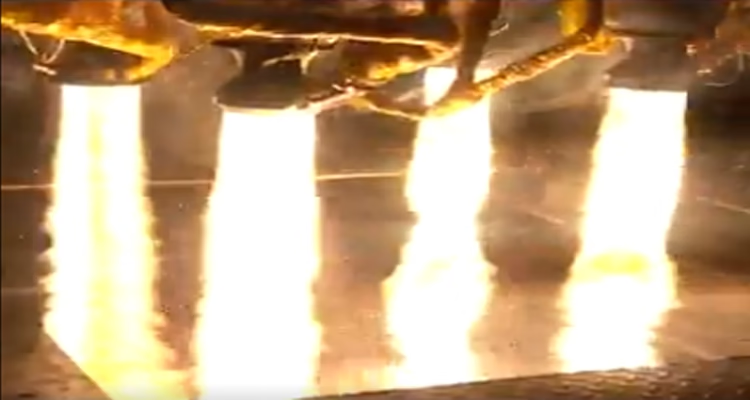
Chennai: Indian spacetech startup Agnikul Cosmos (Chennai based) has successfully test-fired four semi-cryogenic rocket engines simultaneously in a clustered configuration, marking a major technological milestone for India’s private space industry and indigenous rocket development programme.
The company announced that the test involved four fully operational semi-cryogenic engines firing together as an integrated cluster — a critical capability required for future orbital launch missions and advanced satellite deployment systems.
Humbled to share that we successfully test fired 4 semi-cryogenic rocket engines simultaneously, as a cluster.
All the 4 engines are 3d printed as single pieces of hardware – designed and manufactured in-house at AgniKul Cosmos Rocket Factory – 1. As with all our propulsion… pic.twitter.com/3wtpdGS4lK
— AgniKul Cosmos (@AgnikulCosmos) May 19, 2026
Fully 3D-Printed Engines Fired Together
AgniKul said all four engines used in the test were entirely 3D-printed as single-piece hardware units and were both designed and manufactured in-house at the company’s “Rocket Factory-1” facility in Chennai.
“As with all our propulsion systems, the engines were built completely in-house,” the company said while sharing details of the successful firing.
The clustered test required precise synchronisation of multiple electric motors, pumps and control systems operating together in real time, demonstrating the startup’s progress in advanced propulsion engineering.
Why the Four-Engine Cluster Test Matters
The successful simultaneous firing of four rocket engines is considered a major step in launch vehicle development because clustered engines generate significantly higher thrust required to carry heavier payloads into orbit.
Instead of depending on a single large engine, multiple engines working together can improve launch flexibility, enhance mission safety and provide better operational reliability during flight.
Experts say mastering engine clustering is one of the most complex aspects of rocket science because all engines must function in near-perfect coordination during liftoff and ascent.
The achievement also demonstrates India’s growing capability in advanced indigenous propulsion integration — a field traditionally dominated by leading global space powers.
Humbled to share that we successfully test fired 4 semi-cryogenic rocket engines simultaneously, as a cluster.
All the 4 engines are 3d printed as single pieces of hardware – designed and manufactured in-house at AgniKul Cosmos Rocket Factory – 1. As with all our propulsion… pic.twitter.com/3wtpdGS4lK
— AgniKul Cosmos (@AgnikulCosmos) May 19, 2026
Key Step Towards Agnibaan Rocket Missions
The successful cluster firing is expected to play a crucial role in the development of AgniKul’s small satellite launch vehicle, Agnibaan, which uses clustered semi-cryogenic engines in its booster stage.
The company is aiming to position Agnibaan as a flexible and low-cost launch platform for the rapidly expanding global small satellite market.
Industry observers believe the latest test significantly improves AgniKul’s readiness for future commercial orbital launches.
Advantages of 3D-Printed Rocket Engines
AgniKul’s engines are manufactured as single-piece 3D-printed hardware instead of being assembled from hundreds of separate components like conventional rocket engines.
This approach reduces manufacturing complexity, lowers production costs and improves reliability by minimising the number of joints and failure points inside the engine.
The use of additive manufacturing technology also allows faster production cycles, helping the company rapidly scale future rocket manufacturing operations.
Advanced Semi-Cryogenic Propulsion Technology
Semi-cryogenic engines use liquid fuel and oxidisers stored at extremely low temperatures, offering higher fuel efficiency and improved performance compared to many traditional propulsion systems.
AgniKul’s propulsion architecture uses electric motor-driven pump systems, an innovative design intended to simplify engine operations while improving overall efficiency and reliability.
Boost for India’s Private Space Sector
The successful four-engine cluster test comes at a time when India’s private space industry is witnessing rapid expansion following reforms that opened the space sector to private participation.
Founded at IIT Madras, Agnikul Cosmos previously made headlines for launching the Agnibaan SOrTeD mission using a fully 3D-printed rocket engine.
The latest achievement is expected to strengthen India’s ambitions in low-cost satellite launches, indigenous propulsion systems and commercial space operations, while boosting the country’s position in the global spacetech ecosystem.