
Dr. Maguni Charan Behera
Retd. Professor of Tribal Studies, Rajiv Gandhi University
Presently, Chief Editor, Sampratyaya (sampratyaya.com)
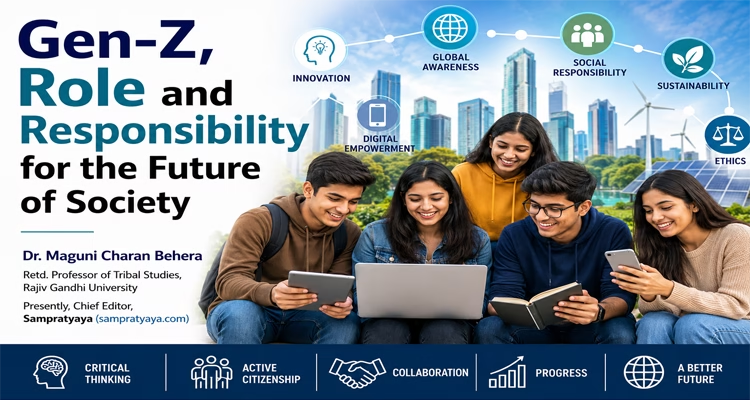
An insightful article by Dr. Maguni Charan Behera on Gen-Z’s role and responsibility in shaping the future of society, technology, ethics, leadership, critical thinking, and constructive social change.

The speed of scientific invention has moved in geometric progression since the twentieth century, while social thought and ethical understanding have often advanced much more slowly. Scientific progress does not automatically bring proportionate wisdom, morality, or social responsibility. Human society is therefore passing through one of the fastest and most complex periods of transformation in history.
Technology changes daily. Mobile phones, social media, artificial intelligence, online education, digital entertainment, and global communication have transformed the way people think, work, learn, and interact. In this changing world, the term “Gen-Z” has become widely discussed. It generally refers to people born between the late 1990s and early 2010s who grew up in the digital age.
Today, Gen-Z is discussed in politics, business, media, education, and social movements. Some praise them as creative, aware, bold, and technologically skilled, while others criticise them as impatient, distracted, or emotionally vulnerable to influence. Both praise and criticism are often exaggerated. The truth lies somewhere in between.
The important question is not whether Gen-Z is good or bad. The real question is: how should young people understand their role in society? Should they see themselves only as members of a technological generation, or as part of a larger social structure involving family, culture, nation, profession, and humanity?
This question is important because youth are the future strength of every society. Their energy can build nations, advance science, protect humanity, and promote peace. However, the same energy, if emotionally misdirected, can also create confusion, division, anger, and instability. Certain political groups, ideological organisations, pressure groups, or self-interested movements may deliberately attempt to emotionally mobilise young people for hidden agendas rather than genuine social welfare. Such manipulation often targets Gen-Z because of their emotional idealism, digital exposure, and desire for recognition. Therefore, young people must learn to “look before leaping.” Every attractive slogan, movement, trend, ideology, or emotionally charged campaign should be examined carefully before being accepted.
Technology as the Milestone of Identity
Every age in history has been shaped by some dominant force. Earlier generations were shaped mainly by agriculture, industry, wars, nationalism, religion, or economic systems. Today’s generation is shaped strongly by digital technology.
Gen-Z is the first generation to grow up fully connected to the internet. A student in India can watch videos made in America, debate politics with someone in Europe, learn coding from Japan, and play games with people across the world. This global connectivity creates a feeling that young people belong to one worldwide generation beyond traditional boundaries.
This has positive aspects. It increases awareness, creativity, scientific learning, and cultural exchange. A young person from a small village can now access knowledge once available only to a few privileged people. Technology can reduce isolation and expand opportunities.
However, technology also creates new dangers. Algorithms, viral trends, and emotional content often influence people without deep understanding. Information spreads rapidly, but wisdom develops slowly. Young minds are continuously exposed to excitement, outrage, comparison, and emotional stimulation.
As technology changes rapidly, new generations also emerge quickly. Terms like Baby Boomers, Gen-X, Millennials, Gen-Z, and Gen-Alpha reflect this process. But if society overemphasises technological generations alone, then deeper human connections may weaken.
A person is not only a member of a technological generation. Every person also belongs to a family, locality, language, nation, culture, profession, and humanity itself. These identities create continuity in civilisation. If one temporary identity becomes more important than all others, social balance may weaken.
For example, a young doctor belongs to Gen-Z. But the doctor is also a citizen, a family member, a professional, and a human being with ethical duties. If the person thinks only in terms of generational identity, broader responsibilities may be ignored.
Therefore, Gen-Z should not reject older generations, nor should older generations reject youth. Progress comes through cooperation between experience and innovation.
Youth: The Potential Stage of Manipulation
Youth is naturally a period of energy, idealism, ambition, and emotional intensity. Young people seek recognition and wish to change society quickly. This is not wrong; it is part of human development.
History shows that many leaders, organisations, political parties, and movements have used emotional slogans to influence young people. Some movements genuinely improve society, while others exploit youth for political, ideological, financial, or personal gain.
For example, during the Cultural Revolution in China (1966–1976), large numbers of students and young people were emotionally mobilised through revolutionary slogans and ideological campaigns. Many sincerely believed they were protecting society and promoting equality, but the movement later resulted in social chaos, persecution, destruction of educational institutions, and widespread suffering.
Similarly, in several countries, extremist political organisations have recruited frustrated or unemployed youth by using emotional narratives based on anger, fear, identity, or nationalism. Such groups often simplify complex social and economic problems into slogans against particular communities, governments, or institutions, thereby encouraging emotional reaction instead of thoughtful and constructive solutions.
Certain groups deliberately attempt to emotionally provoke Gen-Z by creating anger, fear, insecurity, victimhood, or exaggerated expectations. Instead of encouraging balanced understanding, they often simplify complicated social problems into emotionally attractive narratives. Such strategies can misguide youth away from rational thinking and constructive social participation.
Unscrupulous individuals understand how to capture imagination. They present complex issues in emotionally charged language rather than through careful reasoning. Instead of explaining root causes honestly, they encourage division and agitation while avoiding practical solutions.
For example, unemployment may arise from multiple causes such as population growth, technological change, lack of skills, weak industries, corruption, international economic conditions, educational weaknesses, and consumer culture. Yet a manipulative leader may reduce the entire issue to a single emotional slogan against one group, institution, community, or government.
This creates temporary excitement but not lasting solutions.
Social media intensifies this problem because emotional content spreads faster than balanced thinking. A short video filled with anger or sensationalism attracts more attention than a thoughtful discussion on economics, governance, or public policy. As a result, many young people become emotionally mobilised before fully understanding facts.
This is why critical thinking is essential. Young people must ask:
- Who benefits from this movement?
- What is the long-term solution?
- Are all sides being explained honestly?
- Is this movement constructive or merely destructive?
- Will this action improve society or deepen division?
- Does the movement genuinely serve society, or does it primarily serve the hidden interests of a few individuals or organisations?
To question emotionally attractive ideas is not weakness; it is a sign of intellectual maturity and responsible citizenship.
Protest and Responsibility
Every society has problems. No country is free from corruption, inequality, unemployment, crime, or political conflict. Problems exist in families, institutions, religions, governments, and economies. Therefore, criticism and protest are natural parts of democracy and social development.
Young people have often played important roles in positive social change. Student movements have fought against colonialism, dictatorship, racial discrimination, corruption, and injustice in many countries. Without youth participation, many reforms would never have happened. However, protest alone is not sufficient.
A society cannot permanently remain in a condition of agitation and emotional confrontation. After protest comes the far more difficult responsibility of governance, institution-building, economic management, social harmony, and long-term policy implementation.
Many movements succeed in opposing existing systems but fail to create better alternatives afterwards.
Take the example of Nepal. Young people strongly participated in anti-corruption and anti-establishment politics. Yet after political change, corruption and dissatisfaction did not disappear completely. Why? Because corruption is not only a problem of one person or one government. It is connected to institutions, culture, economic pressures, political habits, and human behaviour.
Similarly, the Assam Movement under leaders like Prafulla Kumar Mahanta gained massive support among students and youth over the issue of illegal immigration. The movement reflected genuine public concerns. However, governing a state after a movement proved far more complicated than leading protests.
This teaches an important lesson: identifying a problem is easier than solving it.
Political parties, legal systems, diplomacy, economics, international relations, constitutional limits, and administrative realities all affect solutions. A movement that ignores these complexities may create unrealistic expectations among youth.
Therefore, youth should participate in public life not only emotionally but intellectually. They should study economics, law, agriculture, science, governance, and history. Real social progress requires patience, cooperation, and practical thinking.
Plural Identities and Social Balance
One of the strongest foundations of civilisation is the network of plural identities. A person may simultaneously be:
- A member of a family
- A citizen of a nation
- A follower of a religion, philosophy, or ideology
- A speaker of a language
- A participant in a profession
- A resident of a region
- A member of a generation
- A part of humanity
These identities are not enemies of one another. They complement each other. Problems arise when one identity is exaggerated above all others.
If generational identity becomes the highest identity, then society may become fragmented. Young people may begin to see older generations as obstacles instead of partners. Older generations may respond with fear or hostility. This conflict weakens social continuity.
Civilisation survives because knowledge, values, institutions, and responsibilities pass from one generation to another. A child learns from parents. Students learn from teachers. Young workers learn from experienced professionals. At the same time, older generations learn new ideas and technologies from youth. This mutual dependence is the foundation of peaceful coexistence.
Therefore, Gen-Z should neither worship nor reject generational identity. It should understand that identity is one part of life, not the whole of life.
Consumerism, Technology, and Social Challenges
Modern economies are heavily influenced by consumerism. Advertising continuously creates new desires, while social media encourages unhealthy comparison and unrealistic expectations. People increasingly feel pressure to display success, consume more products, and imitate lifestyles presented online.
Demand often grows faster than available resources, while global supply systems are affected by wars, trade conflicts, environmental crises, inflation, and international politics. As a result, economic instability occurs frequently.
Young people often become frustrated because digital media constantly displays luxurious lifestyles, yet many face unemployment, financial insecurity, or uncertainty in reality. This gap between expectation and reality creates anxiety, frustration, and emotional vulnerability.
Technology also changes employment patterns. Machines, automation, and artificial intelligence reduce some jobs while creating new ones. Traditional forms of work decline. Rural populations migrate to cities. Agriculture becomes less attractive to educated youth.
Many educated youths leave villages and avoid farming or physical labour. Society begins depending excessively on outside goods, technology, and services. This creates vulnerability.
What is the solution?
The answer is not rejecting technology. Technology is necessary for progress. But technology must remain connected to practical realities.
Society needs balanced development:
- Modern education along with practical skills
- Technology along with agriculture
- Urban growth along with rural development and cultural preservation
- Consumption along with sustainability
- Growth with social justice
- Rights along with responsibilities
Young people should not feel ashamed of productive labour. Farming, craftsmanship, teaching, healthcare, engineering, and scientific research all contribute to society.
Countries become strong when citizens create value, not merely consume products.
Action, Not Mere Verbal Criticism
One weakness of modern political culture is excessive criticism and emotional rhetoric without constructive alternatives or productive action. Criticism is easy; institution-building is difficult.
A student may criticise corruption, but does the student practise honesty in daily life? A citizen may criticise unemployment, but does society encourage entrepreneurship, vocational training, skill development, and local production? A person may condemn environmental destruction while continuously consuming unnecessary products. Similarly, some people condemn corruption publicly yet privately justify bribery by saying, “everyone is doing it.”
Every social problem has deeper structural and behavioural dimensions.
For example, unemployment cannot be solved only through government jobs. No government can provide employment to everyone directly. Societies also require industries, agriculture, private enterprise, research, innovation, and local economic initiatives. Young people should therefore think practically and pragmatically:
- What skills are needed?
- What local resources exist?
- What industries can develop sustainably?
- How can villages become economically stronger?
- How can technology support local production?
- How can education connect with real needs?
Practical thinking creates confidence. It is therefore said: “Look before you leap.” Unjustified anger blocks rational thinking.
Ethical Leadership
Some leaders deliberately create a permanent atmosphere of crisis because fear and emotional instability increase control over followers. They divide people into categories, encourage hostility, and simplify complex realities into emotional narratives. Certain political or ideological groups may especially target young people through social media campaigns, selective information, provocative speeches, or identity-based emotional mobilisation.
Therefore, young people should evaluate leaders rationally rather than emotionally.
Responsible leadership is different. A responsible leader:
- Explains problems honestly
- Encourages dialogue
- Respects institutions
- Accepts criticism
- Suggests practical solutions
- Promotes cooperation
- Thinks long term
Popularity does not always indicate wisdom, honesty, selflessness, or genuine concern for society.
A person may speak attractively yet offer no realistic plan. Another may speak calmly yet contribute genuinely to social progress. Emotionally attractive speeches often gather crowds quickly, but emotional mobilisation without constructive direction can ultimately harm society and disappoint the very youth who trusted such leadership.
Interdependence: The Basis of Civilisation
Human civilisation exists because people cooperate, share, and respect each other.
Farmers produce food. Scientists create medicines. Teachers spread knowledge. Workers build infrastructure. Doctors treat illness. Families nurture children. Soldiers protect borders. Artists preserve culture. Engineers create technology. No group survives independently.
Even the most technologically advanced society depends upon human cooperation. Therefore, the idea that one category alone can transform society is unrealistic.
Gen-Z is important, but so are children, adults, and elderly people. Every generation contributes differently.
Interdependence is not weakness; it is civilisation itself.
When people recognise mutual dependence, they become more responsible. They understand that social harmony matters. They learn patience and empathy.
This does not mean accepting injustice silently. Rather, it means solving problems in ways that strengthen society instead of destroying trust.
Lessons from History
History repeatedly demonstrates the dangers of misguided leadership, selfish rulers, manipulative politics, and emotionally driven mass movements. Many movements in history began with idealism but later produced new problems because they ignored social complexity and practical realities. Revolutions have sometimes removed oppression but created chaos. Ideologies promising equality have, in some cases, produced dictatorship. Economic systems claiming prosperity have occasionally increased inequality and social instability.
This does not mean change is harmful. It means change must be thoughtful, responsible, and guided by wisdom rather than emotional excitement alone.
The phrase “look before leaping” therefore remains deeply relevant.
Before joining any movement, ideology, political campaign, or social trend, young people should ask:
- What are the long-term consequences?
- Does this strengthen society?
- Are facts being presented honestly?
- Is the movement inclusive and constructive?
- Does it encourage responsibility?
- Are the proposed solutions practical and sustainable?
Emotional excitement fades quickly, but social consequences may remain for generations.
A Positive Role for Gen-Z
Despite all challenges, Gen-Z possesses enormous strengths. They are:
- Technologically adaptable
- Globally connected
- More aware of mental health
- More open to innovation
- More willing to question outdated practices
- More conscious of environmental issues
- More creative in communication
These qualities can greatly benefit humanity. The goal should not be to suppress youth energy but to direct it constructively. Gen-Z can:
- Use technology for education and healthcare
- Promote scientific thinking
- Build ethical businesses
- Strengthen democratic participation
- Improve environmental sustainability
- Support local economies
- Encourage social harmony
- Develop practical innovations
Young people should become problem solvers, not merely critics. A nation progresses when youth combine idealism with discipline, creativity with responsibility, and freedom with wisdom.
Conclusion
Gen-Z is an important generation shaped by extraordinary technological change. Their identity reflects a new historical period of digital culture and global connectivity. This identity has positive value because it promotes awareness, creativity, innovation, and worldwide interaction.
However, no generation exists above society, nation, family, culture, or humanity. Every individual possesses multiple identities and responsibilities. Civilisation advances through cooperation between generations, not conflict among them.
Youth naturally seek meaning, recognition, and social change. Yet this energy can also be manipulated through emotional slogans, consumer culture, political opportunism, ideological propaganda, and social media influence. Therefore, critical thinking and ethical responsibility are essential.
Protest and criticism are necessary in every society, but they must be accompanied by practical solutions, ethical leadership, social responsibility, and constructive participation. Problems should be understood within broader social realities because isolated or emotional solutions may create deeper problems elsewhere.
Human progress depends not upon division but upon interdependence. Gen-Z should recognise its immense potential not merely through opposition or emotional reaction, but through constructive action, discipline, innovation, wisdom, and service to humanity.
The future belongs neither to blind tradition nor blind rebellion. It belongs to thoughtful cooperation guided by reason, responsibility, and moral balance.
Young people should therefore remember an old but timeless wisdom: before being carried away by attractive words, emotional excitement, or temporary trends, one must always “look before leaping.” That balance between imagination and responsibility is the true path toward peace, progress, and a stronger civilisation.