
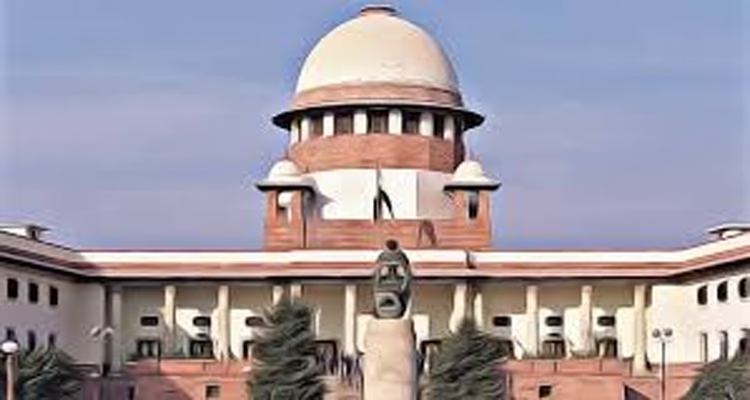
News Desk: The Supreme Court (SC) on Wednesday upheld the constitutional validity of the Election Commission of India’s (ECI) Special Intensive Revision (SIR) of electoral rolls, ruling that the exercise is legally sound and aimed at strengthening the integrity of the electoral process.
A bench headed by Chief Justice Surya Kant observed that the ECI acted within its constitutional and statutory authority while conducting the large-scale voter verification drive in Bihar, West Bengal, and other states. The court stated that the poll body derives its powers from Article 324 of the Constitution, along with provisions of the Representation of the People Act and related electoral rules.
WATCH || Supreme Court of India uphelds the Election Commission of India’s Special Intensive Revision (SIR) of electoral rolls under Article 324 and the Representation of the People Act, 1950.#SIR #SpecialIntensiveRevision @ECISVEEP @SpokespersonECI @MIB_India @PIB_India pic.twitter.com/vJmC8ryoR9
— DD India (@DDIndialive) May 27, 2026
Describing the exercise as one that “breathes life into the Constitution,” the apex court said the preparation of accurate and updated electoral rolls is central to ensuring free and fair elections in a democracy. The bench further held that the Special Intensive Revision cannot be termed “ultra vires” merely because it differs from the ordinary revision process undertaken periodically by the Election Commission.
The verdict came on a batch of petitions filed by political parties, activists, and civil society groups challenging the legality of the SIR exercise. Petitioners had argued that the revision drive could potentially lead to large-scale voter exclusion and disenfranchisement, particularly among poor and migrant populations, due to stringent documentation and verification requirements.
Several opposition parties had also alleged that the exercise resembled a citizenship verification process and raised concerns over the exclusion of Aadhaar and voter identity cards as primary proof documents in certain cases.
Supreme Court’s SIR verdict in a nutshell
Read here: https://t.co/VTLlzbDHVy pic.twitter.com/AL3xBFdKc2
— Bar and Bench (@barandbench) May 27, 2026
However, the Supreme Court rejected the argument that the Election Commission had exceeded its powers. The court held that maintaining the “purity, integrity, and accuracy” of electoral rolls is a constitutional responsibility of the ECI and that periodic intensive revisions are permissible to identify duplicate, shifted, deceased, or otherwise ineligible entries.
At the same time, the court underlined that the revision process must remain fair, inclusive, and non-arbitrary. It noted that adequate safeguards and appellate mechanisms exist for voters whose names may be omitted or disputed during the verification process.
The Special Intensive Revision was first launched in Bihar ahead of Assembly elections and later expanded to other states and Union Territories as part of the Election Commission’s broader effort to clean up voter databases and address concerns related to migration, demographic changes, and outdated electoral rolls.
The ruling is being seen as a major endorsement of the Election Commission’s powers and autonomy ahead of upcoming elections. While the ECI welcomed the judgment as a boost to electoral transparency, opposition parties continued to express concerns over implementation and the potential impact on vulnerable sections of voters.