
Ajay Kumar, Senior Journalist
Lucknow | Uttar PradeshDoes India’s justice system treat everyone equally? Examining high-profile cases, judicial discretion, anticipatory bail, and the growing perception that wealth and influence can shape legal outcomes.

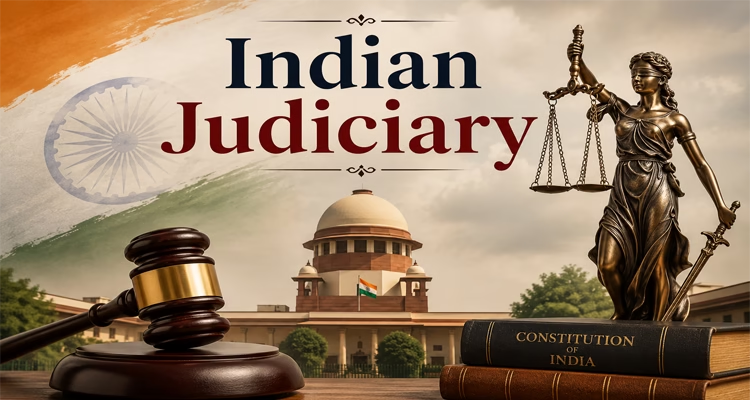
There has long been a deep sense of confusion among ordinary citizens regarding the functioning of India’s judicial system. The law teaches that the Goddess of Justice wears a blindfold, symbolizing impartiality and equality before the law. In theory, the rich and the poor, the powerful and the powerless, the famous and the unknown are all weighed on the same scale. Yet, the reality often appears far removed from this ideal.
When an accused person enjoys widespread popularity, commands the loyalty of millions of followers, and possesses the financial resources to engage a team of high-profile lawyers, the judicial response often appears markedly different from that experienced by an ordinary citizen lacking fame, influence, or wealth.
The events that unfolded in Patna on June 2 have once again brought this uncomfortable question into public focus. A violent confrontation reportedly took place between Gyan Bindu GS Academy and the coaching institute run by the well-known educator Khan Sir in the Kadamkuan police station area. The clash allegedly involved violence and even firing.
In connection with the incident, the Patna District Court granted interim protection from arrest to Khan Sir, a teacher who enjoys immense popularity among students across the country. His counsel, Advocate Arvind Mauar, filed an anticipatory bail petition before the court of Principal District and Sessions Judge Rupesh Dev. After hearing the matter, the court granted interim relief and stayed his arrest.
However, a very different outcome emerged for others involved in the same case. The court rejected the bail application of Roshan Anand, Director of Gyan Bindu Academy, and he remains in judicial custody. Similarly, the regular bail applications of Khan Sir’s two security guards, Deepak Kumar and Talebar Singh, are still pending while both remain behind bars.
In other words, those who reportedly admitted to firing shots into the air on Khan Sir’s instructions are in jail, while the individual on whose behalf these allegations have been made continues to enjoy judicial protection. Such contradictions naturally raise questions about equality before the law.
This is not an isolated instance. Indian judicial history contains numerous examples where an accused person’s social status, popularity, or financial strength appeared to shape the course of legal proceedings.
One of the most prominent examples is actor Salman Khan’s blackbuck hunting case. The matter continued for years, with a trial court eventually convicting him before higher courts granted relief. Throughout the prolonged litigation, many observers noted that a celebrity accused did not appear to face the same hardships that an ordinary citizen might have encountered. Bail was secured quickly, hearings stretched over years, and the legal battle ultimately ended in his favor.
Similarly, in the arms case involving actor Sanjay Dutt, legal proceedings continued for decades. Although he served a prison sentence, legal relief remained available to him at various stages of the process.
The list becomes even longer when politically influential figures are considered. Former Bihar Chief Minister Lalu Prasad Yadav, convicted in the fodder scam cases, repeatedly secured bail on medical and other grounds. Andhra Pradesh leader Jagan Mohan Reddy obtained bail in a disproportionate assets case and later went on to become Chief Minister.
A common thread running through many such cases is the role played by influential and highly sought-after lawyers.
One of the uncomfortable realities of the Indian legal profession is that, alongside legal expertise, a lawyer’s stature, reputation, and connections often carry substantial weight. The atmosphere inside a courtroom can change dramatically when a prominent advocate appears. Such lawyers have the ability to present the same set of facts from a perspective that may be difficult for an ordinary lawyer to articulate with equal force and sophistication.
By skillfully combining constitutional safeguards, judicial precedents, procedural protections, and arguments relating to bail, they often succeed in portraying their clients as deserving of judicial leniency, if not outright exoneration.
In Khan Sir’s case, his lawyer reportedly argued that serious charges, including attempt to murder and provisions of the Arms Act, had been invoked primarily to exert pressure and that no individual had actually suffered a gunshot injury. The effectiveness of this argument became evident in the court’s decision to grant interim protection.
The influence of powerful lawyers often extends beyond courtroom advocacy. Procedural strategies such as seeking adjournments, filing fresh petitions, approaching successive higher courts, and eventually moving the Supreme Court are frequently used to prolong litigation and secure time. During this period, accused persons often remain out on bail or obtain facilities unavailable to ordinary prisoners.
Experienced lawyers also possess a deep understanding of the judicial system’s functioning. While it would be inappropriate to suggest that judges can be influenced improperly without evidence, seasoned legal practitioners undoubtedly know which legal forums, benches, or procedural routes may offer more favorable opportunities for their clients.
When ordinary citizens observe these realities, their faith in the justice system inevitably begins to weaken. They see a security guard behind bars, a coaching institute director in jail, and yet another individual at the center of the controversy enjoying legal protection. Whether such perceptions are fully justified or not, they contribute to a growing public belief that justice is not always experienced equally by all.
This perception highlights one of the most persistent weaknesses of India’s judicial system—a problem that has been discussed for decades but remains largely unresolved.
The principle of justice demands that the benefit of doubt be extended to the accused. Anticipatory bail exists precisely to protect individuals from unnecessary arrest and harassment. The difficulty arises when this protection appears accessible primarily to those with influence, resources, and legal firepower, while ordinary citizens continue to face the harsher side of the law.
Until greater transparency is introduced into judicial processes and meaningful efforts are made to eliminate disparities between rich and poor litigants, the pursuit of justice will continue to feel like an uphill battle for the common man.
The credibility of any judicial system rests not merely on the fairness of its judgments but also on the public’s confidence that justice is being administered equally. If that confidence erodes, the very foundation of the rule of law begins to weaken.