
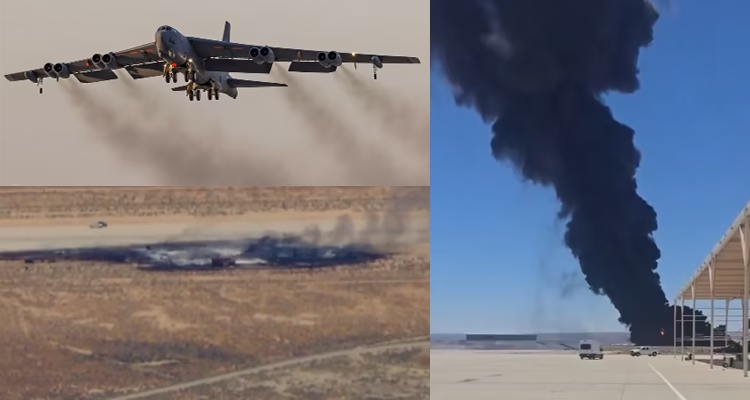
News Desk: A United States Air Force B-52H Stratofortress bomber crashed shortly after takeoff from Edwards Air Force Base in Southern California on 15 June 2026, resulting in the deaths of all eight personnel aboard. The aircraft was conducting a routine test mission related to a radar modernization program when it went down at approximately 11:20 a.m. local time. The incident has become one of the deadliest B-52 accidents in recent decades and has prompted a comprehensive military investigation expected to take several months to complete.
Background
The Boeing B-52 Stratofortress is one of the most recognizable aircraft in the history of military aviation. Introduced during the 1950s, the long-range heavy bomber remains a central component of the United States Air Force’s strategic bomber fleet. Designed to carry both conventional and nuclear weapons, the aircraft has participated in numerous military operations from the Cold War era to modern conflicts.
The aircraft involved in the accident was assigned to Edwards Air Force Base, a premier U.S. military testing and evaluation facility located in California’s Mojave Desert. Edwards has historically served as a center for aviation innovation and flight testing.
‼️ Official release regarding today’s B-52 crash at Edwards. Our thoughts and prayers are with the families and unit members at this time.
More information will be released as it becomes available. pic.twitter.com/410V2gqCFv
— Edwards Air Force Base (@EdwardsAFB) June 15, 2026
The Incident
According to official statements from Edwards Air Force Base, the B-52 Stratofortress departed on a routine test mission before crashing moments after takeoff at approximately 11:20 a.m. local time. Witnesses and media reports described a large plume of black smoke rising from the crash site, visible from several miles away.
The aircraft crashed within the boundaries of Edwards Air Force Base, allowing emergency responders to contain the situation without broader public safety concerns. Initial assessments indicated that the crash was not survivable.
Colonel James Hayes, Deputy Commander of the 412th Test Wing, described the event as a national tragedy, stating that the United States had lost “eight great Americans.”
BREAKING: A U.S. Air Force B-52 bomber crashed shortly after takeoff at Edwards Air Force Base, triggering an emergency response.
Emergency crews rushed to the scene as thick black smoke billowed from the wreckage scattered across the desert airfield.
More details, including… pic.twitter.com/JRx3R4ElJW
— Fox News (@FoxNews) June 15, 2026
Casualties
All eight individuals aboard the aircraft lost their lives. The crew consisted of a combination of military personnel, government civilians, contractors, and two employees of Boeing. Boeing later confirmed that two of its staff members were among the victims and pledged support to the affected families.
Authorities initially withheld the identities of those killed pending notification of next of kin.
Immediate Response
Emergency response teams were deployed immediately after the crash. Airfield operations at Edwards Air Force Base were temporarily suspended, and incoming aircraft were diverted while first responders secured the area.
California Governor Gavin Newsom expressed condolences to the victims’ families and the Edwards Air Force Base community, describing the event as a tragic loss.
Military officials emphasized that the accident was fully contained within the base perimeter and posed no threat to surrounding communities.
Investigation
The cause of the crash remains unknown. Air Force officials have launched a formal investigation to determine the sequence of events that led to the loss of the aircraft.
Investigators are expected to examine:
- Aircraft maintenance records.
- Flight data and telemetry.
- Engine and flight-control system performance.
- Mission objectives and test procedures.
- Weather and environmental conditions.
Colonel Hayes indicated that the investigation could take more than six months before final conclusions are reached.
While aviation experts have speculated that factors such as flight-control issues, engine malfunctions, or system calibration problems could be examined, no official cause has been identified.
Significance of the B-52 Fleet
The B-52H Stratofortress remains one of the longest-serving combat aircraft in military history. Despite its age, the aircraft continues to undergo extensive modernization, including upgrades to radar systems, engines, communications equipment, and weapons integration.
The aircraft involved in the accident was reportedly participating in testing associated with the Air Force’s radar modernization efforts, which are intended to keep the bomber operational for decades to come.
The B-52 fleet is expected to remain in service until at least the 2050s, reflecting its enduring strategic importance.
Historical Context
Although the B-52 has maintained a strong operational record over many decades, several notable accidents have occurred throughout its service history. Aviation historians note that the June 2026 Edwards crash represents one of the deadliest B-52 incidents in recent years and underscores the inherent risks associated with flight testing and military aviation operations.
Conclusion
The crash of the B-52 Stratofortress at Edwards Air Force Base marks a significant loss for the United States Air Force and the broader aerospace community. The deaths of eight personnel, including military members, government civilians, contractors, and Boeing employees, highlight the dangers faced by those involved in testing and maintaining advanced military aircraft.
As investigators work to determine the cause of the accident, attention will focus on whether mechanical, operational, or other factors contributed to the tragedy. The findings are expected to influence future safety procedures and modernization efforts involving one of America’s most iconic strategic bombers.