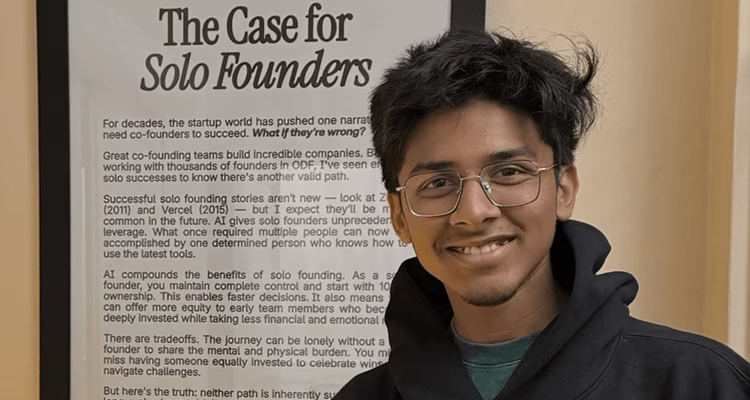
Mumbai: At an age when most teenagers are navigating college life, Mumbai-born entrepreneur Dhravya Shah has emerged as one of India’s youngest AI startup founders, raising nearly $3 million (around ₹26 crore) in seed funding for Supermemory, an artificial intelligence infrastructure startup tackling one of AI’s biggest unsolved challenges—long-term memory.
The funding round has drawn support from prominent Silicon Valley investors and technology leaders, underlining growing confidence in Shah’s vision of giving AI systems the ability to remember information across multiple conversations instead of treating every interaction as a fresh start.
From Hackathon Idea to Global AI Startup
Launched as a hackathon project in 2024, Supermemory initially began as a consumer-focused “second brain” application that helped users organise and retrieve personal information. The project soon became one of the fastest-growing open-source AI tools, crossing 10,000 GitHub stars and attracting developers worldwide.
As startups began seeking long-term memory capabilities for their AI products, Shah pivoted the platform from a consumer app to enterprise-grade AI infrastructure, positioning Supermemory as a memory layer for AI applications.
Building AI That Doesn’t Forget
Unlike conventional AI chatbots that lose context between conversations, Supermemory enables AI agents to retain and retrieve relevant information over time. The platform converts unstructured data—including emails, chats, PDFs, documents and files—into an organised knowledge graph, allowing AI systems to recall past interactions with lower latency and stronger access controls.
The company says its technology is already being used by AI startups such as Cluely, Montra and Scira, highlighting growing demand for persistent AI memory infrastructure.
Backed by Silicon Valley’s Biggest Names
Supermemory completed its seed funding round in late 2025. While TechCrunch reported the investment at $2.6 million, several Indian publications estimated the round at about $3 million, a figure widely cited by the company and investors.
The round was led by Susa Ventures, Browder Capital and SF1.vc, with participation from an impressive lineup of technology leaders, including Google AI Chief Jeff Dean, Cloudflare CTO Dane Knecht, DeepMind’s Logan Kilpatrick, and Sentry founder David Cramer.
Dhravya Shah sold two companies before he could legally drink, then raised $3 million alone at 19.
This 73-minute interview is the clearest case I’ve heard for why AI memory is the next platform.
Here’s the part I can’t stop thinking about:
> everyone will have their own AI… https://t.co/6GxYtycl60 pic.twitter.com/Xqh0rueOWa
— Phosphen (@phosphenq) June 26, 2026
Teen Entrepreneur Who Chose Startups Over IIT
Shah’s entrepreneurial journey began long before Supermemory. He sold his first venture at just 16, built more than 15 open-source software projects, and chose to pursue startups instead of the conventional IIT route followed by many aspiring Indian engineers.
His achievements have also earned him the prestigious U.S. O-1 visa, granted to individuals recognised for extraordinary ability in fields such as science, business and technology.
Why Supermemory Matters
As AI assistants become increasingly integrated into everyday life, one of the industry’s biggest technical limitations remains their inability to retain meaningful context over long periods. Supermemory aims to solve this by providing a dedicated memory infrastructure that enables AI applications to learn from previous interactions, making conversations more personalised, accurate and efficient.
With fresh funding and backing from some of the biggest names in artificial intelligence, Supermemory is positioning itself as a key infrastructure player in the next generation of AI-powered applications.