
Dr. Maguni Charan Behera
Retired Professor of Tribal Studies, Chief Editor, Sampratyaya
Email: sampratyaya.ijr@gmail.com

The Ratha Yatra, one of the most sacred festivals associated with Lord Jagannath, has traditionally been celebrated at a divinely ordained sacred time. However, the International Society for Krishna Consciousness (ISKCON), by deciding to alter the time of its observance in certain places, has brought the issue into a wider philosophical debate concerning religious consciousness and fidelity to tradition. This raises a fundamental question: Is the consciousness within ISKCON today the same consciousness upon which the organisation was originally established?
Can consciousness within a religious tradition be regarded as absolute? If consciousness is absolute, then the path leading to it—including its rituals, sacred time, discipline, and observances—must also remain absolute. If these are modified according to human judgment, an important philosophical question arises: Does the same consciousness continue to be expressed? This essay explores that question.
Tithi: An Unchangeable Sacred Order
Religious traditions throughout the world distinguish between ordinary time and sacred time. Sacred time is not created by human preference, organisational policy, or geographical convenience. It derives its authority from the tradition itself. Consequently, the authenticity of a religious observance depends not only upon the ritual being performed but also upon its observance at the appointed sacred time. The prescribed day is therefore inseparable from the meaning of the festival.
Christmas provides a familiar example. Christians celebrate Christmas on 25 December throughout the world. In Europe and North America, it falls during winter, while in Australia, New Zealand, and many countries of the Southern Hemisphere, it falls during summer. The climate changes, but the date does not. Christians do not postpone Christmas to July simply because winter imagery appears more appropriate. The sanctity of Christmas is attached to its recognised date within the Christian tradition, not to the surrounding weather. Celebrating Christmas on another day merely because it appears more convenient would not simply constitute a change of date; it would raise questions about fidelity to the inherited tradition.
The same principle applies to New Year’s Day. Seasons vary across continents, yet no nation transfers New Year’s Day from 1 January to another month because the climate is more favourable. The authority lies in the calendar itself, while the weather merely provides the surrounding circumstances.
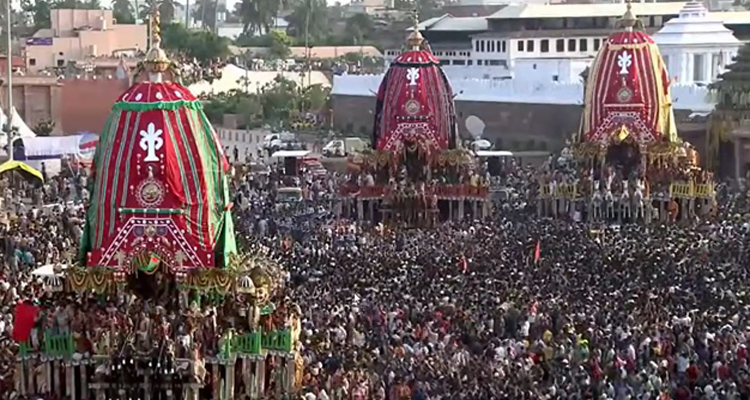
The principle is equally fundamental in Hinduism. Many sacred observances are determined not by season but by the tithi, the prescribed lunar day. The Ratha Yatra of Lord Jagannath is one such festival. For centuries, it has been celebrated according to the sacred tithi—Ashadha Shukla Dwitiya, the second day of the bright fortnight of the month of Ashadha (June–July). The tithi is not an administrative convenience for fixing dates; it forms part of the sacred order through which the tradition understands divine time. The sanctity of the festival is therefore inseparable from the tithi itself.
What Does a Change of Tithi Mean for Tradition and Guru Parampara?
If, for local or externally influenced reasons, a religious organisation chooses to celebrate Ratha Yatra on a day other than the prescribed tithi, the issue extends far beyond the calendar. The fundamental question is whether the authority for determining sacred observance continues to reside in the inherited tradition or has shifted to human judgment.
If climate, public holidays, weekends, or organisational convenience become the determining factors, then the basis of observance has subtly changed. Authority no longer rests exclusively in the sacred tradition but in institutional decision-making.
This question becomes even more significant when viewed in relation to the guru. A genuine guru does not merely teach abstract philosophy; he transmits an entire path towards spiritual realisation. That path includes doctrine, discipline, ritual, sacred time, and devotional practice. These are not independent elements that may be selected or modified according to changing circumstances. Together, they form the living expression of the consciousness realised by the guru and transmitted through the disciplic succession (parampara).
His Divine Grace A. C. Bhaktivedanta Swami Prabhupada, the Founder-Acharya of the International Society for Krishna Consciousness (ISKCON), introduced Krishna consciousness not as a philosophy to be continually adapted according to local convenience but as a disciplined way of life inherited through the Gaudiya Vaishnava tradition. The disciple’s responsibility is therefore not to improve the path but to follow it faithfully. Authority lies in the guru and the tradition he received, not in subsequent institutional interpretation.
If the guru established the observance of sacred festivals according to the prescribed tithi, then that observance forms part of the path he transmitted. To alter it is not merely to alter a timetable; it raises a deeper philosophical question. Does such a change preserve the same path, or does it mark the beginning of another? A path remains a path because its direction remains constant. If its defining disciplines are altered by human discretion, the direction itself becomes open to reinterpretation.
Perceiving Consciousness
This brings us back to the question of consciousness. Spiritual consciousness has traditionally been understood as absolute, eternal, and beyond the reach of human reasoning. It is not created through argument but realised through surrender. The devotee does not negotiate with the sacred order but aligns himself or herself with it. In this understanding, consciousness requires submission to what has been revealed rather than adaptation according to what appears reasonable.
If sacred time itself becomes negotiable, then consciousness also becomes subject to negotiation. Instead of consciousness determining human conduct, human judgment begins to determine how consciousness should be expressed. The relationship is effectively reversed. Consciousness ceases to function as the governing principle and instead becomes something administered through institutional discretion.
This argument does not question the sincerity or devotion of individual practitioners. Rather, it concerns the source of authority. Is the disciple conforming to the path transmitted by the guru, or is the path being conformed to institutional preferences? These represent two fundamentally different understandings of spiritual life.
The issue, therefore, is not whether celebrating Ratha Yatra on another day is practical. Practicality belongs to the temporal world. Consciousness, if truly absolute, belongs to a realm beyond practicality. Once practical considerations determine sacred observance, authority has shifted from revelation to human interpretation.
Conclusion
The philosophical conclusion is therefore unavoidable. If absolute consciousness is inseparable from complete fidelity to the revealed tradition, then any deliberate departure from that tradition signifies more than an organisational adjustment. It represents a different understanding of consciousness itself. The institution may continue to employ the same language, the same scriptures, and the same rituals, yet its governing principle has changed. The centre of authority no longer lies wholly in the revealed tradition but partly in human discretion.
Whether one chooses to describe this as a departure from the original consciousness, a redefinition of consciousness, or—using a deliberately provocative expression—as “no consciousness in ISKCON,” the underlying philosophical question remains the same: Can a consciousness that is claimed to be absolute still be regarded as absolute when its expression is determined by human choice rather than by the sacred order inherited through the guru and the disciplic tradition?