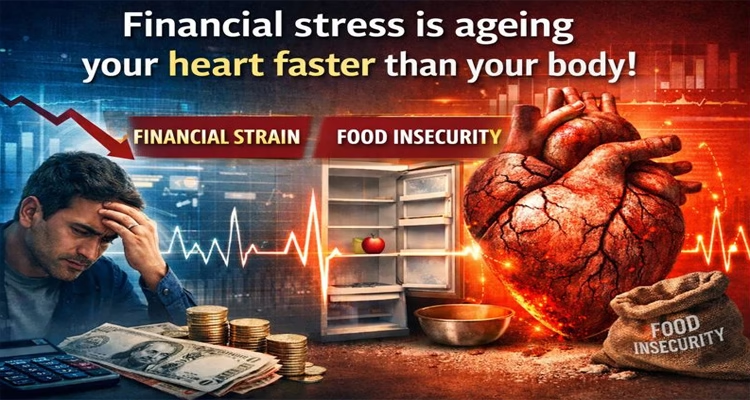
Money worries (Financial Strain) may be ageing your heart faster than your body, a major new study has found—putting financial stress alongside food insecurity as some of the strongest hidden drivers of heart disease and early death.
A large-scale analysis published in Mayo Clinic Proceedings reveals that social and economic pressures—often overlooked in routine medical care—play a decisive role in how quickly the heart biologically ages, sometimes outweighing traditional risk factors like cholesterol or blood pressure.
Stress beyond lifestyle
The research, led by cardiologists at the Mayo Clinic, examined more than 280,000 adults who sought care at the institution between 2018 and 2023. Scientists looked beyond clinical data, focusing on social determinants of health (SDoH)—including financial strain, food insecurity, housing instability, physical activity, stress levels and social connections.
Using an AI-enabled electrocardiogram (AI-ECG), researchers estimated each patient’s “cardiac age” and compared it with their actual age. A larger gap meant the heart was biologically older, signalling a higher risk of future cardiovascular disease and death.
Financial strain tops the risk list
The findings were stark. Financial stress and food insecurity emerged as the most powerful accelerators of cardiac ageing, across both men and women. In fact, the combined impact of social stressors proved more influential than many conventional medical risk factors.
Several SDoH—particularly financial strain, unstable housing and physical inactivity—were also strong predictors of mortality, in some cases matching or surpassing traditional causes of death linked to heart disease.
Why this matters now
With the US population aged 65 and above projected to nearly double to 82 million by 2050, doctors are increasingly shifting focus from lifespan alone to healthy ageing and quality of life.
“Traditional risk factors do not explain cardiovascular disease equally for everyone,” said lead investigator Amir Lerman, from the Department of Cardiovascular Medicine at Mayo Clinic.
“There are social factors we often don’t ask our patients about, yet these may be critical—and potentially reversible—contributors to biological ageing of the heart.”
A new tool for early warning
The study highlights the growing promise of AI-ECG technology as a non-invasive way to detect biological ageing during routine heart tests. Researchers say identifying an “older-than-expected” heart may alert clinicians to underlying social risks that standard check-ups miss.
However, the authors caution that the AI algorithm was validated internally at Mayo Clinic, and most participants were non-Hispanic White—meaning results may not translate uniformly across all populations.
The bigger message
The takeaway is clear: heart health is not shaped by biology alone. Economic insecurity, access to food and stable living conditions are deeply entwined with cardiovascular ageing.
“Recognising these social drivers allows for targeted prevention—not just in clinics, but in communities,” Dr Lerman said. “It also enables truly patient-centred care by addressing the social realities that quietly shape heart disease.”
In short, the study sends a powerful reminder: reducing financial stress and food insecurity may be as vital to heart health as controlling blood pressure or quitting smoking.