 Dr. Vinod Chandrashekhar Dixit
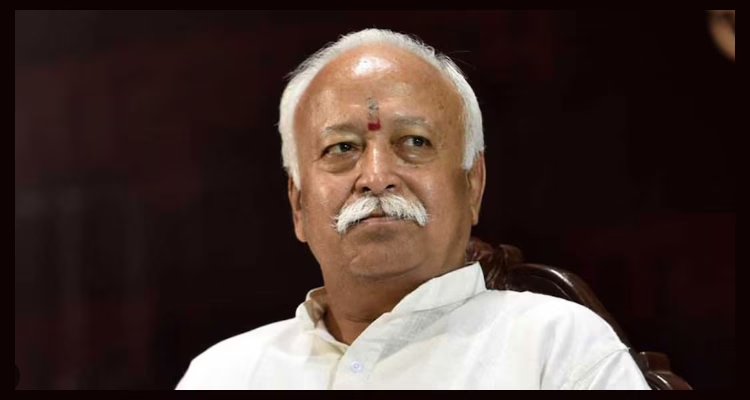
Asserting that the country belongs to everyone, RSS chief Mohan Bhagwat has rightly called for social harmony, urging people to rise above divisions of caste, wealth, and language and to treat “everyone as one’s own.” In a world where differences often divide societies, this call is more relevant than ever.
This timeless message, echoed by visionaries and leaders across cultures, urges us to recognize the inherent value of every individual and to foster a sense of unity and belonging. It reminds us that social cohesion is not built by erasing differences but by respecting them within a shared moral framework.
India’s diversity is staggering. Over 1,600 languages are spoken, eight major religions are practiced, and countless festivals are celebrated across the country. From the snow-capped Himalayas to the sun-kissed beaches of the South, each region boasts unique customs, cuisines, and traditions. Yet, amid this immense diversity, Indians share a deep sense of national pride and collective identity.
India’s history itself is a testament to cultural fusion. The legacies of the Indus Valley Civilization, the Mughal era, and British rule have blended over centuries to shape a rich and layered heritage. Leaders such as Gandhi, Nehru, and Ambedkar championed unity, weaving diverse social, cultural, and ideological threads into the fabric of the nation.
However, caste, wealth, and language remain powerful forces that have historically fragmented societies. Caste hierarchies have marginalized communities, wealth disparities have widened economic inequalities, and language has at times been used as a tool of exclusion rather than communication. When these divisions dominate social relations, they breed prejudice, resentment, and conflict.
Treating everyone as one’s own is therefore not merely a moral ideal; it is a practical pathway to collective strength and progress. When societies embrace shared humanity, they unlock vast potential. Empathy and compassion build trust, strengthening communities and encouraging collaboration. Diverse perspectives fuel innovation and help address complex social and economic challenges.
Recognizing our interconnectedness also nurtures collective resilience. It fosters a sense of belonging that enhances both individual dignity and societal well-being. As barriers dissolve, inclusive spaces emerge where every individual can contribute, innovate, and grow. In this unity lies the blueprint for a more harmonious and prosperous future—one where progress becomes a shared journey rather than a privilege for a few.
India’s vibrant diversity is not a weakness but its greatest strength. It is a living tapestry woven from countless cultural, linguistic, and traditional threads, creating a rich mosaic that enhances national resilience and creativity. This diversity broadens perspectives, fuels innovation, and strengthens India’s global engagement. Far from dividing the nation, it unites Indians in a shared journey of coexistence and growth.
As we navigate the challenges of the 21st century, it is imperative to harness this unity to build a more inclusive future. As Mahatma Gandhi famously observed, “Our ability to reach unity in diversity will be the beauty and the test of our civilization.” Let us choose unity over division and compassion over indifference. By treating everyone as our own, we weave a fabric of strength in which every thread contributes to the beauty of the whole. Together, we can rise above differences and create a world where everyone truly belongs.