India becomes first nation to deploy ramjet-powered 155mm artillery shells
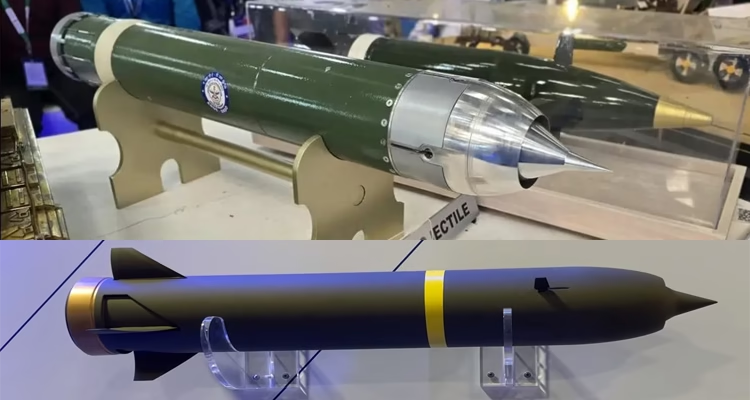
New Delhi: In a major leap for conventional warfare capabilities, India is set to become the first country in the world to operationally deploy ramjet-powered shells for 155mm artillery guns, significantly extending the range and lethality of its gun artillery without altering existing platforms.
The breakthrough munition has been developed under an indigenous programme involving the Defence Research and Development Organisation (DRDO) in collaboration with Indian academic institutions and domestic defence manufacturers. The project has received clearance from the Army Technology Board, clearing the path for induction into the Indian Army’s artillery regiments.
What sets ramjet-powered artillery apart
Unlike conventional or rocket-assisted artillery rounds, ramjet-powered shells employ air-breathing propulsion. After the projectile exits the gun barrel, a ramjet engine ignites mid-flight, drawing in atmospheric oxygen to generate sustained thrust. This allows the shell to maintain higher velocity for longer durations, resulting in dramatically extended ranges.
Defence sources indicate that the new ammunition can increase the effective range of 155mm guns by 30 to 50 per cent, potentially enabling strikes at distances previously achievable only by missiles or guided rocket systems.
🚨𝐁𝐑𝐄𝐀𝐊𝐈𝐍𝐆 : The #IndianArmy is set to become the world’s first force to field ramjet-powered 155mm artillery shells, extending range by 30–50% without any loss of lethality. 🇮🇳🚀💥
The system can be retrofitted to existing ammunition and is under trials with IIT Madras. pic.twitter.com/3xBXrjyznY
— Tanmay Kulkarni 🇮🇳 (@Tanmaycoolkarni) January 2, 2026
When and where the shell was tested
Before being cleared for deployment, the ramjet-powered 155mm shell underwent extensive ground and flight trials at the Pokhran Field Firing Range in Rajasthan, India’s primary testing site for artillery and missile systems.
According to officials familiar with the programme, multiple test phases were conducted during 2023 and 2024, focusing on critical parameters such as propulsion stability, air-intake efficiency, structural integrity under extreme acceleration, and sustained thrust after muzzle exit.
Subsequent evaluations assessed the shell’s compatibility with standard 155mm/52-calibre artillery guns, including performance consistency, aerodynamic stability, and safety under operational firing conditions. The successful completion of these trials led to approval by the Army Technology Board, paving the way for user-assisted trials and eventual induction.
Compatible with existing artillery systems
A key advantage of the ramjet shell is that it is designed to work seamlessly with India’s existing artillery inventory, including ATAGS, K9 Vajra-T, and M777 howitzers. This ensures that the Indian Army can deploy the new capability without major changes to gun platforms, logistics, or training frameworks.
Strategic and operational impact
Military analysts view the development as a game-changer in conventional firepower, allowing Indian artillery units to strike deeper targets while remaining well outside enemy counter-battery range. It also reduces reliance on expensive guided munitions for long-range engagements.
The programme aligns with India’s broader Atmanirbhar Bharat push, strengthening domestic capability in advanced munitions and reducing dependence on foreign suppliers for high-end artillery ammunition.
India leads a global race
While several countries, including the United States and some European nations, have experimented with ramjet-assisted artillery concepts, available public information suggests India is the first to move from experimentation to deployment-ready capability in the 155mm class.
Defence officials caution that further announcements on production scale and induction timelines are expected, but the successful trials mark a significant milestone in India’s artillery modernisation drive.
Ramjet-Powered 155mm Artillery Shells
Ramjet-powered 155mm artillery shells are advanced artillery munitions equipped with a ramjet engine. After the shell is fired from the gun, the engine uses oxygen from the surrounding air to generate additional thrust during flight, giving the projectile greater speed and extended range.
Explained in simple terms
155mm → The size (calibre) of the artillery shell
Artillery shell → A heavy projectile fired from large-calibre guns
Ramjet-powered → An air-breathing engine that boosts the shell’s speed while it is in flight
How does it work?
Once the shell leaves the artillery gun, it is already travelling at very high speed. This speed activates the ramjet engine, which draws in air and produces sustained thrust, allowing the shell to travel much farther than conventional rounds.
What are the advantages?
Significantly longer range compared to standard artillery shells
Can be fired from existing 155mm guns, without the need for new artillery systems
Enables accurate strikes from safer stand-off distances, reducing exposure to enemy fire
Definition
Ramjet-powered 155mm artillery shells are advanced munitions that use an air-breathing engine to achieve far greater range than conventional artillery rounds.