by Nava Thakuria
Bangladesh heads to general elections on February 12 to elect its 13th Jatiya Sansad, with Sheikh Hasina’s Awami League barred from contesting amid political turmoil, minority violence concerns, and strained India–Bangladesh relations.

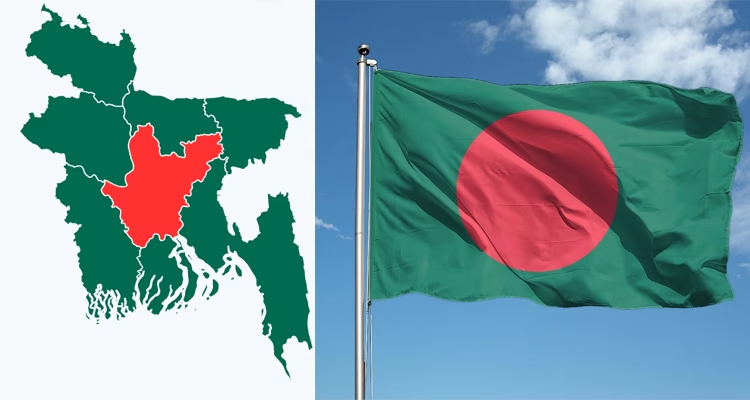
Bangladesh, a Muslim-majority nation of over 170 million people, goes to general elections on 12 February 2026 to elect its 13th Jatiya Sansad in Dhaka. According to the Bangladesh Election Commission, a total of 127,711,895 voters are eligible to cast their ballots, including more than 4.5 million newly registered young voters who have recently attained the age of 18. Voting will take place at 42,766 polling stations across the country, with 785,225 presiding and polling officers deployed. Over 900,000 security personnel are expected to monitor and ensure the safety of candidates and voters during the election.
Altogether 2,034 candidates representing 51 political parties, along with 275 independent contenders, are in the fray for 299 parliamentary seats (polling has been postponed in one constituency due to the death of a Jamaat-e-Islami Bangladesh candidate). Only 78 women, including 17 independents, are contesting. However, 50 additional seats are reserved for women in Parliament and will be filled through indirect voting.
Campaigning, which began on 22 January, ended at 7:30 pm on 10 February. Electoral authorities imposed a ban on all public rallies and processions for 96 hours before and after polling day. Voting on Thursday will run from 7:30 am to 4:30 pm. Nearly 500 foreign election observers, including over 150 journalists representing 45 global media outlets, have arrived in the country.
Notably, ousted Prime Minister Sheikh Hasina’s party, the Awami League, has been barred from participating in the electoral process, leaving a clearer field for its arch rival, the Bangladesh Nationalist Party (BNP). The country last held general elections in January 2024, but the overthrow of Hasina’s government following a student-led mass uprising just six months later necessitated fresh polls.
Hasina, who ruled the country since 2009 after consecutive electoral victories, fled a mass rebellion on 5 August 2024 and took temporary shelter in neighbouring India, reportedly continuing her stay in a locality in Delhi. The septuagenarian leader, widely seen as pro-India in Bangladesh, was recently convicted by a local court and sentenced to death in absentia for crimes against humanity. The July–August 2024 unrest led to the deaths of more than 1,400 people, including minors, and paved the way for an interim government led by Nobel laureate Dr Muhammad Yunus. The Yunus administration has since sought her extradition, further straining diplomatic relations with India ahead of the election.
Meanwhile, the electoral path has remained turbulent for the Yunus administration. Tensions escalated after the shooting of Sharif Osman Bin Hadi, a young leader who emerged during the 2024 unrest targeting the Hasina regime. He later died in Singapore on 18 December while undergoing treatment. Rumours that his killers fled to India revived anti-India (and anti-Hindu) sentiments in Bangladesh. Thousands of incidents were reported in which extremist elements attacked non-Muslim communities, prompting strong reactions from India. Public protests erupted outside Indian missions, followed by counter-demonstrations near Bangladeshi missions. Amid mounting diplomatic tensions, both countries restricted tourist visas after summoning each other’s high commissioners on multiple occasions.
India’s foreign ministry recently stated that more than 2,900 incidents of attacks on religious minorities were reported in Bangladesh under the Yunus-led interim government, calling persistent hostility against Hindus, Christians, and Buddhists by extremist groups a matter of grave concern. Independent sources recorded nearly 200 deaths in mob violence over the past year. The Bangladesh Hindu, Buddhist, and Christian Unity Council also reported a sharp increase in incidents targeting minorities amid political instability following Hasina’s ouster.
International media reported with shock on 18 December that Deepu Chandra Das, 29, was lynched, his body hanged and set on fire by a mob in Mymensingh over an alleged blasphemy charge. This was followed by the lynching of Amrit Mondal, 30, in Rajbari on 24 December. Bajendra Biswas, 42, a garment worker, was shot dead in Mymensingh on 29 December. Similarly, businessman Khokon Chandra Das, 50, was hacked and set ablaze in Shariatpur, dying later in hospital on 3 January. Samir Kumar Das, 28, an auto-rickshaw driver, was stabbed to death in Chittagong on 11 January. The mysterious deaths of Akash Sarkar, a student at Jagannath University in Dhaka, along with Mithun Sarkar, Proloy Chaki, Sarat Chakraborty Mani, and others, added to the tally of minority victims.
The New Delhi-based Rights & Risks Analysis Group (RRAG) documented a surge in targeted attacks on Bangladesh’s Hindu minority, attributing them to Islamist forces under the guise of election-related unrest. RRAG director Suhas Chakma said deliberate temple arson, vandalism of homes, and physical assaults on minorities were continuing. Bangladesh recorded more than 520 communal attacks in 2025, with over 60 non-Muslims killed and 28 cases of rape and violence against women reported. Desecration of religious sites and idols was also documented.
Chakma told this writer that official denials of religious motives emboldened fundamentalists, while victims often described arson attacks as “accidents or foul play” out of fear of reprisal, despite attempts to burn them alive or render them destitute. Even the Bangladeshi government’s press wing admitted that at least 274 violent incidents occurred following Hadi’s killing in Dhaka during the latter half of December.
The situation became more fragile when Hasina, in a public speech on 23 January, accused Yunus of “presiding over an illegal and violent regime” that had plunged Bangladesh into lawlessness. Addressing the media at the Foreign Correspondents’ Club in New Delhi via audio message for the first time since leaving Dhaka, she personally attacked Yunus, calling him “a murderous fascist, money launderer and traitor.” The daughter of Bangabandhu Sheikh Mujibur Rahman — revered as the Father of the Nation — denied all charges against her, stating she had not committed crimes against humanity. Dhaka reacted sharply, accusing New Delhi of giving her undue space and worsening bilateral tensions.
Speaking to this writer from Dhaka, a local trader noted that elections in Bangladesh have long remained controversial, recalling how the BNP boycotted past national polls in 2024, 2018, and 2014, resulting in low voter turnout. He argued that while the absence of the Awami League in the forthcoming election is significant, similar circumstances prevailed when the BNP stayed away. He added that Hasina’s continued presence in Delhi complicates bilateral relations, and criticised Indian political actors — both ruling and opposition — for viewing Bangladesh largely through Hasina’s lens. The trader questioned whether she deserved refuge and asked why thousands of her party leaders were reportedly allowed to stay in India, particularly in New Delhi and Kolkata.