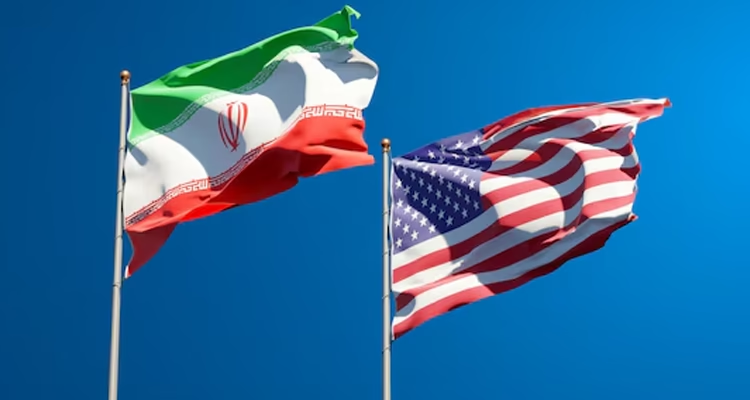
A sweeping peace framework attributed to US President Donald Trump has brought the Iran crisis back into sharp global focus. The proposed 15-point plan, aimed at ending hostilities and curbing Tehran’s nuclear ambitions, goes far beyond earlier agreements—placing nuclear rollback, regional restrictions, and crucially, the reopening of the Strait of Hormuz at its centre.
However, the proposal has been firmly rejected by Iran, exposing deep divisions not only over nuclear policy but also over sovereignty, security, and control of one of the world’s most vital energy routes.
What Trump’s 15-Point Plan Proposes
The plan is understood to be a comprehensive, high-pressure framework combining nuclear, military, and economic conditions. Though no officially published document exists, multiple diplomatic briefings and media reports suggest the framework broadly revolves around:
Key provisions include:
- Complete halt to uranium enrichment and rollback of advanced nuclear activities
- Permanent guarantee that Iran will never develop nuclear weapons
- Intrusive international inspections, including sensitive sites
- End to Iran’s ballistic missile programme
- Curtailment of support to regional armed groups
- Long-term monitoring beyond previous nuclear agreements
- Phased sanctions relief tied strictly to compliance
The Hormuz Clause: The Strategic Core
At the heart of the proposal lies a non-negotiable demand:
- Iran must reopen and guarantee unrestricted navigation through the Strait of Hormuz
The strait carries nearly one-fifth of global oil shipments, making it a lifeline for global energy markets. The US position is that free and secure passage must be ensured permanently, removing any threat of disruption.
Why Iran Rejects the Plan
Tehran has dismissed the proposal as one-sided and coercive, arguing it demands sweeping concessions without credible guarantees.
Iran’s key objections:
- Violation of sovereignty: Intrusive inspections and external oversight of sensitive facilities
- Loss of strategic deterrence: Ending the missile programme is seen as unacceptable
- Hormuz control is non-negotiable: Seen as a core geopolitical and economic lever
- Distrust of US commitments: Following Washington’s withdrawal from the 2015 nuclear deal
- Expansion beyond nuclear scope: Inclusion of regional influence and military posture
For Iran, the plan is viewed as an attempt to reshape its entire defence and foreign policy architecture, not just its nuclear programme.
Iran’s Stand on Nuclear Weapons
At the centre of the dispute lies a long-standing global concern: Does Iran want nuclear weapons?
Official Position: No Nuclear Weapons
Iran maintains that:
- Its nuclear programme is strictly peaceful
- It does not seek to build nuclear weapons
- It has the right to uranium enrichment under international law
Religious Doctrine
Iran also cites a religious decree by Supreme Leader Ayatollah Ali Khamenei, which:
- Prohibits the development, possession, or use of nuclear weapons
- Declares such weapons morally and religiously forbidden
Strategic Reality: Capability Without Declaration
Despite its stated position:
- Iran has developed advanced nuclear capabilities, including high-level uranium enrichment
- Experts believe it has the technical capacity to produce a nuclear weapon in a short timeframe if it chooses
This has led to the perception that Iran is pursuing a strategy of “nuclear hedging”—maintaining capability without openly weaponising.
Conditional Ambiguity
Iran has also signalled that:
- If faced with extreme threats or military pressure, it may reconsider its stance
This introduces a layer of strategic ambiguity into its nuclear doctrine.
What Iran Wants Instead
Tehran has outlined its own conditions for any agreement:
- Immediate and unconditional lifting of US sanctions
- Recognition of its right to peaceful nuclear enrichment
- No restrictions on its missile programme
- No interference in its regional alliances
- Security guarantees against future US withdrawal from any deal
- Retention of influence—and potential control—over the Strait of Hormuz
- In some positions, compensation for damages from conflict and sanctions
Iran insists any agreement must be limited to the nuclear issue, rejecting broader geopolitical conditions.
Hormuz: The Real Flashpoint
While nuclear concerns dominate headlines, the Strait of Hormuz has emerged as the central battleground in negotiations.
- For the US: Uninterrupted global energy flow is non-negotiable
- For Iran: Control over Hormuz is a strategic asset and sovereign right
The clash over this narrow waterway reflects a larger struggle over power, influence, and economic leverage in the region.
The Bottom Line
Trump’s 15-point plan represents an effort to fundamentally reshape Iran’s nuclear, military, and regional posture.
But for Tehran, accepting it would mean giving up key pillars of national security—its nuclear leverage, missile deterrence, and strategic control over Hormuz.
With both sides holding firm, the standoff underscores a deeper reality:
this is not just a nuclear dispute, but a broader contest over sovereignty, security, and global power balance.