
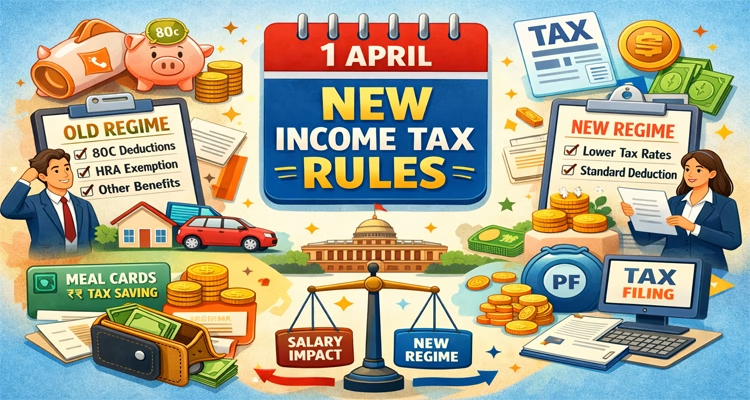
Financial Desk: Starting April 1, India’s income tax system is set for a major reset, bringing changes (new) that will directly affect your take-home salary, tax savings, and financial planning. The updated rules aim to simplify taxation, reduce complexity, and gradually shift taxpayers toward a cleaner, exemption-light system.
Here’s a clear and detailed breakdown of what really changes—and what it means for you.
🔷 New Tax Regime Now the Default Option
From the new financial year, the new tax regime becomes the default choice for all taxpayers.
This means:
- You will automatically be taxed under the new regime unless you actively choose the old one
- The new regime offers lower tax rates
- But removes most deductions and exemptions
However, the government has made the new system more attractive by allowing a standard deduction, giving salaried individuals some relief.
👉 Simple takeaway: If you don’t actively choose, your taxes will be calculated under the new system.
🔷 Impact on Your Take-Home Salary
One of the biggest changes could be seen in your monthly salary structure.
Under revised norms:
- Basic salary must be at least 50% of total CTC
- This increases contributions to Provident Fund (PF) and gratuity
👉 What this means:
- Your in-hand salary may slightly decrease
- But your long-term savings and retirement benefits will increase
🔷 Allowances and Perks: Now More Transparent
The government has tightened rules around allowances and perks to make taxation more uniform.
Key changes include:
- Some perks like company car, accommodation, club memberships, and utilities may now be taxable
- Clearer valuation rules for employer-provided benefits
- Reduced scope for tax-free perks
👉 Result: Less confusion, but fewer hidden tax-saving benefits.
🔷 HRA and Other Benefits (Old Regime Still Matters)
If you continue with the old tax regime:
- HRA (House Rent Allowance) benefits remain available
- Metro residents can claim up to 50% of salary as exemption
- Education and other allowances continue with revised limits
👉 Important: These benefits are mostly not available in the new regime.
🔷 Meal Benefits & Small Savings Still Help
Certain structured benefits can still reduce your tax burden:
- Meal vouchers/cards can provide annual tax savings
- Some employer-structured components remain partially tax-efficient
👉 These may look small but can add up significantly over time.
🔷 Simpler Tax System, Stricter Compliance
The new system focuses on ease + transparency:
- Simplified tax filing (ITR forms)
- Increased use of faceless assessments
- Better tracking of income and disclosures
👉 But at the same time:
- Stricter reporting rules mean fewer chances to hide income or misuse exemptions
🔷 Old vs New Tax Regime: What Should You Choose?
You now have two options:
New Regime
✔ Lower tax rates
✔ Simpler filing
❌ Almost no deductions
Old Regime
✔ Multiple deductions (HRA, 80C, etc.)
❌ Higher tax rates
❌ More complex
👉 Rule of thumb:
- If you invest heavily in tax-saving schemes → Old regime may benefit
- If you prefer simplicity with fewer investments → New regime is better
🔷 A Transition Phase Ahead
Even though the new rules kick in from April 1, some older provisions may continue temporarily. This means taxpayers could experience a transition phase where both systems coexist in practice.
🔷 What Should You Do Now?
This is not just a routine tax update—it’s a structural shift in how income is taxed in India.
✔ Review your salary structure
✔ Compare both tax regimes carefully
✔ Plan investments accordingly
From April 1, your salary slip may look different, your tax calculation will change, and your financial planning will need a fresh strategy.
For taxpayers, this isn’t just a new financial year—it’s a new tax mindset.