No Moon Landing, Still Historic: NASA’s Artemis II to Orbit the Moon
Beyond Apollo: NASA’s Artemis II Mission to Push Humans 402,000 KM into Deep Space
In a major leap toward humanity’s return to deep space, NASA has approved the launch of its first crewed Artemis mission—Artemis II—for April 1, setting the stage for a 10-day journey around the Moon without landing. The mission marks the first time astronauts will travel beyond low-Earth orbit since the Apollo 17 mission in 1972.
Crew of Artemis II: Four Astronauts Leading the Mission
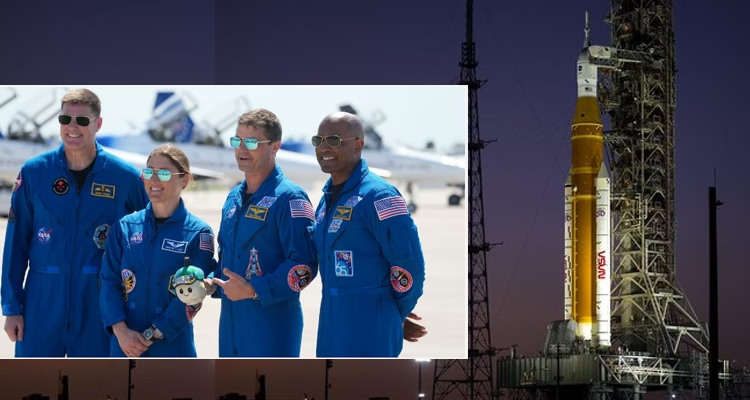
The Artemis II mission will be carried out by a four-member crew selected by NASA in 2023. The team includes commander Reid Wiseman, pilot Victor Glover, and mission specialist Christina Koch.
They will be joined by Jeremy Hansen, a mission specialist from the Canadian Space Agency, underlining the global collaboration behind the Artemis programme. The crew has undergone extensive training for what will be humanity’s first crewed deep-space mission in over five decades.
Action. Wonder. Adventure. Artemis II has got it all. Don’t miss the moment. Our crewed Moon mission will launch as early as April 1.
Learn how to watch: https://t.co/fAg0bGAqEc pic.twitter.com/2uhg8EhwTv
— NASA (@NASA) March 30, 2026
Powered by the Most Powerful Rocket Ever Built
The crew will be launched aboard the Orion spacecraft atop the 322-feet-tall Space Launch System (SLS) rocket—the most powerful ever developed—built by Boeing and Northrop Grumman.
After liftoff, the spacecraft will execute a gravity-assisted slingshot maneuver around the Moon, a trajectory previously demonstrated during the Artemis I mission and by the Apollo 13 mission crew.
Orion: Advanced Deep-Space Capsule
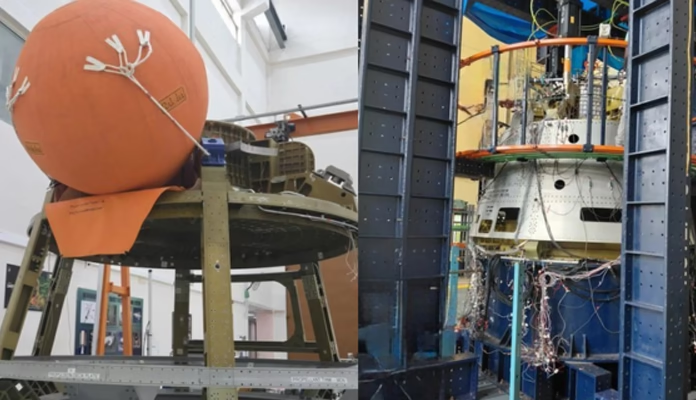
The Orion capsule, developed by Lockheed Martin, will be fully pressurised and equipped with potable water, oxygen, and nitrogen storage systems to sustain the crew.
While Artemis I validated the rocket and uncrewed capsule, Artemis II will test both the SLS rocket and Orion’s life-support systems under crewed conditions, along with its performance in deep space—laying the groundwork for the Artemis III mission, which aims to land humans on the Moon.
What Happens During the 10-Day Mission
Around three and a half hours after launch, pilot Victor Glover will take control of the spacecraft to test Orion’s manual thrusters, manoeuvrability, and alignment systems.
The crew will then travel toward the Moon’s far side, reaching nearly 402,000 kilometres from Earth, surpassing the record set by Apollo 13 astronauts. During this phase, communication blackouts of up to 50 minutes are expected.
Astronauts will:
- Test life support, propulsion, power, and navigation systems
- Record and monitor their own medical data
- Capture and transmit deep-space imagery to Earth
These operations will generate crucial data for upcoming missions, including Artemis III mission and Artemis IV mission.
Slingshot Return and High-Speed Re-Entry
After looping around the Moon’s far side, Orion will use lunar gravity to propel itself back toward Earth without requiring a major engine burn.
NASA estimates a re-entry speed of around 40,200 km/h, potentially surpassing the record held by the Apollo 10 mission.
As the spacecraft re-enters Earth’s atmosphere, its heat shield will endure extreme temperatures before parachutes deploy, guiding the capsule to a splashdown in the Pacific Ocean near California. Five orange airbags will stabilise and upright the capsule, enabling safe crew exit before recovery teams retrieve them.
A Defining Step Toward the Moon—and Beyond
Artemis II is more than a mission—it is a critical systems test for human deep-space exploration. Its success will directly shape NASA’s long-term vision of establishing a sustainable lunar presence and eventually sending humans to Mars.
Though astronauts won’t land on the Moon this time, Artemis II marks a historic return to deep space—proving humanity is once again ready to push the boundaries of exploration.
What is a “Lunar Flyby”?
A lunar flyby is a spaceflight technique in which a spacecraft does not land on the Moon but instead travels around it, using the Moon’s gravity to change direction or gain momentum before heading back toward Earth or deeper into space.
In this process:
- The spacecraft passes close to the Moon
- It may loop around it or follow a curved trajectory
- It uses the Moon’s gravitational pull like a “slingshot” to redirect its path
This method helps save fuel and increase mission efficiency, making it especially useful for deep-space missions.
In simple terms:
A lunar flyby is like a vehicle taking a sharp turn around a roundabout without stopping—except in space, the turn is powered by the Moon’s gravity.