 Dr. Vinod Chandrashekhar Dixit
The sight of children lugging heavy school bags has become increasingly common in India, raising serious concerns about their health and well-being. The burden of textbooks, notebooks, and other study materials is taking a toll on young students, leading to fatigue, back pain, and stress. It is time to rethink the education system and explore practical ways to lighten this load.
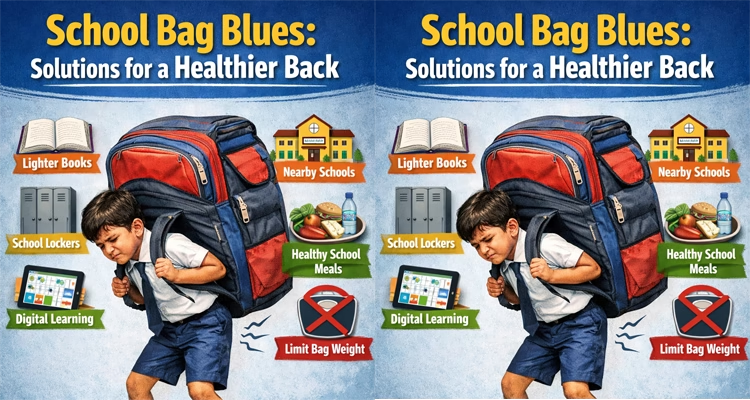
The issue of heavy school bags is pressing and demands immediate attention. One effective solution could be to divide textbooks into smaller, chapter-wise sections. Schools with adequate financial resources may also provide locker facilities, as is common in many Western countries. Although several methods to reduce school bag weight exist, implementation remains weak.
While splitting textbooks and notebooks is a positive step, schools must ensure that students are not required to carry all sections at once. Strict regulations should be enforced to limit the weight of school bags to less than one kilogram. Additionally, schools could provide snacks and meals, with costs recovered from parents, thereby reducing the need for children to carry extra items.
Most schools have eight to nine periods in a day, which allows for better distribution of books across the timetable. A portion of homework should be completed in class, and children up to Class IV should ideally not be assigned homework. Their textbooks can be safely stored in school.
It would also be beneficial to admit students living within a 5 km radius of the school to reduce travel time and physical strain. Homework assignments and textbooks could be sent home primarily over weekends for parental review. Schools may adopt a system where a single notebook per subject is used for an entire term, while heavier books and files remain in the classroom.
Items such as craft kits, drawing materials, and bulky pencil boxes need not be carried daily. School authorities should establish clear guidelines based on the daily timetable, specifying which books and materials students need to bring.
For language subjects, both textbooks and notebooks may be required. However, for core subjects such as mathematics, general science, and social science, carrying only notebooks should suffice, with textbooks kept at home.
The current education system remains overly goal-oriented, focusing more on examinations than on meaningful learning. Continuous assessment through daily observation by teachers could serve as a more effective basis for student promotion. It is crucial to prioritize students’ health alongside academic achievement.
The State Human Rights Commission’s recommendation to reduce the burden of school bags is a welcome step. Measures such as term-wise textbooks and desks with lockers can significantly ease the load. Many schools abroad follow such systems, making learning more comfortable and enjoyable for students.
If schools ensure that textbooks and notebooks remain in classrooms, children can focus on learning during school hours and carry home only essential workbooks. Concluding classes by 2:30 p.m. would give students ample time to rest, complete homework, and engage in extracurricular activities.
By adopting simple yet effective strategies—such as smart packing and the use of digital resources—we can significantly reduce the burden of school bags. This will not only improve children’s physical health but also enhance their productivity and overall learning experience.
It is time to act collectively and build a healthier, more balanced education system for our children.