Maguni Charan Behera
Former Professor of Tribal Studies
Chief Editor, Sampratyaya
(sampratyaya.ije@gmail.com)
Former Professor Maguni Charan Behera explores the deeper civilizational, cultural, and ethical significance of “Jai Shri Ram,” arguing that the expression transcends electoral politics and reflects India’s enduring cultural continuity and collective memory.
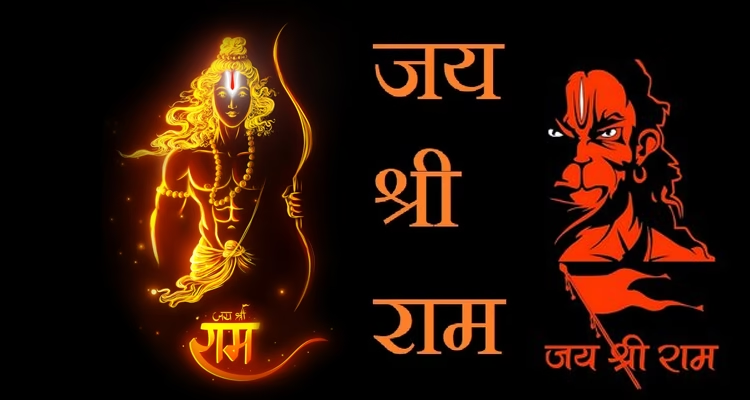
Jai Jagannath. I do not ordinarily say “Jai Shri Ram” in daily life, yet whenever I utter it, I experience the same sublime feeling that arises when I say “Jai Jagannath.” The emotional and cultural resonance of these expressions cannot be confined merely to the domain of ritual religion. They belong to a much larger civilizational consciousness that has evolved over thousands of years in Bharat.
In recent political discourse, particularly during the Bengal elections, the slogan “Jai Shri Ram” became a matter of controversy. Saayoni Ghosh appeared reluctant to use the phrase directly and instead chose to say “Jai Siya Ram.” Certainly, “Jai Siya Ram” carries a beautiful and meaningful invocation, acknowledging both Rama and Sita together and emphasizing balance and gender sensitivity. However, does the use of “Jai Siya Ram” require the rejection of “Jai Shri Ram”? The two are not contradictory. One need not discard the other.
The political rejection of “Jai Shri Ram” creates a deeper concern because it risks reducing a civilizational expression into the possession of a political party. Once such a phrase is confined within political boundaries, its wider cultural and historical significance becomes diminished. Saayoni Ghosh argued that her political party did not need to use “Jai Shri Ram” for electoral gain because it carried a religious tone. Yet she publicly sang lines referring to “Kaaba in the heart and Madina in the eyes.” Is that not also religious in tone? She also recited the Hanuman Chalisa. Therefore, the issue is not simply religion. The deeper issue concerns selective acceptance and selective rejection.
This raises an important question: Is “Jai Shri Ram” merely a religious slogan comparable to invocations associated exclusively with one faith tradition, or does it possess a wider civilizational significance similar to “Vande Mataram”? “Jai Shri Ram” is not merely a cry of worship. It carries within it memories, ethics, values, literature, collective psychology, social discipline, and historical continuity. It reflects a cultural ethos that has shaped India’s civilizational journey across centuries.
India is among the world’s oldest living civilizations. Unlike many ancient civilizations that disappeared or survived only in fragments, Indian civilization has retained continuity. Its traditions evolved, adapted, absorbed influences, and transformed themselves while preserving a recognizable core. Within this continuity, Rama occupies an enduring place. The Ramayana is not merely a religious scripture; it is a civilizational text influencing language, poetry, music, theatre, ethics, village traditions, festivals, family values, and ideas of governance. Its influence extends far beyond India into many parts of Southeast Asia.
During my childhood, nearly sixty-five years ago, I observed people counting numbers beginning with the utterance “Ram” before proceeding to two, three, and beyond. There was no political movement attached to Rama then, nor was there any political appropriation of the name. Ordinary people uttered the name naturally in daily life. Similarly, the phrase “Ram Naam Satya Hai” is traditionally spoken while carrying a deceased person to the cremation ground. It is not a political slogan. It is a civilizational expression reminding society of truth, mortality, humility, and the eternal journey of life.
I also remember people greeting one another with “Jai Shri Ram” in villages and towns without hostility or aggression. The invocation represented familiarity, cultural warmth, and shared belonging. Mahatma Gandhi’s last words are believed to have been “Hey Ram.” Gandhi envisioned “Ram Rajya” not as a theological state but as a moral society founded upon justice, dignity, truth, compassion, and ethical governance. Rama, for Gandhi, symbolized moral order rather than sectarian domination.
Some argue that “Jai Shri Ram” has become a war cry similar to slogans such as “Har Har Mahadev,” “Jai Bajrangbali,” “Bole So Nihal,” “Sat Sri Akal,” “Waheguru Ji Ka Khalsa, Waheguru Ji Ki Fateh,” or “Durga Mata Ki Jai.” Certainly, such slogans have often inspired courage, unity, and motivation. Chhatrapati Shivaji Maharaj’s forces used “Har Har Mahadev” as a cry of valor. Yet hearing such invocations does not make me feel alienated. Rather, they evoke a sense of belonging because they arise from the civilizational landscape of Bharat. These expressions carry spiritual force, but they also strengthen social confidence, collective identity, and emotional resilience.
Long before the emergence of present-day India, many communities, tribes, cultures, and traditions inhabited this land. Over centuries, these streams interacted and contributed to the formation of civilizational Bharat. Some traditions remained central, while others occupied peripheral spaces, but together they participated in a vast and evolving cultural universe. Shri Ram became one of the strongest unifying elements within this civilizational framework. To disregard or deliberately discard Rama is not merely to reject a religious figure; it risks weakening a foundational cultural memory that has contributed to social continuity.
Saayoni Ghosh herself is, in many ways, a manifestation of this civilization. Her sari, bindi, language, metaphors, gestures, and cultural expressions emerge from the civilizational matrix of Bengal and Bharat. She was born within a social and cultural context shaped by this civilization, and her artistic talent reflects its richness. No individual exists outside civilization. Civilization shapes language, emotions, aesthetics, symbols, humour, music, and imagination.
At the same time, Indian civilization repeatedly warns against excessive ego, alienation from society, and the abandonment of ethical restraint. The epics of India are not merely stories; they are psychological and moral explorations of civilization itself. Ravana was immensely learned and powerful, yet his arrogance and inability to respect moral limits led to his downfall. Duryodhana possessed royal authority and military strength, yet ego, envy, and disregard for dharma destroyed him. Similar patterns appear across world history. Cleopatra’s brilliance could not ultimately prevent political ruin. Napoleon Bonaparte’s ambition transformed Europe but eventually consumed him. Adolf Hitler mobilized mass psychology but led Germany into catastrophe. These examples demonstrate that intelligence and talent without ethical restraint often culminate in destruction.
Why, then, does “Jai Shri Ram” receive particular attention instead of invocations such as “Jai Shri Krishna”? Certainly, expressions like “Radhe Krishna,” “Radhe Radhe,” “Hare Krishna,” and “Jai Shri Krishna” remain deeply respected and spiritually meaningful. Yet “Jai Shri Ram” occupies a distinctive position in India’s public imagination because Rama symbolizes order, duty, sacrifice, discipline, kingship, responsibility, and social harmony. Krishna often represents divine playfulness, wisdom, and transcendental philosophy, while Rama represents ethical steadiness and civilizational order. Therefore, “Jai Shri Ram” resonates not only in religious contexts but also in social, intellectual, psychological, and cultural domains.
The story of Shabnam Shaikh, a devout Muslim woman who travelled from Mumbai to Ayodhya while chanting “Jai Shri Ram,” illustrates this distinction clearly. She did not abandon Islam, nor did she convert to Hinduism. Her participation reflected cultural openness and civilizational understanding rather than religious insecurity. Across India, Muslim singers have performed bhajans, Hindu musicians have sung Sufi compositions, and people from different communities have emotionally connected with one another’s traditions. Such experiences demonstrate that human feeling can transcend rigid religious boundaries.
The challenge arises when civilizational normalcy is interpreted exclusively through the lens of political hostility. Those who reject every inherited cultural expression in the name of ideological opposition often create unnecessary fragmentation within society. Respect for civilization does not require blind conformity, nor does disagreement require contempt. One may criticize political misuse of symbols without rejecting the civilization from which those symbols emerge.
There are many women leaders in India who, despite ideological differences, generally remain connected to India’s civilizational ethos. Leaders such as Sushma Swaraj, Nirmala Sitharaman, Smriti Irani, Sumitra Mahajan, Sheila Dikshit, Vasundhara Raje, and even President Droupadi Murmu often expressed public life within the broad framework of Indian cultural continuity. Their political positions differed widely, yet they did not appear detached from the civilizational foundations of Bharat.
Civilizational disconnection frequently strengthens excessive individualism, vanity, narcissism, self-glorification, and social fragmentation. History repeatedly demonstrates that societies weaken when individual ego dominates collective responsibility. Egoistic personalities may achieve temporary popularity because sections of society project their aspirations onto them. Such figures may appear successful for some time, particularly when they satisfy immediate emotional or material desires. However, civilizations survive not through temporary excitement but through ethical continuity and collective discipline.
Is Saayoni Ghosh completely detached from civilizational ethos? Perhaps not. She says “Jai Bangla” and “Jai Ma Kali.” Muslims often use expressions such as “Insha Allah,” reflecting their own civilizational and religious heritage. Communities across the world preserve such expressions naturally. Why, then, should “Jai Shri Ram” become uniquely problematic?
Bengal itself cannot be separated from the wider civilizational fabric of Bharat. The Bengal Renaissance, the poetry of Rabindranath Tagore, the spiritual universalism of Ramakrishna Paramahamsa, the nationalism of Subhas Chandra Bose, the devotional ecstasy of Chaitanya Mahaprabhu, and the songs of Kazi Nazrul Islam all emerged from the broader stream of Indian civilization. Bengal has never stood outside Bharatiyata; rather, it has enriched and refined it.
One may choose not to use “Jai Shri Ram” for political reasons, and democratic freedom certainly permits such choice. Yet civilizational expressions cannot be understood only through the narrow lens of electoral politics. Human life extends beyond elections, parties, and ideological rivalries. There are homes, festivals, temples, literature, theatre, songs, village traditions, Ram Navami processions, Hanuman Jayanti celebrations, Durga Puja gatherings, and countless moments of cultural continuity where such expressions arise naturally and without political calculation.
Civilizational Bengal and civilizational Bharat are not antithetical. Bengal is one of the finest cultural expressions of Bharat itself. Its language, music, philosophy, spirituality, and emotional depth have contributed immensely to the civilizational identity of India. Therefore, rejecting a civilizational expression merely because it has acquired political association risks creating an artificial separation between Bengal and Bharat, between regional pride and civilizational continuity.
A civilization survives not only through institutions and laws but through inherited expressions, shared memories, ethical narratives, and emotional bonds. “Jai Shri Ram” belongs to that larger continuity. One may interpret it differently, use it differently, or even avoid it personally, but reducing it solely to a partisan slogan diminishes its wider cultural and historical significance.
As we know, in ancient civilizational consciousness, nature — trees, rivers, mountains, forests, animals, and even the earth itself — was not perceived merely as an object or a resource. Nature was experienced through reverence and participation, as part of a larger community of being in which human life was interconnected with all existence. Rivers were regarded as mothers, mountains as sacred presences, trees as living companions, and the earth itself as divine.
This mode of perception was fundamentally different from the modern tendency to objectify nature. Once nature became merely an object of consumption and utility, it acquired a separate existence outside human moral concern. Human beings no longer saw themselves as participants within nature but as masters over it. The result was exploitation, ecological destruction, and spiritual emptiness. Human progress increasingly came to mean thriving at the cost of nature rather than in harmony with it.
A similar transformation is taking place within society and civilization itself. Advertisements, market culture, consumerism, and excessive material competition have gradually pushed humanity toward what may be called a “civilization of objects.” In such a civilization, success is measured by possession, visibility, consumption, and individual assertion rather than inner fulfilment, social responsibility, or ethical restraint. Relationships become transactional, culture becomes performative, and identity becomes detached from deeper civilizational roots.
Indian civilization repeatedly warned against such excessive attachment to objects and material attraction. It emphasized that outer prosperity without inner discipline ultimately produces imbalance and suffering. The attraction toward wealth, fame, ego, and sensory gratification was never denied, but it was expected to remain under ethical and spiritual restraint.
In this context, Saayoni Ghosh appears, symbolically at least, to represent aspects of this object-centred civilization. The emphasis shifts from civilizational continuity toward individual assertion; from shared cultural belonging toward personal ideological positioning; from social harmony toward self-projection. Such a civilization flourishes on individualism that often places the individual in opposition to society itself, even though society remains the very foundation upon which individual growth becomes possible. This contradiction lies at the heart of modern cultural fragmentation.
Saayoni Ghosh undoubtedly possesses talent, intelligence, artistic expression, and public appeal. Yet talent detached from civilizational restraint can become self-objectifying. Indian epics repeatedly warn against this condition. Ravana was extraordinarily learned, a master of the Vedas, music, politics, and warfare, yet his ego transformed knowledge into destructive ambition. Duryodhana possessed courage and authority, yet envy and arrogance blinded him to ethical limits. Similarly, figures such as Macbeth in Shakespearean tragedy, Napoleon in European history, and Hitler in modern politics demonstrate how brilliance combined with unchecked ego can eventually turn ruinous.
Object worship — whether in the form of power, fame, political identity, consumerism, or self-glorification — ultimately weakens civilization because it disconnects individuals from moral continuity and collective responsibility. A civilization cannot survive merely on competition, provocation, and individual assertion. It survives through sustaining values, emotional bonds, ethical memory, and cultural continuity.
Expressions such as “Jai Shri Ram” symbolically stand against this excessive objectification of life. They invoke not merely religion but restraint, duty, sacrifice, dignity, social harmony, and civilizational continuity. Such civilizational invocations nourish society emotionally and morally because they connect individuals to something larger than themselves. They remind society that human fulfilment lies not merely in material assertion or ideological display, but in participation within an enduring ethical and cultural order.
Therefore, the conflict is not simply between one slogan and another, nor between religion and secularism. At a deeper level, it is a conflict between a civilization rooted in continuity, ethical restraint, and shared cultural memory, and a civilization increasingly driven by objectification, consumerism, ego, and fragmented individualism. In this symbolic sense, Saayoni Ghosh appears to represent the latter tendency.