“An in-depth analysis of secularism, religious conversion,
and constitutional freedom in India, examining Article 25, anti-conversion laws,
missionary activities, vulnerable communities, faith healing, social justice, and
ethical concerns surrounding coercion, manipulation, and religious liberty.”
Dr. Maguni Charan Behera
Retd. Professor of Tribal Studies
Chief Editor: Sampratyaya (sampratyaya.com)

Religious conversion has remained one of the most debated and emotionally charged subjects in India. It is often viewed as contradictory to the Indian ethos of coexistence rather than conversion. Recent newspaper reports, including allegations of attempted religious conversion activities in a hotel in Bhubaneswar, have once again brought the issue into public discussion. Some groups argue that vulnerable communities such as Scheduled Castes (SCs), Scheduled Tribes (STs), economically distressed people, widows, patients, and socially marginalised individuals are often targeted by missionaries and conversion networks. Others maintain that many such allegations are exaggerated, politically motivated, or unsupported by evidence, and that individuals possess a constitutional right to freely choose and practise any religion.
The issue, therefore, cannot be understood merely through emotion or political slogans. It requires balanced scrutiny of history, constitutional law, social inequality, ethics, religion, and human psychology. Any serious discussion must also avoid hatred or prejudice against entire communities. Not all Christians engage in missionary activities, and not every allegation of conversion is true. At the same time, genuine concerns regarding coercion, inducement, deception, or exploitation of vulnerable individuals cannot be ignored. All these dimensions deserve careful attention.
This article examines these difficult questions objectively and rationally while respecting the constitutional values of India.
Conversion Concerns
Reports from Odisha and other states have intensified debate over alleged religious conversion activities. In May 2026, Odisha Police reportedly raided a hotel in Bhubaneswar after receiving allegations that religious conversion activities were being conducted there. The incident led to protests and public tension, although investigations were still ongoing at the time of reporting. One person was reportedly arrested in connection with the matter.
Similarly, there have been cases in Rajasthan, Uttar Pradesh, Gujarat, and other states where individuals were arrested under anti-conversion laws for allegedly offering inducements such as money, education, gifts, or promises of healing and employment. Arunachal Pradesh, a strategically important border state, has also witnessed growing concerns regarding religious conversion, particularly in interior regions and among youths.
At the same time, there have also been documented incidents where Christians or pastors were attacked merely on suspicion of conversion without proper proof. In Odisha’s Dhenkanal district, for example, a pastor was allegedly assaulted and publicly humiliated by a mob over accusations of forced conversion.
These incidents reveal two important realities:
- Concerns regarding unethical conversion practices are genuine and remain part of public discourse.
- False accusations, mob violence, and the spread of communal hatred are equally dangerous and unconstitutional.
Therefore, the issue must be approached through law, evidence, ethics, and constitutional principles, rather than prejudice or collective blame.
Why Vulnerable Communities Become Targets
One of the most frequently raised questions is why conversion efforts often focus on socially vulnerable groups such as SCs, STs, economically distressed families, isolated tribal communities, patients, or people facing emotional crises.
The answer lies partly in sociology and human psychology.
People who experience social humiliation, poverty, caste discrimination, neglect, illiteracy, addiction, domestic violence, or lack of institutional support are naturally more vulnerable to external influence. A person who feels socially alienated may become emotionally receptive to any group offering dignity, emotional support, financial assistance, education, healthcare, or a sense of community identity.
Historically, missionaries in many parts of India worked among tribal populations, Dalits, leprosy patients, and poor rural communities because these groups often lacked access to schools, hospitals, and social support. In some places, missionaries genuinely provided education and healthcare. In other cases, critics allege that humanitarian aid became linked with religious persuasion, and that those receiving assistance eventually embraced Christianity.
This distinction is extremely important.
Serving poor people is not wrong. However, if service is made conditional upon conversion, or if emotional pressure, fear, miracle claims, or inducements are used, ethical and constitutional concerns arise. No humanitarian religion permits deceitful means to convert people. Those who engage in such practices undermine the very religion they claim to represent.
Many critics argue that vulnerable individuals may not always possess the educational background or religious understanding necessary to make a fully informed spiritual choice. A starving or distressed person can often be psychologically influenced more easily than a secure and educated individual.
At the same time, supporters of missionary work argue that many oppressed communities voluntarily converted because they experienced humiliation and exclusion within existing social structures. Thus, debates surrounding conversion cannot be separated from India’s social inequalities.
Are Converts Socially Privileged?
Another common misconception is that all Christians are wealthy, educated, or socially privileged. This is factually incorrect.
India has millions of poor Christians, including Dalit Christians, tribal Christians, fishermen, agricultural workers, sanitation workers, and daily wage labourers. Many Christians in rural India face economic hardships similar to members of other communities.
Globally as well, Christianity exists across all economic classes. Latin America, Africa, and parts of Asia contain large Christian populations living in poverty. A clear distinction must therefore be maintained between:
- Individual believers
- Organised missionary strategies
- Unethical conversion practices
- Constitutional religious freedom
Faith Healing: Does Medical Science Approve It?
Faith healing raises an important question: is it not similar to practices often criticised in other religions? Some preachers claim miraculous healing through prayer, divine intervention, or religious faith. Many faith healers have reportedly obtained training and religious degrees from churches abroad. Critics ask: if divine healing alone is sufficient, why do Christian-majority countries maintain hospitals, medical research institutions, and health insurance systems? Why are traditional healing practices among tribal communities often dismissed as superstition, while faith healing in missionary settings receives social legitimacy?
Words can be powerful enough to influence, persuade, and even mesmerise people.
Returning to the central issue: can faith healing replace modern medicine? In countries with strong Christian traditions, modern healthcare systems remain essential because diseases require scientific treatment. Faith may provide emotional strength, psychological comfort, hope, and community support, but it cannot replace medical science.
Historically, many hospitals around the world were founded by Christian institutions. However, those institutions themselves depend upon doctors, scientific research, medicines, surgery, and technology rather than prayer alone.
Therefore, exaggerated miracle claims should be viewed critically. When desperate patients are told that prayer alone will cure serious illness, ethical concerns naturally arise. If religious persuasion exploits fear, illness, grief, or emotional vulnerability, the line between spiritual comfort and psychological manipulation becomes blurred.
At the same time, one must recognise that spiritual belief exists in almost all religions. Hindus, Muslims, Sikhs, Buddhists, and Christians all possess traditions of prayer and faith. The constitutional issue arises not from personal belief itself, but from coercion, deception, or exploitation.
Can Any Religion Claim Superiority?
All religions, in their own ways, seek to guide human beings toward truth, inner peace, moral upliftment, spiritual fulfilment, liberation, or salvation. Christians may believe in salvation through Christ; Hindus may believe in moksha through dharma and spiritual realisation; Muslims may regard Islam as the final revelation; Buddhists may follow the Eightfold Path.
Personal belief is protected under freedom of religion.
However, problems arise when belief turns into disrespect, humiliation, or aggressive denigration of other religions. Declaring one’s faith inherently superior often implies that other religions are inferior.
In a plural civilisation like India, mutual respect is essential. No religion should regard others as uncivilised, impure, inferior, or spiritually worthless. Such attitudes undermine social harmony and violate the spirit of constitutional secularism. They may also reflect arrogance, ignorance, or hidden ideological agendas.
Conversion: Free Choice vs Manipulation
Adopting any religion through genuine personal conviction is not the central issue. The real question is: when does religious persuasion become manipulation?
A person has the right to change religion after serious reflection, spiritual conviction, or personal experience. Freedom of conscience is fundamental to human dignity. However, ethical concerns arise if conversion involves:
- Fear of divine punishment
- Fake miracle claims
- Financial inducements
- Gifts or money
- False promises
- Exploitation during illness or grief
- Misinformation about other religions
- Emotional blackmail
- Social isolation
- Pressure upon children
- Targeting people lacking adequate understanding
If conversion becomes transactional or manipulative, many view it not as spiritual freedom but as psychological exploitation. The Constitution protects freedom of conscience, not organised exploitation.

The Concern of Secret Conversion
Some missionary activities reportedly occur in private homes, prayer meetings, hostels, rented halls, or small gatherings. Critics interpret this as secrecy and argue that if religious claims are genuine, they should be presented openly through transparent dialogue rather than emotionally persuasive private settings.
However, it is important not to generalise all Christians or Christian organisations. Christianity is a highly diverse religion with numerous denominations and approaches. Some churches openly preach in public, run schools and hospitals transparently, publish literature openly, and engage in interfaith dialogue. Others may conduct small private meetings for prayer or religious instruction, which by itself is not illegal.
The real questions are:
- Was there informed consent?
- Was there pressure or manipulation?
- Was vulnerability exploited?
- Were inducements offered?
- Was another religion insulted deceptively?
- Was there concealment of intent?
If meetings are deliberately hidden to avoid scrutiny while questionable methods are used, critics view such conduct as ethically suspicious. If people voluntarily gather for prayer or discussion without coercion, the law may treat it differently.
Open religious debate is limited across many faith traditions, not only Christianity. Most religious beliefs spread through family, community, emotional experience, social service, preaching, or personal relationships rather than formal philosophical debate. Yet in a democratic and plural society like India, transparent discussion and mutual respect are healthier than aggressive or manipulative persuasion.
Thus, secrecy alone does not automatically prove wrongdoing. However, when secrecy combines with inducement, coercion, fake miracle claims, targeting distressed persons, or misinformation, legal and ethical concerns become stronger.
The concern is therefore not merely about conversion itself, but about the methods through which conversion is sometimes pursued among SCs, STs, marginalised communities, and other vulnerable groups. In such contexts, coercion, manipulation, inducement, or hidden agendas cannot simply be dismissed, even if all missionaries do not engage in such practices.
Secularism in the Indian Sense
Secularism in India differs significantly from Western secularism. In several Western countries, secularism implies strict separation between religion and the state. India adopted a different model because religion is deeply interwoven with Indian society and culture.
Indian secularism broadly means:
- Equal respect for all religions
- State neutrality among religions
- Protection of religious freedom
- Prevention of religious discrimination
The Indian Constitution guarantees:
- Freedom to profess religion
- Freedom to practise religion
- Freedom to propagate religion
However, these freedoms are not absolute.
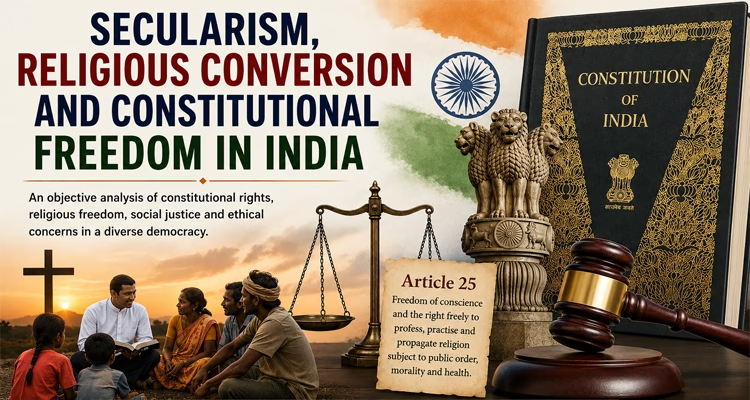
Under Article 25 of the Constitution of India:
Freedom of religion is subject to public order, morality, and health under Article 25 of the Constitution of India.\text{Freedom of religion is subject to public order, morality, and health under Article 25 of the Constitution of India.}
This means religious freedom exists, but the State may regulate or restrict practices that threaten:
- Public order: social peace, law and order, communal harmony
- Morality: practices considered unethical, exploitative, or contrary to constitutional morality
- Health: activities harmful to physical or mental well-being
Therefore:
- A person may voluntarily adopt any religion.
- Peaceful propagation of religion is constitutionally protected.
- But coercion, fraud, intimidation, manipulation, or inducement may legally be restricted.
- The Supreme Court has repeatedly held that the right to “propagate” does not include a fundamental right to forcibly convert another person.
This is why several Indian states enacted anti-conversion laws addressing conversion through force, fraud, coercion, or inducement.
At the same time, the Constitution also protects minorities from violence, discrimination, or attacks merely because of their religion.
Indian secularism therefore seeks to balance:
- Freedom of conscience
- Protection from exploitation
- Social harmony
India’s constitutional secularism is meant to protect both religious liberty and citizens from exploitation in the name of religion.

Push Factors and Pull Factors
A society that practises humiliation, exclusion, caste discrimination, untouchability, social neglect, or denial of dignity unintentionally creates conditions in which vulnerable people become psychologically open to outside influence. When people repeatedly experience disrespect, isolation, or hopelessness within their own social environment, they may become more receptive to groups offering emotional acceptance, support, identity, or dignity. In this sense, social inequality can become a “push factor” behind conversion.
At the same time, some missionary or religious groups may use “pull factors” such as:
- Emotional reassurance
- Promises of equality
- Educational or medical support
- Miracle claims
- Financial assistance
- Gifts
- Social inclusion
- Promises of future benefits
Critics argue that when these pull factors target people already suffering from poverty, loneliness, discrimination, family breakdown, addiction, illness, or social insecurity, ethical concerns become serious.
Therefore, merely condemning conversion without addressing internal social injustices cannot solve the deeper problem. A society should not create the very conditions that make vulnerable people susceptible to external influence.
If society genuinely reforms:
- Caste humiliation
- Social exclusion
- Neglect of tribal and poor communities
- Denial of dignity
- Gender injustice
- Lack of emotional support
then the attraction of external religious influence may naturally weaken.
Regarding cultural change and family structure, many people feel that rapid modernisation, weakening family bonds, consumer culture, digital influence, and changing social values have created identity confusion among younger generations. Earlier, women were often regarded as preservers of language, customs, rituals, and family traditions. Today, exposure to global culture, social media, urbanisation, and changing aspirations has transformed attitudes toward religion, marriage, authority, and identity.
However, this issue must be discussed carefully and fairly. Cultural change cannot be blamed solely on women or daughters. Social transformation affects entire families and societies across gender lines. Parents, educational systems, media, economic pressures, migration, politics, and technology all play crucial roles in shaping cultural change.
Where emotional belonging weakens within families or communities, outside ideological or religious influence can become stronger. Thus, the issue is not merely conversion itself, but also social cohesion, dignity, family stability, cultural confidence, and ethical reform within society.
A confident civilisation preserves itself not through fear or hatred toward others, but through justice, dignity, education, compassion, and meaningful belonging for its own people.
Representation vs Responsibility: Can Education Reduce External Influence?
Responsibility cannot be placed upon any one group alone. When people lack education, critical thinking skills, emotional support, economic security, healthcare access, social dignity, and constitutional awareness, they become more vulnerable to external influence—whether religious, political, ideological, commercial, or social.
Responsibility therefore exists at multiple levels:
- Society bears responsibility when caste discrimination, humiliation, untouchability, exclusion, illiteracy, poverty, addiction, and neglect of tribal and Dalit communities persist across generations.
- The State bears responsibility when quality education, healthcare, employment opportunities, legal awareness, constitutional literacy, and social protection fail to adequately reach vulnerable populations.
- Religious or ideological organisations bear responsibility if they exploit poverty, illness, grief, loneliness, emotional distress, or lack of education to promote conversion or ideological expansion.
- Families and communities bear responsibility when emotional belonging, ethical grounding, cultural confidence, and systems of mutual support weaken.
- Educational institutions bear responsibility when education becomes merely economic training rather than fostering reasoning ability, scientific temper, constitutional values, and independent thought.
- Educated individuals, including those from marginalised communities, also bear responsibility when they fail to contribute to the upliftment of their own communities.
But can education alone protect marginalised communities from exploitation through propaganda and manipulation?
Education alone cannot completely free individuals from ideological bias. Even educated people may be influenced by propaganda, political ideologies, social movements, cults, or religious narratives. Nevertheless, societies with broader access to education, rational inquiry, constitutional awareness, emotional security, and social dignity are generally better equipped to resist manipulation in all its forms.
Conclusion
Religious conversion in India remains a deeply complex issue shaped by constitutional freedoms, social realities, economic inequality, ideological conflict, political interests, and personal belief. The central constitutional and ethical concern is not whether conversion itself is inherently “good” or “bad,” but whether the decision is genuinely free, informed, voluntary, and free from coercion, deception, manipulation, or exploitation.
For this reason, long-term solutions cannot rely solely on banning, condemning, or politicising conversion. A more durable and democratic approach would instead focus on:
- Universal access to quality education
- Promotion of scientific temper and critical thinking
- Strengthening constitutional awareness and legal literacy
- Removal of caste-based humiliation and discrimination
- Economic dignity and employment opportunities
- Better healthcare access
- Stronger emotional and community support systems
- Ethical reform within society itself
A society that is educated, socially just, emotionally secure, and economically dignified is far less vulnerable to coercion, fear-based influence, ideological manipulation, or inducement from any source, whether religious or otherwise.
A democratic and secular society must protect both freedom of religion and the rights of individuals against coercion, exploitation, or discrimination. Sustainable solutions lie not in polarisation, but in strengthening education, social justice, constitutional awareness, and human dignity. An informed, equitable, and inclusive society is better equipped to uphold both individual liberty and social harmony.