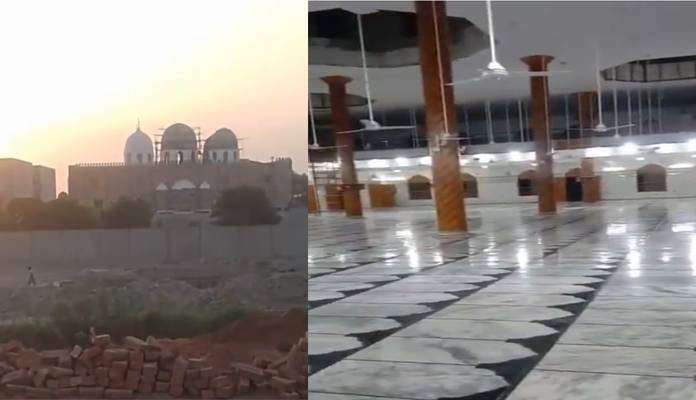
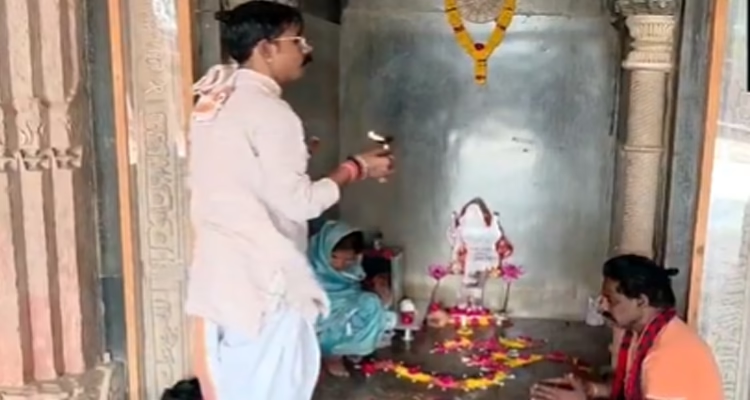
Dhar (MP): The long-running Bhojshala-Kamal Maula dispute in Madhya Pradesh took a dramatic turn on Sunday as Hindu devotees installed an idol of Goddess Saraswati inside the Bhojshala complex days after the Madhya Pradesh High Court declared the site a temple.
Members of the Bhoj Utsav Samiti, accompanied by a large gathering of devotees, performed elaborate religious rituals inside the Dhar complex before placing the idol. The ceremonies included purification with Ganga water and cow urine, while an “Akhand Jyoti” (eternal flame) was lit within the sanctum amid chants and prayers.
#WATCH | Dhar, MP | Prayers being offered to Goddess Saraswati, whose idol was consecrated at the Bhojshala complex yesterday
Bhojshala Mukti Yagna Convener Gopal Sharma says, “The High Court has directed the government that the idol (of Goddess Vagdevi) should be repatriated… pic.twitter.com/ntFB5gqIwH
— ANI (@ANI) May 18, 2026
The development comes shortly after the Madhya Pradesh High Court struck down a 2003 Archaeological Survey of India (ASI) order that had allowed Muslims to offer namaz at the site.
High Court Recognises Bhojshala as Temple
The verdict was delivered by a division bench of Justices Vijay Kumar Shukla and Alok Awasthi, which observed that historical records, archaeological evidence and literary references pointed to Bhojshala being a Saraswati temple linked to Raja Bhoj, the Paramara ruler known for transforming Dhar into a major centre of Sanskrit learning.
The court recognised the site as a protected monument as well as a place of worship dedicated to Maa Saraswati, ending years of legal and religious contest over the structure.
Major victory for Hindus in the Bhojshala case 👏🏻
The court has ruled that Bhojshala is a temple and authorized the Center to install Murti of Maa SaraswatiReclaim 🔥Reestablish🔥 pic.twitter.com/dsHVNWQIWo
— Sheetal Chopra 🇮🇳 (@SheetalPronamo) May 15, 2026
Poster Restricting Entry Sparks Controversy
Hours after the idol installation, controversy erupted after a poster was reportedly placed outside the complex stating that non-Hindus would not be allowed entry.
According to Bhoj Utsav Samiti member Gopal Sharma, only devotees wearing tilak and saffron scarves would be permitted inside, citing security and religious reasons.
The move has triggered sharp reactions from several quarters, with critics questioning the legality of restricting entry to a protected monument.
CM Mohan Yadav Welcomes Verdict
Madhya Pradesh Chief Minister Mohan Yadav welcomed the High Court ruling, calling it a “historic and emotional moment” for devotees.
In a post on X, Yadav said the judgment honoured India’s cultural heritage, faith and historical legacy. He added that the dignity of Bhojshala would be preserved under ASI supervision and devotees’ rights to worship would be protected.
The Bhojshala-Kamal Maula site has remained one of Madhya Pradesh’s most sensitive religious disputes for decades, with both Hindu and Muslim groups claiming rights over the monument. The latest developments are expected to intensify the political and legal debate surrounding the site.
Know the Bhojshala?
Located in the historic town of Dhar in Madhya Pradesh, Bhojshala has long stood at the centre of one of India’s most sensitive religious and historical disputes. Hindus believe the centuries-old structure is a temple dedicated to Goddess Saraswati and linked to legendary Paramara king Raja Bhoj, who transformed Dhar into a renowned hub of Sanskrit learning and culture in the 11th century.
Muslims, however, identify the site as the Kamal Maula Mosque, named after Sufi saint Kamaluddin Chishti. For decades, both communities have laid claim to the ASI-protected monument, turning Bhojshala into a flashpoint of faith, archaeology, politics and identity.
The court recognized Bhojshala as a Temple, ordered the installation of Mother Saraswati’s idol.
You cannot erase faith by demolishing Temples, by seizing stones..
The Sanskrit verses on the walls are screaming.Bhojshala was a temple, is a temple and will remain a temple🚩 pic.twitter.com/1Ll1kQrj1B
— Bhakt Prahlad🚩 (@RakeshKishore_l) May 15, 2026
The site had operated under a disputed arrangement for years, with Hindus and Muslims offering prayers on different days under ASI supervision. The recent Madhya Pradesh High Court verdict recognising Bhojshala as a Saraswati temple has now dramatically altered the course of the decades-old conflict, potentially reshaping the religious and political landscape surrounding the monument.