
Dr. Maguni Charan Behera
Retired Professor of Tribal Studies
Chief Editor: Sampratyaya (www.sampratyaya.com)

In contemporary society, almost everybody speaks about privacy. Governments discuss privacy laws, courts recognize privacy as a fundamental right, technology companies promise protection of personal data, and citizens increasingly demand personal freedom and confidential space. Privacy has become one of the most frequently used concepts in political, legal, social, and technological discussions. In many ways, it appears to have become a modern fashion or a popular social slogan. Yet behind this widespread use lies a serious philosophical and social question: What exactly is privacy, and what role does it play in the growth of society?
Privacy is not merely a legal concept. It is deeply connected with culture, morality, human relationships, technology, and the development of civilization. Important questions therefore arise: Did people have privacy before it became a constitutional right? How is modern privacy different from earlier forms of privacy? Is privacy rooted in individualism? Does it distance people from society? Has modern privacy encouraged negative thinking and excessive dependence on mobile phones?
The present discussion seeks to examine the meaning and significance of privacy in modern society. It explores whether privacy contributes to the growth of society or weakens social cohesion, whether it protects human dignity or promotes excessive individualism, and whether the modern obsession with privacy reflects a genuine human need or merely a fashionable trend of contemporary civilization.
Privacy in the Past
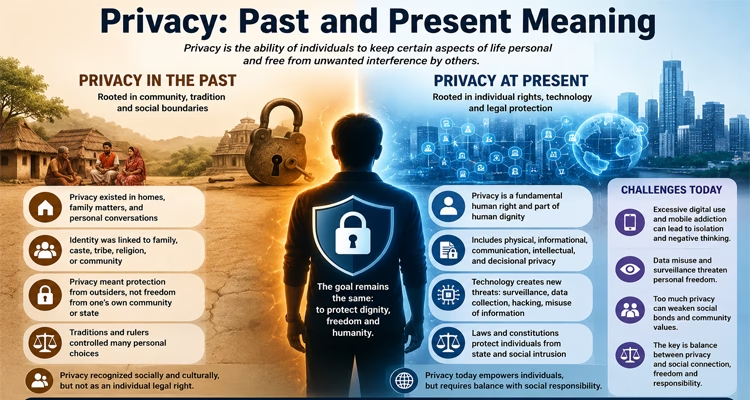
Privacy existed long before modern laws and constitutions recognized it as a legal right. Human beings have always desired some personal space, secrecy, and autonomy to make their own choices and live without unnecessary interference. People wanted privacy in their homes, personal conversations, family matters, emotions, and religious beliefs. Even in ancient societies, families did not want outsiders interfering in their internal affairs. Villages respected certain social boundaries, and religious traditions recognized the importance of personal dignity. In this sense, privacy may be defined as the ability of a person or group to keep certain aspects of life personal and free from unwanted interference by others.
However, earlier forms of privacy were very different from modern ideas of privacy. Traditional societies focused more on collective identity than on individual freedom. A person’s identity was closely linked to family, caste, tribe, religion, or community. Identity refers to the way a person is recognized and understood in society through social relationships, beliefs, and roles. Identity and privacy are related, but they are not the same. Identity explains “who a person is,” while privacy concerns “what aspects of a person’s life one wishes to keep personal.” For example, a person may identify with a particular religion or community but still desire privacy regarding personal relationships or opinions. Privacy therefore cannot be understood separately from identity because people seek privacy partly to protect personal aspects of who they are.
Community life strongly shaped everyday existence in earlier societies. In villages, people knew one another closely, joint families shared living spaces, and social customs regulated many personal choices such as marriage, occupation, and behaviour. Consequently, individuals often had limited personal independence.
In ancient and medieval societies, privacy mainly meant protection from outsiders rather than freedom from one’s own family or community. One family, for example, might keep financial matters or disputes hidden from another family, but individual members within that family could still be controlled by parents or elders. Similarly, kings and rulers often interfered in people’s lives through taxation, punishment, or restrictions on movement, while religious authorities regulated behaviour through moral and social norms.
Women in many societies had little privacy in matters such as education, marriage, or lifestyle because these decisions were generally made by families or communities. They could not freely make personal decisions in these areas because social authority rested largely with collective institutions. In this context, privacy may also be understood as autonomy in decision-making. Thus, earlier societies recognized privacy socially and culturally, but not as an individual legal right against society or the state.
Privacy: Nature and Meaning in the Present
Modern privacy developed mainly through the rise of democracy, liberalism, industrialization, urbanization, and modern legal systems. Several historical developments transformed the meaning of privacy.
Democratic thought emphasized individual dignity and liberty. Philosophers such as John Locke, Jean‑Jacques Rousseau, and John Stuart Mill argued that individuals possess rights that should not be violated by rulers or society. Freedom of thought, conscience, expression, and personal life gradually became central political values.
Industrialization and urbanization weakened traditional community structures. People migrated to cities, lived among strangers, and increasingly valued personal independence. Nuclear families replaced many joint family systems, while economic mobility enabled individuals to shape their own lives more freely.
At the same time, modern states became increasingly powerful through bureaucracy, policing, taxation, and surveillance. Citizens therefore demanded protection from excessive state intrusion. Privacy became closely associated with civil liberties and democratic rights.
Technological developments such as photography, newspapers, telephones, and later the internet created new threats to personal life. Information could spread rapidly and intrude into personal spaces. Legal systems responded by recognizing privacy as an essential component of human dignity and liberty.
Modern privacy now includes bodily autonomy, informational control, confidential communication, and the freedom to make personal decisions without unnecessary interference. Unlike earlier forms of privacy, modern privacy focuses primarily on the rights of the individual rather than merely the customs of the community.
Does Privacy Mean Individualism?
Modern privacy is closely associated with individualism. Individualism emphasizes that individuals possess personal freedom, moral worth, and autonomy independent of society. Modern privacy reflects this belief by protecting personal decisions, emotions, beliefs, and lifestyles.
Privacy, understood in this sense, is the freedom and ability of an individual to control personal life, personal information, thoughts, choices, and relationships without unnecessary interference from others, society, or the state. These ideas assume that individuals should possess a sphere of life free from unnecessary control.
However, privacy should not be confused with selfishness or complete separation from society. Human beings are inherently social creatures, and privacy exists within social relationships. In many situations, privacy actually strengthens social life. Confidential conversations build trust between friends, privacy within families protects emotional bonds, medical privacy encourages honest treatment, and intellectual privacy promotes creativity and independent thinking.
Thus, privacy is not necessarily anti-social. Rather, it creates healthy boundaries that make social relationships more respectful and humane.
Privacy vs. Individualism
A major confusion in contemporary discussions concerns the difference between healthy privacy and extreme individualism.
Healthy privacy involves respecting personal boundaries, protecting dignity, preserving emotional safety, encouraging independent thought, and preventing unnecessary intrusion. It allows individuals to develop psychologically and emotionally while remaining connected to society.
Excessive individualism, however, involves ignoring social responsibilities, rejecting community values entirely, prioritizing personal pleasure above collective welfare, and avoiding meaningful human relationships.
Privacy itself does not automatically create extreme individualism. Problems arise when privacy becomes disconnected from ethics and responsibility. A student studying alone, a patient keeping medical information confidential, or a writer reflecting privately before expressing ideas publicly are not anti-social acts. However, when individuals use privacy to avoid all social obligations or pursue only personal gratification, privacy becomes distorted.
Privacy is therefore morally neutral. Its social value depends upon how individuals use it.
The Scope of Privacy
Modern privacy includes several important dimensions.
Physical Privacy
Physical privacy refers to protection of the body and personal space. It includes protection against physical intrusion, forced searches, and violations of bodily autonomy. Entering someone’s home without permission is an example of violating physical privacy.
Informational Privacy
Informational privacy concerns control over personal data. In the digital age, this dimension has become especially significant. It includes financial information, medical records, online activity, social media behaviour, personal photographs, and location tracking. Technology companies and governments now collect vast amounts of user information, making informational privacy central to contemporary legal and political debates.
Communication Privacy
People expect certain forms of communication to remain confidential. Letters, phone calls, emails, personal discussions, and digital messages all fall within communication privacy. Without confidentiality, trust in human relationships becomes difficult.
Intellectual Privacy
Intellectual privacy protects the freedom to think, read, learn, and explore ideas without constant observation. Creativity, scientific progress, democracy, and philosophical inquiry all depend upon intellectual freedom.
Decisional Privacy
Modern privacy also includes personal decision-making in matters such as marriage, family life, religion, education, and medical treatment. This aspect remains controversial because societies differ regarding how much personal freedom individuals should possess.
Privacy, Social Disconnection, and Negative Thinking
Critics often argue that modern privacy weakens families, communities, and collective values. They observe that many people today spend less time with family, avoid community participation, prefer virtual relationships, and focus excessively on personal freedom. Urban life, digital technology, and consumer culture have increased social fragmentation, causing many individuals to live more privately and independently than earlier generations.
However, privacy itself does not encourage negative thinking or social disconnection. On the contrary, privacy often supports mental health, emotional recovery, creativity, and self-understanding. Human beings need moments of solitude to think deeply and reflect inwardly. Philosophers, scientists, poets, and spiritual leaders throughout history frequently depended upon solitude and private reflection. Religious meditation itself involves forms of inward privacy.
The real concern arises when privacy turns into excessive isolation. There is an important difference between solitude and loneliness. Solitude is meaningful and voluntary, whereas loneliness is painful social disconnection. A person who becomes overly isolated may gradually lose healthy social relationships and develop anxiety, emotional distress, or negative thoughts.
Modern digital culture can worsen this problem. For example, a person who spends excessive time alone scrolling through social media may constantly compare their life with others, feel emotionally disconnected, and develop insecurity or depression. In such situations, privacy itself is not the main cause; rather, the problem lies in the imbalance between personal space and meaningful human interaction.
At the same time, societies with little privacy may also face serious problems such as excessive intrusion, authoritarian control, fear of expressing opinions, and suppression of creativity and innovation. Healthy relationships and democratic societies both require personal boundaries and freedom of thought.
Therefore, the true challenge is to maintain a balance between privacy and social responsibility. People need both private space and meaningful social connection for emotional well-being. A healthy society depends not only on community participation but also on respect for individual privacy and personal freedom.
Privacy in the Digital Age
Modern life often disconnects people from meaningful human relationships and pushes them toward loneliness. In such situations, mobile phones become both a source of comfort and a means of deepening loneliness. People use them to escape isolation, yet excessive dependence on digital interaction can gradually reduce real human connection and increase emotional loneliness.
In the digital age, excessive privacy and isolation are often alleged to contribute to mobile phone addiction. However, the relationship between privacy and mobile addiction is complex. Mobile addiction is not caused by privacy alone, although privacy influences digital behaviour.
Earlier generations spent more time in shared public spaces such as courtyards, village gatherings, outdoor games, and family discussions. Today, individuals often spend long hours alone with smartphones. Personal devices create highly private digital worlds where users consume endless content without social supervision.
This environment may contribute to excessive screen time, social media addiction, emotional isolation, exposure to harmful content, and reduced face-to-face communication.
However, the deeper causes of mobile addiction lie in technological and economic systems. Technology companies intentionally design applications to maximize user attention through notifications, personalized feeds, recommendation algorithms, endless scrolling, and dopamine-based reward systems. Consumer culture, loneliness, stress, and lack of meaningful social engagement further intensify the problem.
Therefore, mobile addiction is more accurately connected to digital capitalism, technological design, and psychological conditioning than to privacy itself. Excessive privatization of digital life may worsen the issue, but eliminating privacy is not the solution. Instead, societies must encourage balanced digital habits and stronger real-world relationships.
The Paradox of Modern Privacy
Ironically, although modern society strongly emphasizes the importance of privacy, actual privacy in the digital age is increasingly under threat. News about computer hacking, exposure of personal data, online fraud, and misuse of private information has become very common. Smartphones track users’ locations, social media platforms collect behavioural patterns, cameras monitor public spaces, and companies store enormous amounts of user data. Artificial intelligence further analyses personal preferences and online activities.
At the same time, many people willingly share intimate details of their lives on digital platforms while also fearing surveillance and data theft. This creates a modern paradox: people demand privacy as a legal right but often surrender it unknowingly through digital technology.
The digital economy itself depends heavily on personal information. User data has become a valuable economic and political resource. Therefore, modern debates about privacy are no longer merely moral or philosophical issues; they have also become major technological, political, and economic concerns.
Privacy and Moral Responsibility
The discussion on privacy must also include its relationship with moral responsibility because the two are closely connected. Privacy gives individuals personal freedom, independence, and control over their lives, but every freedom carries certain responsibilities.
If privacy is used responsibly, it protects dignity, creativity, emotional well-being, and freedom of thought. However, if misused, it may encourage secrecy, avoidance of accountability, neglect of social duties, or harmful behaviour.
At the same time, moral responsibility should not become an excuse for excessive social control or interference in personal life. A society that completely ignores privacy may create fear, oppression, censorship, and loss of individual freedom.
Therefore, a balanced society must protect both privacy and responsibility. It should respect individual dignity and freedom while also encouraging accountability, ethical behaviour, and healthy human relationships.
Privacy and Cultural Differences
The idea of privacy differs from one society to another. In many Western societies, greater importance is given to individual freedom, personal choice, and independence. In contrast, many Asian, African, and traditional societies place stronger emphasis on family bonds, community relationships, and collective living.
For example, joint family systems often provide emotional support, social security, and close human relationships, although they may offer less personal privacy. Nuclear family systems, on the other hand, generally provide greater independence and personal space, but they may also increase loneliness and social isolation.
This comparison shows that no social system is completely perfect. Every society attempts to balance personal privacy and community life according to its culture, religion, history, economic conditions, and social values.
Today, globalization and digital technology are transforming traditional ideas about privacy across the world. Younger generations increasingly value personal freedom and individuality, while older generations often continue to emphasize family responsibility and collective values. As a result, differing attitudes toward privacy are creating tension and debate in many modern families and societies.
Is Privacy a Necessary Social Evil?
A society without privacy would likely become authoritarian and psychologically unhealthy. Without privacy, independent thinking declines, fear increases, creativity suffers, personal dignity weakens, and human relationships become artificial. Even close families require personal boundaries because constant surveillance destroys trust and emotional freedom.
At the same time, a society based entirely on privacy without community would also become unhealthy. Excessive individual isolation increases loneliness, weakens collective responsibility, reduces emotional support, and erodes shared values.
Human flourishing therefore requires both meaningful privacy and meaningful community.
Conclusion
Privacy existed long before it became a legal or constitutional right, but modern privacy developed through democracy, industrialization, and technological change. It emphasizes individual dignity, freedom, and protection from excessive social or governmental interference.
Privacy is linked with individualism, yet it does not necessarily create selfishness or social disconnection. Healthy privacy supports emotional well-being, creativity, and freedom of thought. Problems arise only when privacy turns into extreme isolation or loses connection with moral responsibility.
In the digital age, privacy has become increasingly important because technology enables large-scale surveillance and data collection. Privacy itself does not create loneliness or negative thinking, but excessive isolation, unhealthy digital habits, and weak social relationships can contribute to psychological distress and mobile addiction.
The real challenge of modern society is balance. Human beings need both personal freedom and social connection, both privacy and responsibility. Ultimately, privacy should not separate individuals from society but should help individuals live with dignity, freedom, and humanity.