Controversial RBI Gold Story Withdrawn
“The RBI gold controversy is a reminder that credibility is earned through accuracy. While journalism’s first duty is to inform, its greatest responsibility is to verify.”

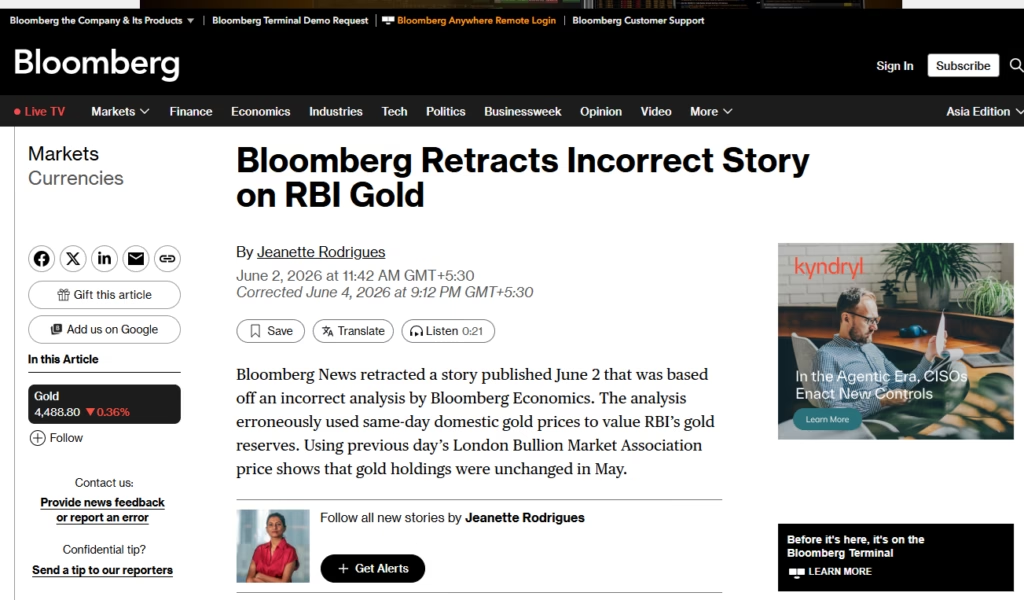
International financial news giant Bloomberg has withdrawn a report that claimed the Reserve Bank of India (RBI) may have sold billions of dollars worth of gold to shore up the country’s foreign exchange reserves.
The now-retracted article, published under the headline “RBI May Have Sold Gold to Save FX Reserves, BE Analysis Shows,” had suggested that India’s central bank sold nearly $12 billion worth of gold during the two weeks ending May 22. The report quickly attracted attention across financial markets and policy circles, triggering concerns about the health of India’s foreign exchange reserves.
However, within days, Bloomberg reversed its position and formally retracted the story after discovering flaws in the analytical methodology used to reach the conclusion.
Bloomberg has retracted a post on X based off an inaccurate Bloomberg Economics report https://t.co/XtCWbLM03p https://t.co/JrW6Pymib4
— Bloomberg (@business) June 4, 2026
RBI’s Firm Rebuttal
The RBI wasted no time in dismissing the report.
In an unusual and strongly worded clarification, the central bank stated that media reports claiming a reduction in its gold holdings were incorrect. It emphasized that India’s physical gold reserves remained unchanged at 880.52 tonnes and that no gold sale had taken place.
The Government of India also stepped in, with the Press Information Bureau (PIB) issuing a fact-check that rejected the claims and pointed to official reserve data.
A news report published by @Bloomberg states that RBI may have sold gold amounting to approximately USD 12 billion.#PIBFactCheck
❌ This claim is FAKE
✔️ According to @RBI, the share of gold in India’s foreign exchange reserves rose from 13.92% at end-September 2025 to 16.70%… pic.twitter.com/eVjxPxEv1i
— PIB Fact Check (@PIBFactCheck) June 3, 2026
Where Bloomberg Got It Wrong
The controversy stemmed from an analysis by Bloomberg Economics that attempted to interpret movements in the RBI’s balance sheet.
According to Bloomberg’s correction, the analysis relied on an incorrect valuation of gold holdings. Changes in the value of gold reserves were mistakenly interpreted as evidence of a physical sale of gold. After reviewing the calculations and applying the correct valuation methodology, Bloomberg concluded that there was no evidence that the RBI had sold any gold.
The agency subsequently removed the report and issued a retraction.
— xurate (@BharatITcel) June 5, 2026
India’s Gold Reserves Continue to Rise
The episode comes at a time when India has been steadily increasing the role of gold in its reserve portfolio.
Official data show that gold’s share in India’s foreign exchange reserves has grown significantly over the past year, reflecting the RBI’s strategy of diversifying reserve assets amid global economic uncertainty, geopolitical tensions and volatile currency markets.
Far from indicating a sell-off, recent reserve data suggest that gold remains an increasingly important pillar of India’s external financial strength.
A Lesson in Financial Journalism
The incident has reignited discussion about the risks of drawing sweeping conclusions from complex central-bank data.
Because central-bank reserve movements are closely watched by investors, governments and financial institutions worldwide, even a speculative report can trigger market reactions and shape public perceptions. The RBI’s swift rebuttal and Bloomberg’s eventual retraction underscore the importance of accuracy, especially when reporting on sensitive issues involving national reserves and monetary stability.
For Bloomberg, the withdrawal marks a rare public reversal. For the RBI, it serves as a validation of its position that India’s gold stock remains intact and that reports of a multi-billion-dollar sale were simply unfounded.