Devarshi Narada Award Conferred on Nava Thakuria; Lakshyajit Gohain, Ranjita Rabha and Mridul Haloi Felicitated
Guwahati: The spread and interpretation of half-truths pose a greater threat to society than outright falsehoods, observed Prakhar Shrivastava, Senior Consulting Editor and Anchor at Delhi Doordarshan Kendra, while delivering the keynote address at a Narada Jayanti programme in Guwahati.
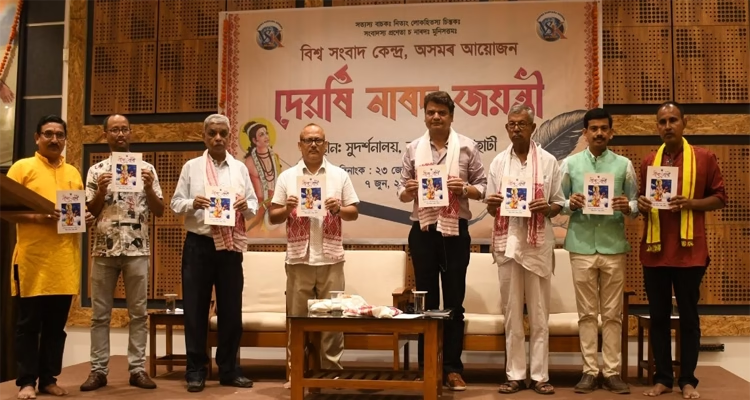
Organised by Vishwa Samvad Kendra, Assam, on June 7, the event featured the presentation of the prestigious Devarshi Narada Award and a felicitation ceremony honouring distinguished media professionals.
This year’s Devarshi Narada Award was conferred upon veteran journalist and editor of Ishan Darpan, Nava Thakuria. The award carried a cash prize of ₹50,000, a traditional seleng sador, a citation, a portrait of Bharat Mata, and a collection of books. Three promising journalists—Lakshyajit Gohain (Senior Journalist, NK TV), Ranjita Rabha (Chief Reporter, Pratham Khabar), and Mridul Haloi (Sub-Editor, Dainik Asam)—were also felicitated for their contributions to journalism.
Addressing the gathering at Sudarshanalaya in Guwahati’s Barbari locality, Shrivastava delivered a thought-provoking speech on contemporary socio-political developments and historical narratives. Referring to the centenary year of the Rashtriya Swayamsevak Sangh (RSS), he noted that media attitudes towards the organisation have undergone significant changes over the decades.
“Today, sections of the media view the Sangh more positively, but that was not the case in earlier decades. When the RSS, founded in 1925, received little attention from the media, the country was facing the trauma of Partition. During that period, RSS volunteers risked their lives to rescue Hindus, Sikhs and others who were targeted by fundamentalist violence in Sindh and other parts of Pakistan,” he said.
Shrivastava also referred to a historical communication from then Defence Minister Baldev Singh to Home Minister Sardar Vallabhbhai Patel after Independence. According to him, Patel had suggested placing the matter before the Cabinet, recommending cooperation with the Sangh’s relief efforts for people stranded in Pakistan during the Partition crisis.
He further claimed that political disagreements over such developments contributed to tensions between Prime Minister Jawaharlal Nehru and the RSS. Commenting on the period following Mahatma Gandhi’s assassination, Shrivastava also referred to incidents of violence directed against individuals associated with Vinayak Damodar Savarkar and his family.
The speaker additionally touched upon issues relating to immigration, demographic changes in Assam, and the historical roles of leaders such as Sir Syed Muhammad Sadullah, Moinul Hoque Choudhury, and Fakhruddin Ali Ahmed.
Accepting the Devarshi Narada Award, Nava Thakuria highlighted the enduring relevance of Narada’s legacy to modern journalism. He said that Narada’s tradition of asking incisive questions and offering constructive counsel continues to inspire journalistic practice.
“The credibility and communication skills associated with the mythological figure Narada remain highly relevant to contemporary journalism,” Thakuria remarked. He also argued that the dominance of Western, institution-centric models of journalism has weakened India’s culturally rooted and nature-centric news values.
Earlier, Vishwa Samvad Kendra Secretary Kishore Shivam presented an overview of Devarshi Narada, describing him as a seeker of knowledge and a remover of social flaws. He suggested that deeper study of Narada’s 84 Bhakti Sutras could provide valuable insights for modern journalism.
The programme also witnessed the release of a commemorative souvenir. A Saraswati Vandana rendered by Tribeni Bujarbaruah added a cultural dimension to the event. Dr Gouranga Sarma, President of Vishwa Samvad Kendra, also addressed the gathering.
The event was conducted by Naba Bujarbaruah, while Guru Prasad Medhi delivered the vote of thanks. More than 300 people from different sections of society attended the function.