India’s citizenship debate intensifies as questions over valid proof of citizenship grow. A closer look at the Assam NRC, legal challenges, and calls for a nationwide NRC.

An intriguing debate has gained momentum after India’s Ministry of External Affairs publicly stated that a passport alone cannot be considered conclusive proof of Indian citizenship. Earlier, the Union government had also clarified that documents such as Aadhaar, PAN, driving licence, or even a voter identity card cannot, by themselves, be treated as definitive evidence of citizenship.
These developments have sparked speculation, as well as demands, that New Delhi may eventually introduce a dedicated citizenship document based on the National Register of Citizens (NRC), enabling residents to establish their Indian citizenship. However, the NRC prepared in 1951 has yet to be updated across the country, except in Assam, where the exercise itself became mired in controversy and confusion.
The Gauhati High Court recently upheld a 28 February 2019 order of the Foreigners’ Tribunal (Kamrup Metropolitan), declaring an Assam resident to be a foreigner. The individual had submitted several documents—including his PAN card, voter identity card, school certificates, land records, and other documents—to establish his citizenship. However, the court did not accept these as conclusive proof. He also produced a computer-generated printout of the NRC containing the names of his father and grandparents, but this too was rejected on the ground that it lacked proper authentication under the Indian Evidence Act, 1872.
Needless to say, the NRC updating process in Assam, carried out between 2015 and 2019, became deeply controversial, with allegations ranging from financial irregularities to the inclusion of illegal migrants as genuine residents. The controversy intensified after the publication of the final NRC list in 2019, which is yet to receive formal approval from the Registrar General of India.
Subsequently, the then State NRC Coordinator, Hitesh Dev Sarma, publicly alleged that his predecessor, Prateek Hajela, had deliberately mishandled the process by manipulating the software to facilitate the inclusion of a large number of illegal migrants, particularly Bangladeshi Muslim settlers.
According to Dev Sarma, an important verification mechanism—Family Tree Matching—was also compromised during the exercise. He called for a credible investigation into the alleged irregularities and submitted multiple complaints to the concerned authorities.
The Comptroller and Auditor General (CAG) of India also flagged financial irregularities amounting to nearly ₹260 crore during the NRC updating process and recommended legal action against Hajela. Assam Chief Minister Himanta Biswa Sarma has likewise stated that the NRC prepared under Hajela was flawed. According to the Chief Minister, the defective NRC could jeopardise national security and adversely affect the interests of Assam’s indigenous communities.
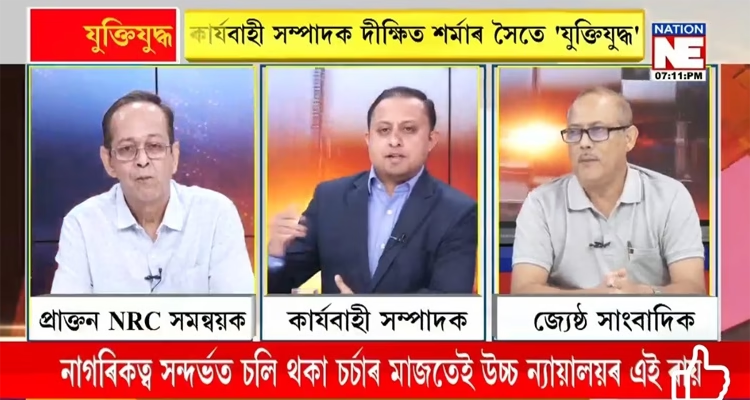
More recently, the Supreme Court of India admitted a writ petition filed by Dev Sarma seeking a comprehensive re-verification of the Assam NRC. Speaking during a debate hosted by journalist Dikshit Sarma and broadcast by Nation NE, Dev Sarma reiterated that a genuine review of the NRC would help identify hundreds of thousands of illegal migrants who continue to avail themselves of government-sponsored welfare benefits.
He also alleged that, barring a few exceptions, much of the Assam media had avoided reporting the financial irregularities associated with the NRC exercise. According to him, several journalists even spread misinformation by claiming that the NRC supplementary list was the final authenticated document, leaving no scope for further verification.
Dev Sarma further alleged that a Guwahati-based television anchor openly advocated acceptance of the NRC without proper verification. The anchor was later criticised extensively on social media, with allegations linking him to the NRC updation scam. However, despite his otherwise outspoken public persona, he has remained silent on those allegations to date. The anchor also authored a book praising Hajela’s work as unparalleled, with what critics perceived as an attempt to secure national recognition for the former NRC coordinator.
Supporters of a fresh verification exercise argue that a fair and independent investigation could uncover the alleged irregularities committed during the much-publicised NRC updating process in Assam and identify those responsible for manipulating the exercise for personal gain at the expense of national interest.