

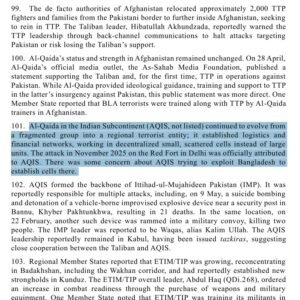
New Delhi: The November 2025 terror attack near Delhi’s iconic Red Fort has acquired a significant international dimension, with a new UN Security Council sanctions-monitoring report officially attributing the attack to Al-Qaeda in the Indian Subcontinent (AQIS).
The finding appears in the 38th report of the Analytical Support and Sanctions Monitoring Team, submitted to the UN Security Council’s 1267 Sanctions Committee dealing with ISIL and Al-Qaeda. The report says AQIS has evolved from a fragmented outfit into a more established regional terrorist entity, supported by logistics and financial networks and increasingly operating through small, decentralised cells.
Red Fort Attack: UN Attribution Puts AQIS in Focus
The UN assessment specifically states that the November 2025 attack in Delhi was “officially attributed” to AQIS. The blast near the Red Fort had caused multiple deaths and injuries, making it one of the most serious terror incidents in the capital in recent years.
#BREAKING | UN report attributes November 2025 Red Fort blast to Al-Qaeda in the Indian Subcontinent (AQI8S). The attack near Delhi’s iconic Red Fort killed 11 people. The report also flags AQIS’s evolving regional network and attempts to expand its presence in Bangladesh.
DD… pic.twitter.com/CeE205BGRF
— DD India (@DDIndialive) August 13, 2026
The latest assessment is noteworthy because an earlier UN monitoring report had recorded information suggesting a possible Jaish-e-Mohammed (JeM) connection. The new report’s AQIS attribution therefore adds an important new layer to the understanding of the attack and the network allegedly behind it.
From Fragmented Outfit to Regional Network
The UN report’s wider warning may be as significant as its attribution of the Red Fort attack.
According to the assessment, AQIS has been developing logistics and financial networks while relying on scattered, decentralised cells rather than large formations. Such a structure can make terrorist networks more difficult to detect and disrupt, while allowing them to operate across borders with relatively small footprints.
The report also flags concerns that AQIS could seek to exploit Bangladesh to establish cells, highlighting the broader regional implications of the organisation’s activities.
NIA Investigation Remains Crucial
The UN assessment comes as India’s National Investigation Agency (NIA) continues its investigation into the Red Fort-area blast. The agency has conducted searches in Jammu and Kashmir as part of the case, underscoring the continuing probe into the suspected terror network and its associates.
The UN finding should, however, be understood as an international sanctions-monitoring assessment, not a substitute for judicial findings in India. Allegations against individual accused persons remain subject to the legal process.
A Wider South Asian Security Warning
The report places the Red Fort attack within a broader picture of persistent terrorist threats across South Asia. It points to AQIS activity, concerns surrounding Afghanistan and Pakistan, and attempts by extremist organisations to exploit instability and build regional support structures.
The significance of the UN report goes beyond naming AQIS. It suggests that the terror threat is increasingly being shaped by smaller, dispersed cells backed by financial and logistical networks—posing a more complex challenge for security agencies across the region.
For India, the Red Fort attribution is likely to sharpen attention on AQIS’s organisational footprint, cross-border networks and potential links to extremist modules operating in the region.