
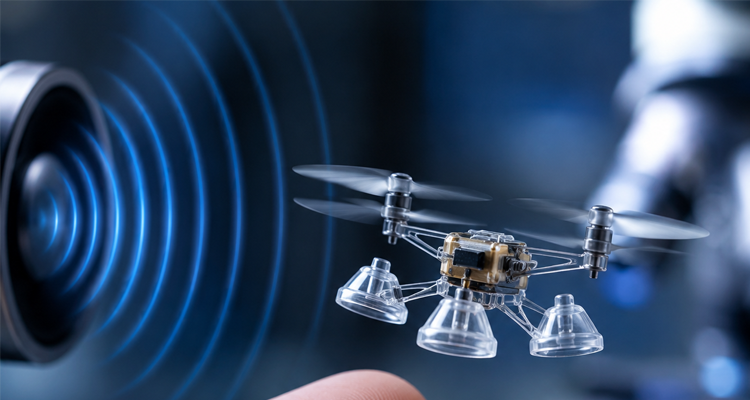
Switzerland: Scientists of École Polytechnique Fédérale de Lausanne (EPFL) at Switzerland have developed extraordinarily small flying machines that can generate thrust using sound waves instead of conventional motors, gears or onboard batteries.
The breakthrough, developed by researchers at EPFL’s MicroBioRobotic Systems (MICROBS) Lab, uses specially engineered acoustic resonators to convert sound energy into directional airflow and mechanical thrust. The research has been published in the journal Science Advances.
How can sound make a drone fly?
The technology is based on a phenomenon known as Helmholtz resonance—the same basic acoustic effect responsible for the sound produced when air is blown across the opening of a bottle.
The EPFL researchers created tiny hollow, round or bell-shaped cavities. When sound at the right frequency reaches one of these cavities, the air trapped inside begins to oscillate strongly.
The design then forces that oscillating air through a small opening as a concentrated jet. Because the outgoing airflow is more focused than the incoming airflow, the system produces a small but usable amount of thrust.
In other words, the researchers are not simply using sound waves to push a drone through the air. Instead, they have designed the drone itself to turn acoustic energy into propulsion.
Two tiny flying machines
The team demonstrated the concept by creating two different microfliers.
One design weighs only about 150 micrograms and uses three microscopic resonant cavities to generate upward thrust, producing a rocket-like lift.
The second design uses tiny blades containing acoustic resonators. When activated at the appropriate ultrasonic frequency, the blades can spin at speeds of up to approximately 13,000 revolutions per minute, generating aerodynamic lift similar to that of a miniature helicopter.
The flying prototypes are so small that they remain far removed from conventional camera or delivery drones. Their experimental flight height is currently limited to only a few millimetres.
Why use ultrasound?
For the microfliers, the researchers use ultrasonic frequencies, which are beyond the normal range of human hearing.
That makes the propulsion system practically silent to people, while still allowing the resonators to respond to the acoustic energy.
This could eventually be valuable in applications where conventional miniature motors are too large, mechanically complicated or noisy.
However, it is important to clarify that these devices are not self-powered by ambient sound. An external acoustic source supplies the energy required to activate the resonators. The significance of the research is that the sound energy can be converted directly into mechanical propulsion without putting a conventional motor and battery on the tiny flying machine.
The technology also works on miniature boats
The EPFL team tested the acoustic propulsion concept beyond flying machines.
At the centimetre scale, researchers built tiny boats equipped with as many as three acoustic cavities. Each cavity was tuned to a different audible frequency and positioned to generate movement in a particular direction.
By changing the frequency produced by an external speaker, the researchers could activate individual resonators. This allowed the boats to move, turn, navigate around obstacles and even be programmed for autonomous navigation.
This demonstration suggests that the technology could eventually become more than simply a new way of powering miniature drones.
No motors, gears or conventional propulsion
One of the most interesting aspects of the research is its extreme simplicity.
Conventional flying robots depend on combinations of motors, propellers, gears, batteries and electronic control systems. As a robot becomes smaller, shrinking all of these components becomes increasingly difficult.
The EPFL approach replaces much of that mechanical complexity with carefully shaped cavities that themselves become functional parts of the robot.
According to the researchers, the resonators can be manufactured using materials including common 3D-printing plastics, rubber-like polymers and glass. The team also used advanced 3D nanoprinting to create the microscopic flying structures.
Could this lead to mosquito-sized robots?
That remains a possibility rather than an immediate application.
The current microfliers have demonstrated that acoustic resonators can generate sufficient thrust for extremely small-scale flight, but their capabilities are still highly limited. The experimental devices operate only a few millimetres above the surface and cannot yet carry meaningful payloads.
The researchers’ next challenge is therefore to scale up the available thrust without losing the advantages of extreme miniaturisation.
If that can be achieved, the technology could contribute to future micro-robots designed for specialised environments, including inspection, sensing and other situations where conventional propulsion systems are difficult to miniaturise.
A new concept in robotic design
The researchers say the concept could eventually go beyond propulsion. Multiple resonators could potentially be incorporated into a flexible structure, with each resonator responding to a different sound frequency.
That could allow different sections of a robot to move, bend or vibrate selectively, potentially creating sound-responsive robotic structures that change shape without conventional motors.
The research therefore represents more than the creation of a tiny sound-powered drone. It points toward a broader idea in robotics: using the physical structure of a machine itself as its actuator.
Key Facts
|
Why the breakthrough matters
The real significance of the Swiss research is not that sound can suddenly replace the batteries of today’s drones. Rather, it demonstrates a radically different approach to micro-scale propulsion.
By turning a simple hollow cavity into an acoustic actuator, researchers have shown that the structure of a tiny robot can simultaneously serve as part of its propulsion system.
For future microrobotics, that could be a major advantage: fewer mechanical components, lower weight and potentially much greater freedom to miniaturise machines.