Prime Minister Narendra Modi has sharpened his political attack on what he calls “dimagi Naxals”, saying his use of the phrase from the Red Fort on Independence Day worked like a “homeopathic pill” that prompted those he was referring to to reveal themselves.
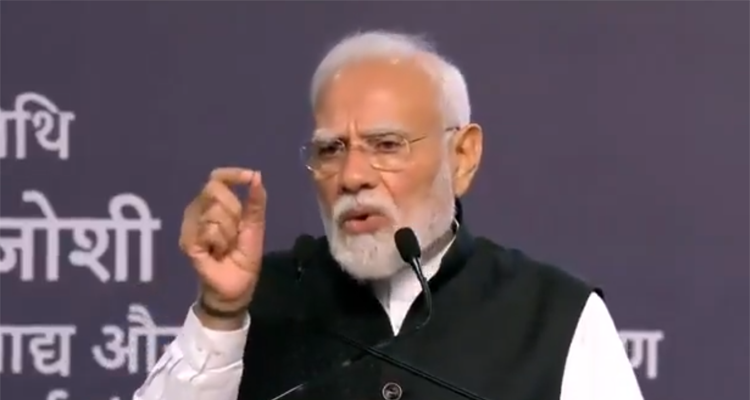
Addressing students at the centenary celebrations of Shri Ram College of Commerce (SRCC) in New Delhi on September 5, Modi recalled his August 15 Independence Day speech. He said, “I gave a homeopathic pill from the Red Fort — dimagi Naxal,” arguing that, much like the principle he attributed to homeopathic treatment, the reaction to the “pill” brought the alleged problem into the open.
‘They started coming out one after another’
Modi said that after he used the term, “all the dimagi Naxals started coming out one after another”, adding that the public could now see the “true colours” of those whom he accused of promoting such a mindset. He did not name specific individuals during the SRCC address.
The remark is a continuation of the political line Modi adopted in his Independence Day address, when he argued that although armed Naxalism had been pushed back, a Naxal ideology still existed in sections of society. He called for such “dimagi Naxals” to be identified and isolated.
I had given a dose of homeopathy from the Red Fort… Dimagi Naxal!
A homeopathy pill temporarily aggravates the disease for a while, and then begins the treatment of the disease.
So as soon as I administered that homeopathy pill for ‘Dimagi Naxal,’ all the Dimagi Naxals… pic.twitter.com/BsxFQECLzO
— Pralhad Joshi (@JoshiPralhad) September 6, 2026
What does ‘Dimagi Naxal’ mean?
The expression has no established legal definition. In Modi’s usage, it refers broadly to people whom he alleges continue to promote or sympathise with Maoist/Naxal ideology despite the decline of armed insurgency.
The government has subsequently sought to clarify the terminology. Parliamentary Affairs Minister Kiren Rijiju said the label should not automatically apply to people who merely criticise or disagree with the government. He linked it instead to people supporting Maoists, separatism, rejection of the Constitution or actions that, in the government’s view, deliberately obstruct national development.
From Naxalism to a broader political battle
Modi’s latest remarks at SRCC came within a wider speech aimed at encouraging young Indians to adopt an ambitious, nation-building outlook. Alongside his “dimagi Naxal” reference, he attacked what he described as a permanently negative political mindset, using the colourful phrase “naraz fufa”—the perpetually disgruntled uncle who questions every major initiative.
He cited projects and initiatives such as the Statue of Unity, bullet trains, UPI, semiconductor ambitions and the new Parliament building as examples of projects that, according to him, were initially questioned but later demonstrated India’s changing capabilities.
A politically loaded phrase
The “dimagi Naxal” formulation has nevertheless triggered controversy. Critics have argued that applying such a label to ideological opponents or dissenters risks blurring the distinction between legitimate political disagreement and support for armed extremism. The controversy intensified after the Independence Day speech, prompting the government’s subsequent clarification that ordinary criticism of the government should not qualify someone as a “dimagi Naxal.”
Modi’s “homeopathic pill” remark therefore adds a new twist to an already contentious phrase. What began as a warning about the ideological remnants of Naxalism has now become a prominent part of the political debate over dissent, development and the boundaries of legitimate opposition.
In short: Modi’s message was clear—he believes the reaction to his “dimagi Naxal” phrase itself exposed the people he had in mind. His critics, however, see the terminology as another example of political labelling that could put dissent under suspicion.