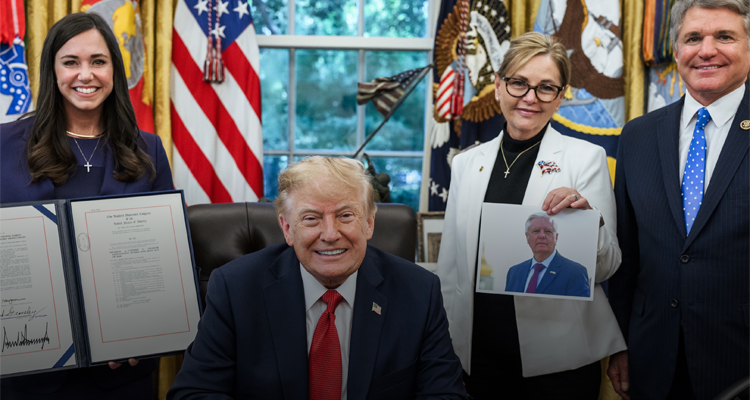
News Desk: US President Donald Trump has signed into law a sweeping Russia-Iran sanctions package that gives his administration new powers to target Moscow’s energy revenues and countries continuing major purchases of Russian oil and natural gas.
The Lindsey O. Graham Sanctioning Russia and Iran Act of 2026 (H.R. 5334) was signed by Trump on September 18, two days after it cleared the US House of Representatives. The White House said the law expands statutory sanctions, tariffs and prohibitions against Russia while extending existing sanctions on Iran.
The legislation has particular significance for India and China, as both remain major buyers of Russian crude. It authorises the US President to impose tariffs of up to 100% on goods imported from countries that rank among the five largest purchasers of Russian crude oil or natural gas, subject to the law’s provisions and presidential decisions.
Donald Trump signs Russia sanctions bill into law
Donald Trump gets power to impose 100% tariffs
India’s Russian oil trade faces US pressure
Former British Diplomat @CormacS63 discusses more with @AadhyaJunejaa pic.twitter.com/4JpnQXhc6n
— WION (@WIONews) September 19, 2026
Bill clears US Congress with strong support
The legislation received substantial bipartisan support in Congress.
The US Senate passed the bill 86-11 on August 7, while the House of Representatives approved it 262-159 on September 16. Trump signed the legislation into law on September 18.
The measure is named after the late Republican Senator Lindsey Graham of South Carolina, one of its key architects and a leading advocate of tougher economic measures against Russia. The legislation was also backed by Democratic Senator Richard Blumenthal.
The broader objective is to reduce the revenues available to Moscow amid the Russia-Ukraine war and increase economic pressure on countries that continue significant commercial engagement with Russia, particularly through energy purchases. The legislation targets Russian officials, financial institutions, energy interests and networks accused of helping Russia evade existing sanctions.
For Lindsey 🇺🇸
President Trump signs the Lindsey O. Graham Sanctioning Russia and Iran Act of 2026, authorizing and expanding statutory sanctions, tariffs, and prohibitions on Russia, and extending existing sanctions on Iran. pic.twitter.com/d9uOCN8aU0
— The White House (@WhiteHouse) September 19, 2026
India and China face new tariff exposure
For New Delhi and Beijing, the most consequential part of the legislation is its tariff mechanism.
The law gives the US President authority to impose duties of up to 100% on imports from countries identified as major purchasers of Russian oil or gas. India and China are among the world’s largest buyers of Russian crude and therefore fall within the group facing potential exposure under the new framework.
However, Trump’s signing of the law does not mean that a 100% tariff has automatically been imposed on India or China.
The legislation provides the administration with considerable discretion over implementation, including decisions concerning the countries covered, tariff levels and possible waivers. This distinction is important because the immediate impact on Indian and Chinese exports to the US will depend on subsequent action by the Trump administration.
India among biggest Russian crude buyers
India’s exposure is particularly significant because Russian crude has become a major component of the country’s oil imports.
According to S&P Global data, India imported about 1.6 million barrels per day of Russian crude in August, making it the largest Russian crude buyer that month, while China imported around 1.1 million barrels per day.
India relies heavily on imported crude to meet domestic demand. The Indian Express reported that imports account for more than 88% of India’s crude-oil requirement, with Russia supplying close to half of those imports in the period examined.
This makes the new US law a potentially important issue for both India’s energy-security strategy and India-US trade relations.
Why the US is targeting Russian oil buyers
The central objective of the legislation is to put greater pressure on Russia’s ability to earn revenue from energy exports.
Despite Western sanctions, Russia has continued selling large volumes of oil to international markets, with countries such as India and China becoming important destinations for Russian crude.
The new law seeks to increase the economic cost for countries that continue major purchases while also targeting the networks that facilitate Russia’s energy trade.
Among the targets is Russia’s so-called “shadow fleet”—a network of vessels and associated companies accused of helping transport Russian oil while circumventing sanctions. The legislation also provides for measures against people and entities involved in Russian energy production, transportation and sanctions evasion.
Iran sanctions extended
The legislation is not limited to Russia.
It also extends existing US sanctions on Iran for five years, maintaining Washington’s statutory sanctions framework against Tehran. The White House described the measure as expanding sanctions, tariffs and prohibitions on Russia while extending existing sanctions on Iran.
The combined Russia-Iran provisions make the legislation a significant addition to the US sanctions regime and give the administration additional tools for economic pressure.
What it means for India
For India, the new law creates a difficult policy equation.
New Delhi has maintained that its crude purchases are guided by energy security, price and market conditions. Russian oil became particularly important after Western sanctions and the restructuring of global energy flows following the Russia-Ukraine war.
A sharp reduction in Russian purchases could potentially force Indian refiners to seek additional supplies from other markets. At the same time, a US tariff action against India could affect Indian exporters seeking access to the American market.
India has already indicated that the issue could have implications for India-US bilateral relations and the global energy market.
China also faces exposure
China is another major purchaser of Russian energy and therefore faces a similar potential risk.
The tariff mechanism is designed around the largest purchasers of Russian oil and gas rather than being limited to a single country. Consequently, Beijing could also face pressure if the Trump administration activates the new tariff provisions.
The measure therefore creates another potential flashpoint in US-China economic relations at a time when Washington and Beijing are already dealing with broader trade and strategic disputes.
100% tariff is a power, not an automatic penalty
One of the most important points surrounding the new law is the difference between authorisation and implementation.
Trump now has a legally established mechanism through which tariffs of up to 100% can be imposed on qualifying countries. But the law itself does not state that India or China must immediately face a 100% tariff.
The administration still has to determine how the provisions will be applied. The law also contains mechanisms for exemptions or waivers under specified circumstances, giving the White House room to consider economic and national-interest factors.
Global oil market could feel the impact
The consequences could extend beyond US trade with India and China.
Russia remains one of the world’s major oil exporters, while India and China are among the largest buyers of its crude. Any significant disruption to those flows could affect global supply patterns and potentially put pressure on international oil prices.
For Washington, the challenge is to pressure Russia without creating a major disruption in global energy markets. For India and China, the challenge is to maintain access to competitively priced energy while limiting the potential economic impact of US measures.
A new pressure point in global trade
Trump’s signature has therefore transformed the Russia sanctions debate from a legislative proposal into a new statutory tool available to the US administration.
For India and China, the immediate issue is not that Washington has already imposed a 100% tariff, but that the President now has the legal authority to consider such action against major Russian-energy buyers.
The coming weeks will be closely watched for decisions on which countries are covered, what tariff rates are selected and whether exemptions or waivers are granted. Those decisions could have consequences not only for India-US and China-US trade but also for global oil flows and the wider international effort to pressure Russia over the Ukraine war.