
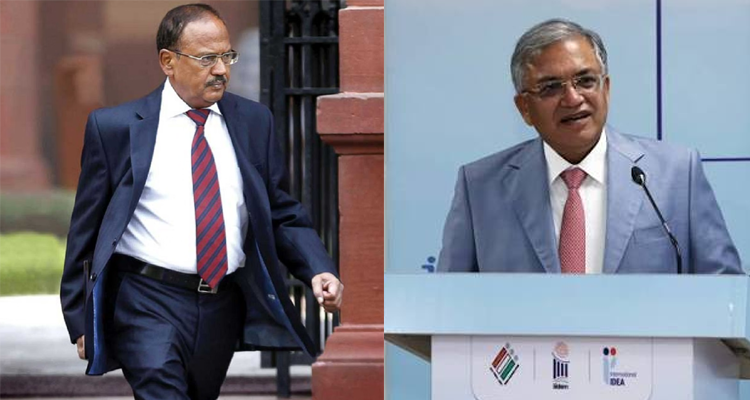
From Ajit Doval to CEC Gyanesh Kumar, explore why Opposition parties are intensifying their challenge to the Modi government and key Indian institutions.

Indian politics appears to be entering another phase of confrontation — one in which the battle is no longer confined to government policies or parliamentary numbers, but increasingly involves the institutions and individuals at the heart of the Modi government’s political, electoral and national-security architecture.
The latest target is Chief Election Commissioner Gyanesh Kumar.
But Kumar is not the beginning of this story.
For years, Opposition parties have challenged people and institutions associated with the Modi government’s core decision-making — from the Election Commission and investigative agencies to the national-security establishment and, at various points, National Security Adviser Ajit Doval.
The question, therefore, is not simply why is the Opposition attacking the government?
The larger question is:
Is India’s political battle gradually shifting from a contest over government policies to a contest over the credibility of the institutions through which the government exercises power?
That question deserves serious examination.
Gyanesh Kumar: The latest institutional flashpoint
The immediate controversy centres on the Election Commission’s Special Intensive Revision (SIR) of electoral rolls.
Opposition parties are preparing another parliamentary motion seeking the removal of CEC Gyanesh Kumar. The Indian Express reported that the move followed an investigation which found that questions had been raised internally within the three-member Election Commission on SIR-related matters on at least 14 occasions over 10 months.
The Opposition has interpreted these reported objections as evidence of serious problems in the functioning of the Commission.
The Election Commission, however, has maintained that differences during internal deliberations are not unusual and has said that its final decisions were unanimous.
That distinction is crucial.
The existence of disagreement is one question. What that disagreement proves is another.
Nevertheless, politically, the controversy has become significant enough for Opposition parties to move towards another formal parliamentary challenge. Reports say the latest move would be the Opposition’s third attempt to seek Kumar’s removal.
The confrontation has also moved outside Parliament, with Opposition parties announcing protests over their allegations concerning the functioning of the Election Commission.
The battle is therefore no longer merely about SIR.
It is about trust in the institution that conducts India’s elections.
But why Ajit Doval?
This is where the story becomes considerably more interesting.
If the Election Commission represents the electoral architecture of the Modi government, Ajit Doval represents a very different pillar — national security.
Doval has served as National Security Adviser since 2014 and has become one of the most recognisable figures associated with the Modi government’s security and strategic policymaking.
That visibility has also made him a recurring figure in Opposition criticism.
And this is not a recent phenomenon.
2016: Uri attack and the first major confrontation
Following the September 2016 Uri terror attack, Congress escalated its attack on the Modi government and demanded the resignation of both Defence Minister Manohar Parrikar and NSA Ajit Doval.
Congress alleged that the attack exposed serious intelligence and operational failures and questioned accountability within the government’s national-security establishment.
This was significant because the demand went beyond criticism of the Prime Minister or Defence Ministry.
The NSA himself was placed directly in the political line of fire.
It established an early pattern that would recur in subsequent years: when a major security controversy emerged, Doval’s position became part of the political debate.
From Pakistan to intelligence, surveillance and national security
Doval’s name subsequently became associated with almost every major political argument surrounding India’s security establishment — Pakistan, counter-terrorism, intelligence operations, surveillance and the government’s wider national-security strategy.
The issue was not always a direct demand for Doval’s resignation.
Instead, his position increasingly became symbolic of the Modi government’s security architecture.
That was evident again in March 2025, during a Rajya Sabha discussion.
An Opposition MP referred to Doval’s long tenure as NSA while discussing the functioning of national-security institutions and subsequently raised concerns over allegations surrounding Pegasus surveillance. The parliamentary record shows the speaker linking Doval’s tenure with wider questions concerning the NIA and alleged surveillance involving Pegasus.
These were political allegations and concerns raised during a parliamentary debate, not judicial findings against Doval.
But politically, the significance was clear:
Doval’s name had become inseparable from the Opposition’s broader scrutiny of the national-security state.
July 2024: Rahul Gandhi puts Doval inside the “Chakravyuh”
Perhaps the most striking example came in July 2024.
During his Lok Sabha speech on the Union Budget, Rahul Gandhi invoked the Mahabharata metaphor of the “Chakravyuh” to describe what he characterised as a system of concentrated political and economic power.
He named six figures whom he said were at the centre of this modern “Chakravyuh”: Prime Minister Narendra Modi, Home Minister Amit Shah, RSS chief Mohan Bhagwat, NSA Ajit Doval and industrialists Mukesh Ambani and Gautam Adani.
The BJP subsequently criticised Gandhi for bringing Doval’s name into political discourse.
BJP general secretary Vinod Tawde described the reference to the NSA as unfortunate and said that Doval’s name should not have been brought into the political debate.
This episode was important for another reason.
It demonstrated how the office of the NSA — traditionally associated with strategic and security matters rather than day-to-day electoral politics — had itself become part of the political vocabulary of the Opposition.
October 2025: Doval answers — without naming the Opposition
Then came another remarkable moment.
On October 31, 2025, while delivering the Sardar Patel Lecture on Governance, Doval spoke about the danger of institutions losing credibility in the public eye.
He warned that the credibility of institutions should not be eroded by “disinformation, hostile propaganda or vested political interests” and specifically referred to institutions including the defence and security establishment, judiciary and electoral system.
His remarks came against the backdrop of the Opposition’s continuing criticism of the Election Commission and its handling of electoral-roll revision.
Several reports interpreted his comments as a veiled response to Rahul Gandhi and Opposition criticism of the electoral system. But Doval did not identify a particular political party in the quoted remarks.
That qualification matters.
Nevertheless, the political symbolism was difficult to miss.
The NSA was now publicly speaking about the credibility of the electoral system and other national institutions at precisely the time when those institutions were becoming major political battlegrounds.
From Doval to Gyanesh Kumar: Is there a pattern?
Here the argument becomes more provocative.
There is no established evidence that Opposition parties have a single coordinated plan to remove or weaken every senior official associated with the Modi government.
Nor should criticism of Doval, Gyanesh Kumar or another constitutional authority automatically be interpreted as an attempt to destabilise the government.
But there is an observable political pattern.
The Opposition has increasingly moved its criticism towards:
- the Election Commission and electoral rolls;
- national-security decision-making;
- intelligence and investigative agencies;
- surveillance allegations;
- the independence of constitutional institutions;
- and the credibility of the broader institutional system.
The present campaign against Gyanesh Kumar therefore fits into a much longer history of institutional confrontation — even though the specific issues and mechanisms are different.
The Opposition’s earlier weapon: No-confidence motions
The strategy of directly challenging the Modi government is hardly new.
Opposition parties brought a no-confidence motion in 2018.
They did so again in 2023, when the Opposition sought to force a parliamentary debate over the government’s handling of the Manipur crisis and related issues.
The 2023 motion was defeated, but the political message was unmistakable: the Opposition was prepared to use the strongest parliamentary mechanism available to challenge the government’s legitimacy.
A no-confidence motion, of course, is an established parliamentary procedure. It does not constitute an extra-constitutional attempt to remove a government.
But politically it serves another purpose:
It forces the government to defend itself before the country.
The battlefield has changed
What has changed since those earlier no-confidence motions is the nature of the confrontation.
The Opposition increasingly appears to be fighting on several fronts simultaneously.
Electoral front
The Election Commission, SIR, electoral rolls and alleged voter exclusions.
Security front
Intelligence agencies, counter-terrorism, Pakistan policy, military operations and the role of the NSA.
Institutional front
Questions concerning the independence and credibility of constitutional and investigative institutions.
Parliamentary front
Removal motions, no-confidence motions and demands for accountability.
Street-politics front
Protests, public campaigns and mobilisation against government institutions.
Each issue has its own facts and its own political context.
But together they have created a much larger contest over institutional credibility.
Is the Opposition trying to destabilise the government?
This is where political commentary can easily cross the line from analysis into assertion.
There is evidence of an increasingly aggressive Opposition campaign against the government and institutions associated with its functioning.
There is evidence of repeated parliamentary challenges.
There is evidence of demands for resignations and removals.
There is evidence of protests over the Election Commission.
There is a documented history of criticism directed at Doval and the national-security establishment.
But these facts alone do not establish a single coordinated conspiracy to destabilise the government.
A democratic Opposition has the right — and indeed the responsibility — to scrutinise those exercising public power.
The real question is whether the allegations are supported by evidence and whether institutional mechanisms are allowed to determine the facts.
That is where the debate should remain.
But the political stakes are enormous
The Modi government possesses a parliamentary mandate.
Therefore, defeating it through a no-confidence motion requires numbers.
If the Opposition lacks those numbers, another route to political pressure is to challenge the legitimacy, credibility or functioning of institutions around the government.
That does not necessarily mean an attempt to overthrow the government.
But it can create something almost equally important in political terms:
a sustained narrative of institutional distrust.
If voters begin asking whether elections are fair, whether security agencies are independent, whether constitutional institutions are credible and whether government decisions are sufficiently transparent, the political debate moves far beyond individual policies.
It becomes a debate over the state itself.
And that is where Gyanesh Kumar becomes more important than Gyanesh Kumar
The present confrontation is not merely about one CEC.
It is about whether citizens trust the institution conducting elections.
Similarly, the political controversy surrounding Ajit Doval is not merely about one NSA.
It is about whether citizens trust the country’s national-security architecture.
That is why these battles matter.
The person may change. The institution remains.
And once political parties begin fighting over the credibility of those institutions, every subsequent election, security operation and major government decision can become part of the same larger political narrative.
The danger is bigger than either side
There is a legitimate democratic argument for holding institutions accountable.
There is also a legitimate democratic concern about repeatedly undermining public confidence in institutions without sufficient evidence.
Both principles can exist simultaneously.
The Election Commission must be answerable.
The government must be answerable.
Security agencies must be accountable.
Opposition allegations must also withstand scrutiny.
And constitutional institutions must be strong enough to withstand political pressure from both sides.
That is the real test.
The battle ahead
India’s political confrontation is no longer simply Modi versus the Opposition.
It is increasingly becoming a contest over competing narratives:
Who controls the government?
Who controls the political narrative?
Who controls the credibility of institutions?
And perhaps most importantly:
Who will convince the Indian voter that the institutions of the Republic can still be trusted?
From the Congress demand for Ajit Doval’s resignation after Uri in 2016, to Rahul Gandhi placing Doval at the centre of his 2024 “Chakravyuh” metaphor, to Doval’s 2025 warning about the erosion of institutional credibility, and now to the Opposition’s campaign against CEC Gyanesh Kumar, the trajectory is striking.
The issues are different.
The institutions are different.
The political actors are different.
But the battlefield increasingly has one common word:
Trust.
And in a democracy, once trust in institutions becomes the central political battlefield, every election becomes more than an election — it becomes a referendum on the credibility of the system itself.