
From Smartphones to Soft Power: Generation Z Takes India to the World
How does Generation Z view freedom and nationalism? Explore how India’s young generation connects patriotism with innovation, democracy, social responsibility and national development.

More than one-fourth of India’s population belongs to Generation Z. This generation has grown up in an era defined by the internet, smartphones, social media, artificial intelligence and the digital economy. As a result, its understanding of freedom, nationalism and civic responsibility appears more pragmatic, global and outcome-oriented than that of earlier generations. It is a generation that wants to live in the present while learning from, rather than being burdened by, the nightmares of the past.
Traditionally, nationalism has been associated with protecting the country’s borders, respecting national symbols, remembering the freedom struggle and upholding national pride. These values remain important, but Generation Z does not want nationalism to be limited to emotional or symbolic expressions. For this generation, true patriotism is reflected in national development, problem-solving, innovation, social responsibility and the protection of democratic values. Various studies and surveys, including those by the Centre for the Study of Developing Societies (CSDS), suggest that young people increasingly view patriotism not merely as a symbol of national identity but also as an opportunity to contribute meaningfully to the country’s progress.
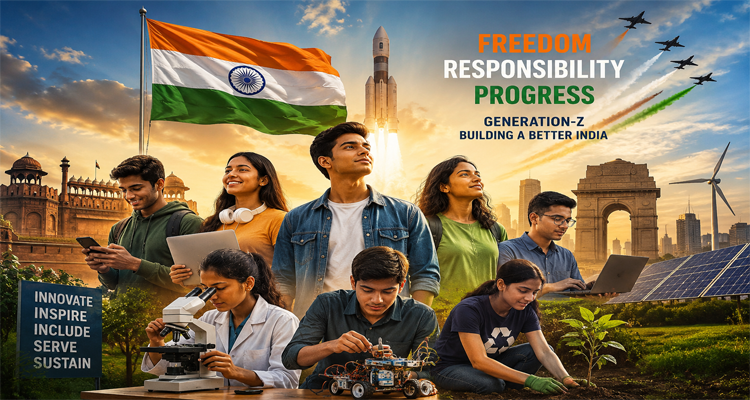
In the economic sphere, self-reliance and innovation have emerged as important pillars of Generation Z’s idea of nationalism. India’s young population has played a significant role in the country’s expanding startup ecosystem and its growing capabilities across sectors. With more than one lakh recognised startups, India has emerged as one of the world’s leading startup ecosystems. The growing participation of young Indians in fintech, space technology, agri-tech, health-tech and artificial intelligence shows that they increasingly see indigenous technology, entrepreneurship and employment generation as instruments of national empowerment. The widespread adoption of digital payment platforms such as UPI, the growing preference for Indian products and the contribution of young Indians working overseas to the domestic economy through remittances are also contemporary expressions of economic nationalism.
Environmental protection and sustainable development have become equally important dimensions of Generation Z’s nationalism. The United Nations and numerous international studies have identified climate change as one of the major concerns of today’s youth. In India, young people are increasingly participating in campaigns involving tree plantation, river conservation, clean energy, water management, reduction of single-use plastics, e-waste management and sustainable lifestyles. For them, patriotism is therefore not confined to defending the nation’s borders; it also means protecting its natural resources and securing a better future for generations to come.
In the digital age, Generation Z has also emerged as an active digital citizen. Through social media and global digital platforms, young Indians are taking Indian yoga, Ayurveda, languages, culture, science, sports and technological achievements to audiences around the world, thereby contributing to the country’s soft power. At the same time, they appear increasingly conscious of the dangers posed by fake news, cybercrime, data breaches, privacy violations and unethical use of digital technology.
Another distinctive feature of Generation Z’s nationalism is its critical and responsible character. Young people expect governments and institutions to be accountable on issues such as social inequality, unemployment, the quality of education, examination-paper leaks, corruption, gender equality, environmental protection and good governance. They also seek a healthy, inclusive and fear-free social environment. In a democracy, asking questions, engaging in constructive criticism and demanding policy reforms should not be regarded as anti-national. Rather, responsible questioning can be an essential part of nation-building and democratic citizenship.
However, Generation Z also faces a number of serious challenges. The rapid spread of misinformation and information disorder on social media, the potential displacement of jobs through artificial intelligence, intense competition for employment, limited opportunities in quality educational institutions, mental-health concerns, digital addiction and declining face-to-face social interaction are creating new pressures. In such an environment, freedom cannot simply mean unlimited choice. It also requires responsible decision-making, respect for facts, awareness of consequences and commitment to constitutional values.
Ultimately, for Generation Z, freedom is not merely a historical achievement secured in 1947; it is an evolving national responsibility. If Independence marked India’s political freedom, today’s young India is seeking to transform that freedom into greater economic strength, technological capability, scientific advancement, strategic autonomy, environmental sustainability and social inclusion.
For Generation Z, nationalism need not mean hostility towards another country, community or ideology. It can instead mean an active commitment to constitutional values, innovation, social justice, environmental protection and national progress. If this energy is guided by democratic values, critical thinking and a sense of responsibility, Generation Z could become one of India’s greatest strengths in its journey towards becoming a developed nation.