Trump-Xi summit revives the G2 debate as the US and China seek strategic stability. What could a stronger US-China axis mean for India and the world?

The latest Donald Trump-Xi Jinping summit has revived a question with implications far beyond Washington and Beijing: Are the United States and China moving towards an informal “G2” arrangement to manage major global issues?
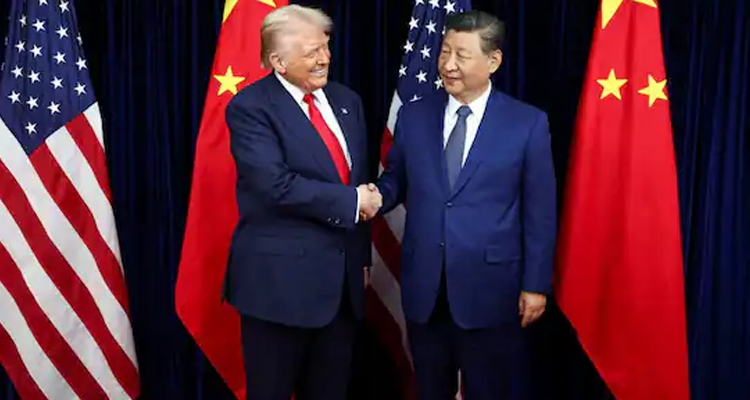
The answer, for now, is not formally. No “G2” grouping was announced at the September 24–25 White House summit. But the scale of the U.S.-China relationship, the issues discussed by the two leaders and Trump’s own use of the term “G2” have strengthened the argument that Washington and Beijing increasingly see their bilateral relationship as central to the wider international order.
Trump’s ‘G2’ formulation
Trump has previously referred to the United States and China as the “G2”, a term that broadly describes the two countries’ enormous economic, technological and geopolitical weight. Reuters reported ahead of the September summit that Trump referred to the two powers in this way while they prepared to discuss AI, trade and defence.
The concept itself is not new. The idea of a U.S.-China “G2” was proposed in the 2000s as a possible mechanism for the world’s two largest economies to cooperate on global challenges. It was never formally established as an international institution.
What happened at the September summit?
Trump and Xi met at the White House on September 24, followed by further engagements on September 25. The meeting produced an extension of the existing trade truce and several areas of continued cooperation, but major disputes remained.
The two sides continued discussions on trade, tariffs, rare-earth supplies, technology, artificial intelligence, Taiwan and broader strategic stability. Washington and Beijing also discussed Iran and other international security issues.
The White House said the two countries agreed to build a relationship of “strategic stability” based on respect, fairness and reciprocity. It also announced a new U.S.-China “Super Intelligence” dialogue and a bilateral communication channel for incidents involving the technology.
However, Reuters reported that the summit produced no major breakthrough on some of the most difficult disputes, including Taiwan, trade and AI.
President Xi and Madam Peng have just left D.C., heading for China. The meeting was one of Friendship, Strength, and Success, for both China and the U.S.A. We will be meeting again in November, in China, and then at the G20 in December, in Miami, Florida. Much has been, and will… pic.twitter.com/1zSEzz8OCd
— Commentary Donald J. Trump Truth Social Posts On X (@TrumpTruthOnX) September 25, 2026
Why the G2 debate matters
The significance of the summit lies less in the creation of a formal G2 and more in the possibility that Washington and Beijing could increasingly manage major international problems through direct leader-level negotiations.
That prospect has implications for the United Nations and existing multilateral institutions. Reuters noted that the Trump-Xi meeting took place while world leaders were gathered in New York for the UN General Assembly, creating a striking contrast between multilateral diplomacy at the UN and direct engagement between the world’s two most powerful states.
A Brookings analysis published this year similarly cautioned that Trump’s “G2” terminology does not necessarily mean he is seeking to create a formal two-power world order. Instead, it may reflect his view that the United States and China possess exceptional material power and that what they do has consequences for the wider international system.
What does it mean for India?
For India, the G2 debate is significant because New Delhi does not want the major strategic decisions affecting the Indo-Pacific and global economy to become exclusively a matter between Washington and Beijing.
The timing is particularly notable. Xi had met Prime Minister Narendra Modi in New Delhi earlier in September on the sidelines of the BRICS summit before travelling to Washington. India-China relations have been undergoing a cautious period of stabilisation, while India’s strategic relationship with the United States remains important.
A U.S.-China arrangement that reduces the risk of confrontation could potentially create greater stability for the global economy. At the same time, analysts have pointed to a different concern: an international system increasingly centred on a small number of great powers could reduce the influence of other major countries and weaken their ability to shape regional outcomes.
That does not mean India is being excluded from a newly created G2. There is no evidence that such a formal arrangement exists.
Rather, the emerging question is whether Trump’s transactional diplomacy and Xi’s emphasis on strategic stability could produce a powerful U.S.-China channel that increasingly influences issues affecting the rest of the world.
G2 or managed rivalry?
The September summit therefore points to a paradox.
Trump and Xi are seeking cooperation where their interests overlap—particularly on trade, economic stability and emerging technologies—while fundamental disagreements over Taiwan, technology competition, strategic influence and security remain.
The result is less a formal “G2” than a managed U.S.-China rivalry with unusually intensive leader-level engagement.
The two leaders are also expected to meet again at the APEC summit in China and the G20 summit in Miami, according to Reuters, giving the relationship further opportunities for direct negotiations.
For now, therefore, the Trump-Xi summit may be described as “G2-like” diplomacy—but not the birth of a formal G2.
The bigger question for the coming months is whether this bilateral engagement remains a mechanism for managing rivalry, or gradually develops into a system in which Washington and Beijing jointly shape decisions with consequences for the wider world.