
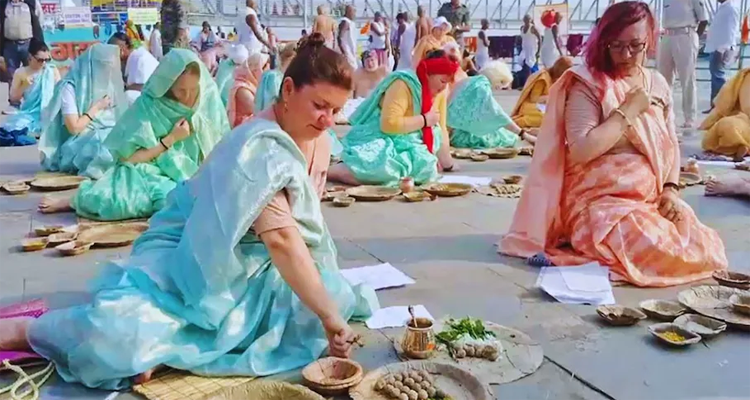
From Russia and Ukraine to Germany, Italy and Africa, overseas devotees gather on the sacred banks of Falgu to pray for departed souls; foreign women perform ancestral rituals in sarees as AI translation bridges language barriers
Faith knows no borders—and the sacred banks of the Falgu River in Gaya-ji offered a striking glimpse of that spirit on Friday as foreign devotees joined the vast sea of pilgrims at the Pitru Paksha Mela Mahasangam-2026 to perform Pind Daan and Tarpan for their departed ancestors and loved ones.
Travelling thousands of kilometres from different parts of the world, overseas pilgrims gathered at Devghat and the Vishnupad area, where they offered prayers, water and traditional pindas while seeking peace and salvation for departed souls.
Among the most captivating scenes were foreign women dressed in traditional Indian sarees, sitting beside priests and solemnly performing the ancestral rites according to Hindu customs. With folded hands, offerings before them and sacred mantras echoing along the Falgu, their participation turned the ancient pilgrimage into a remarkable confluence of cultures united by remembrance and devotion.
Not just Indians, foreigners too perform pind daan in Gaya ji in Bihar
Seen here are Germans performing the rituals in the occasion of Pitru Paksha. pic.twitter.com/0XLVT3v457
— With Love Bihar (@WithLoveBihar) October 2, 2026
From distant lands to sacred Gaya-ji
Foreign pilgrims from countries including Russia, Ukraine, Germany, Italy, Latvia and Ghana, among others, have been reported participating in the rituals during the ongoing mela.
According to one set of local reports, 22 foreign pilgrims from Russia, Ukraine and Germany performed Tarpan and Pind Daan at Devghat on Friday. The pilgrims planned to remain in Gaya for around three days and perform ancestral rites at different designated Pind-vedis.
Their religious ceremonies are being conducted under the guidance of Pandit Loknath Gaur of Varanasi, who has also guided overseas devotees performing ancestral rites in Gaya on previous occasions.
Another report separately mentioned a group of 48 foreign pilgrims, including visitors from Germany, Spain, Italy, the Netherlands and Portugal, performing Pind Daan and Tarpan along the Falgu River in the Vishnupad area.
As published reports differ over both the number and nationalities of the foreign visitors, the figures appear to represent different groups or separate sets of pilgrims rather than a single consolidated foreign delegation.
Other reported overseas participants include devotees from Russia, Ukraine, Italy, Germany, Ghana and Latvia, ranging from people in their 30s to pilgrims in their late 60s.
For them, Gaya is more than another destination on an Indian itinerary. Many reportedly came after learning about the spiritual significance of Pind Daan in Gaya and hearing about foreign devotees who had previously performed the ritual here.
Some were also preparing to observe stringent ritual practices, including Nirjala fasting—abstaining from both food and water—while performing the ancestral ceremonies.
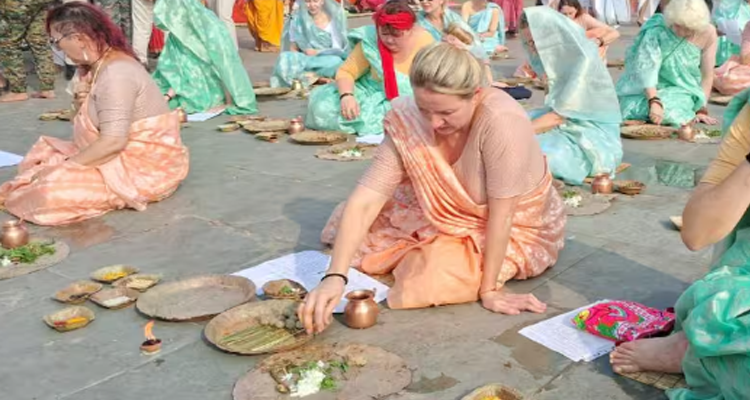
Sarees, Sanskrit mantras and prayers beside the Falgu
The presence of foreign women performing Pind Daan in sarees became one of the most striking sights at Devghat.
Sitting alongside Indian pilgrims, they followed the instructions of priests and participated in the ceremonies step by step, offering pindas, performing Tarpan and praying for those who had passed away.
Nationality and language appeared to fade into the background as pilgrims gathered for a common purpose—to remember those who came before them.
The rituals also reflected the international reach that Gaya’s ancient ancestral traditions have gradually acquired, with overseas visitors not merely observing the ceremonies but actively embracing their religious disciplines.
Devotees from Germany, Ghana and Russia performed the traditional Pind Daan rituals for their ancestors at Gaya Ji in Bihar. The sacred Hindu ritual, believed to help departed souls attain peace, drew international devotees to the pilgrimage site during the ongoing religious… pic.twitter.com/9knw2sk7WP
— Mid Day (@mid_day) October 2, 2026
Why Gaya-ji holds such profound significance
Gaya occupies an exceptional place in Hindu tradition for Shraddha, Tarpan and Pind Daan.
The Bihar Tourism Department describes Pitru Paksha as a sacred period dedicated to honouring departed ancestors, during which pilgrims traditionally perform rites at the Falgu River, Vishnupad Temple and numerous sacred Pind-vedis across Gaya.
According to Hindu tradition, Lord Rama is believed to have performed Pind Daan in Gaya for his father, King Dasharatha, adding to the city’s profound religious association with ancestral worship.
The ancient Vishnupad Temple, situated beside the Falgu River, remains one of the principal centres of the pilgrimage and is traditionally associated with a sacred footprint of Lord Vishnu.
For generations, families from across India have travelled to Gaya with the belief that performing ancestral rites at this sacred land brings spiritual peace to departed souls.
In 2026, that deeply rooted tradition is visibly extending beyond India’s geographical boundaries.
Pilgrim tide swells beyond 21 lakh
While foreign participation has provided a distinctive international dimension, the sheer scale of the overall pilgrimage has been equally remarkable.
Reports citing Gaya district administration figures said 20,71,200 pilgrims had reached Gaya by October 1, with around 4.10 lakh pilgrims arriving on October 1 alone.
By October 2, the overall pilgrim count was reported to have crossed 21 lakh, as devotees continued pouring into the holy city from Bihar and other parts of India.
The massive gathering has transformed the Falgu ghats, Vishnupad area and other Pind-vedis into centres of continuous religious activity, with prayers and ancestral rituals being performed throughout the day.
Ancient rituals meet AI technology
Amid ceremonies rooted in centuries-old tradition, modern technology is also playing an unusual but important role at this year’s mela.
An AI-powered language translation facility has been deployed to assist pilgrims facing communication difficulties.
According to reported administrative data, the translation service had already been used to assist 14,555 pilgrims, enabling people speaking different languages to better understand religious procedures, directions and administrative information.
For foreign visitors in particular, such technology can help bridge a crucial communication gap while they navigate the rituals and arrangements surrounding the massive pilgrimage.
The contrast is striking: ancient mantras and ancestral rites on one side, AI-powered translation on the other—both serving pilgrims gathered for the same timeless purpose.
When faith transcends language and borders
The scenes unfolding along the Falgu River during Pitru Paksha Mela 2026 tell a story that extends beyond numbers.
A Russian devotee, a German pilgrim, a visitor from Ukraine or Africa and an Indian family may speak different languages and come from vastly different cultures, yet at the Pind-vedis of Gaya their prayers converge around a deeply human sentiment—remembrance of those they have lost.
Foreign women in sarees offering Pind Daan, overseas pilgrims fasting and following traditional rituals, priests chanting sacred mantras and millions of devotees converging on the ancient city have together given this year’s gathering a distinctly global character.
For centuries, pilgrims have come to Gaya seeking moksha and peace for their ancestors. Today, those footsteps are arriving from increasingly distant shores.
As the Pitru Paksha Mela 2026 continues until October 10, Gaya-ji is presenting an extraordinary picture of faith without frontiers—where the sacred Falgu carries prayers spoken in many languages, but offered with the same hope: peace for the departed and blessings for generations to come.