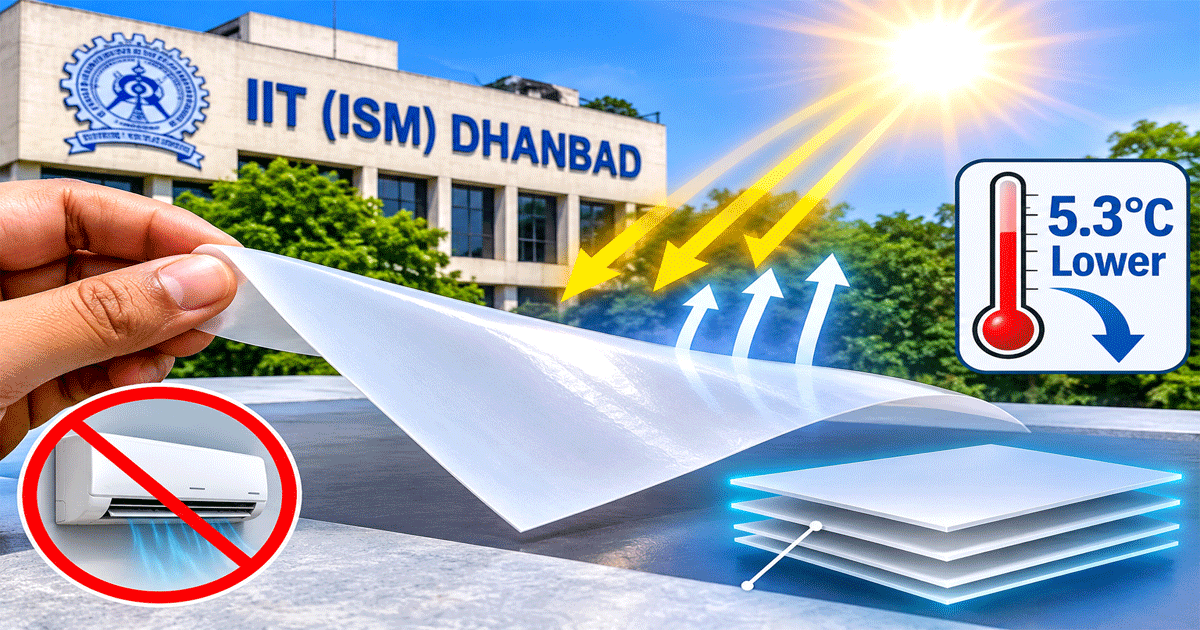
Dhanbad: In a promising breakthrough that could transform energy-efficient cooling, researchers at IIT-ISM Dhanbad have developed an innovative thin-film technology capable of cooling surfaces by up to 5.3°C below ambient air temperature, even under direct sunlight, without consuming electricity.
The innovation could offer a sustainable alternative to conventional cooling systems by reducing heat accumulation in buildings and other structures, potentially lowering dependence on air conditioners, particularly in regions battling extreme temperatures and rising energy demand.
The technology is based on specially engineered thin films made from ultra-high molecular weight polyethylene (UHMWPE), a lightweight and durable polymer, blended with microscopic particles of silicon dioxide and titanium dioxide. The material reflects a substantial portion of incoming solar radiation while allowing heat to escape from its surface into the atmosphere, producing a natural cooling effect.
The process, known as passive daytime radiative cooling, enables surfaces to cool without electricity or external energy inputs. Unlike conventional air-conditioning systems, the technology does not require compressors, refrigerants or continuous power consumption.
A distinctive feature of the innovation is its multilayer design, in which thin films are separated by small air gaps. This arrangement minimises heat transfer, enhances insulation and improves overall cooling performance. Lightweight and flexible, the films could potentially be applied to rooftops, building walls, industrial installations, vehicles and other outdoor surfaces exposed to direct sunlight.
Highlighting the technology’s potential, Gaurav Kumar, Senior Research Fellow (SRF), said the film could deliver effective cooling even under direct sunlight without consuming electricity.
Prof. Kesavan Ravi, faculty member of the Fuel, Minerals and Metallurgical Engineering (FMME) department, said the relatively simple fabrication process and multilayer structure made the technology promising for practical applications. Prof. Sarthak S. Singh of the Mechanical Engineering department said the innovation could help minimise heat accumulation and promote more energy-efficient cooling solutions.
The development assumes significance amid rising global temperatures, increasing electricity consumption and growing demand for air conditioning. If successfully scaled up for commercial use, the technology could provide an environmentally friendly option for reducing indoor and surface temperatures, particularly in hot climatic regions.
The innovation has also secured intellectual property protection. Patent No. 609802, titled “Method of Fabrication of Ultra-High Molecular Weight Polyethylene Thin Film Capable of High Sub-Ambient Cooling and Method to Enhance the Sub-Ambient Cooling Therein,” was granted on November 17, 2026.
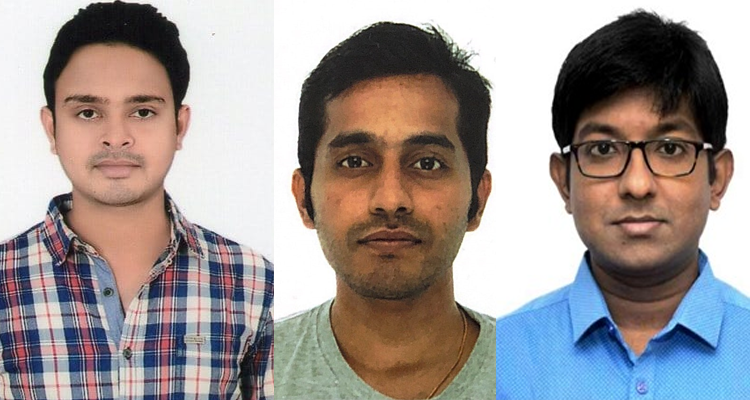
The research team comprises Gaurav Kumar (SRF), Prof. Kesavan Ravi and Prof. Sarthak S. Singh of IIT (ISM) Dhanbad.