New Delhi: In a significant boost to India’s efforts to reclaim its stolen cultural heritage, three ancient bronze idols, repatriated from the United States and the Netherlands, have returned to India. The Archaeological Survey of India (ASI) formally handed them over to the Idol Wing-CID of Tamil Nadu Police at a ceremony held at Dharohar Bhawan in New Delhi on Thursday.
The three antiquities include two bronze sculptures returned from the Smithsonian Museum in the United States and one recovered from The Hague in the Netherlands. All three have been traced to historic temples in Tamil Nadu and belong to the state’s rich Chola and Vijayanagara artistic traditions.
The idols were formally handed over by ASI Director-General Yadubir Singh Rawat, along with other senior officials of the organisation.
Three ancient idols and their historical significance
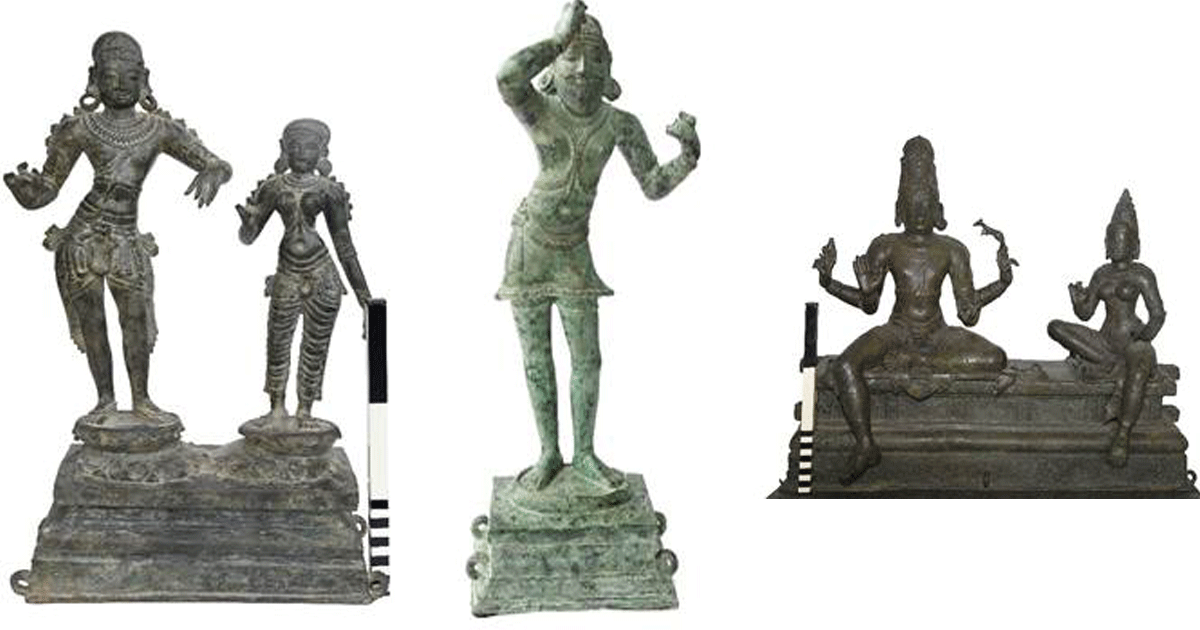
The first is a 16th-century bronze sculpture of Saint Sundarar with Paravai Nachiyar, belonging to the Vijayanagara period. The sculpture was photographed in 1956 at the Sri Narisvara Shiva Temple in Viracholapuram, Kallakurichi district, Tamil Nadu. It was subsequently repatriated from the Smithsonian Museum in the US.
The second is the bronze idol of Saint Kannappa Nayanar, belonging to the Chola period. Originally associated with the Arulmigu Agneeswarasamy Temple at Thirupugalur in Nagapattinam district, the sculpture depicts the Shaivite saint standing in the traditional tribhanga posture, with his right hand raised towards his eye. It was returned from The Hague, Netherlands.
The third antiquity is Somaskanda, depicting Lord Shiva and Goddess Uma, a 12th-century bronze sculpture from the Chola period. It was photographed in 1959 at the Sri Visvanatha Shiva Temple in Alattur, Mannargudi taluk, Thanjavur district. This sculpture was also repatriated from the Smithsonian Museum.
Bringing India’s heritage home! 🇮🇳
@ASIGoI hands over three repatriated bronze antiquities from the USA and the Netherlands to Tamil Nadu Police, marking another milestone in safeguarding and restoring India’s cultural legacy!
Read More: 🇮🇳👇
🔗 https://t.co/8eSvWGOuMW https://t.co/sQ2XVqwLcf— PIB Culture (@PIBCulture) November 27, 2026
How the Netherlands idol was traced
The recovery of the Saint Kannappa Nayanar idol involved coordinated efforts by Indian authorities and heritage conservation groups. According to media reports, the sculpture came to notice in 2025 after it was offered for sale at the European Fine Art Foundation (TEFAF) art fair in Maastricht, Netherlands.
The India Pride Project alerted the Indian Ambassador to the Netherlands and Tamil Nadu Police’s Idol Wing, triggering efforts to establish the sculpture’s Indian provenance and facilitate its return.
The idol was reportedly stolen from its original temple around 2010, with a theft case registered at Thittachery Police Station on August 8, 2010. Its recovery involved coordination between the Tamil Nadu Police Idol Wing-CID, ASI, the Ministries of Culture and External Affairs, and Dutch authorities.
India’s continuing efforts to reclaim lost heritage
The return of the three bronze sculptures represents another step in India’s ongoing campaign to recover antiquities that have found their way into foreign museums, galleries and private collections.
Historical photographs, temple records and other documentary evidence play a crucial role in establishing the provenance and ownership of such artefacts.
The Ministry of Culture said the ASI continues to work with national and international agencies to identify, recover and repatriate India’s lost cultural treasures.
The formal transfer to Tamil Nadu Police marks an important stage in the process of restoring these ancient sculptures to their country of origin. Further decisions regarding their custody and eventual return to their respective temples will be taken by the concerned authorities.