
Iran is rapidly developing a heavily fortified underground complex in central Iran, strategically positioned between two of its most sensitive nuclear-related facilities, raising fresh concerns over Tehran’s military and nuclear ambitions.
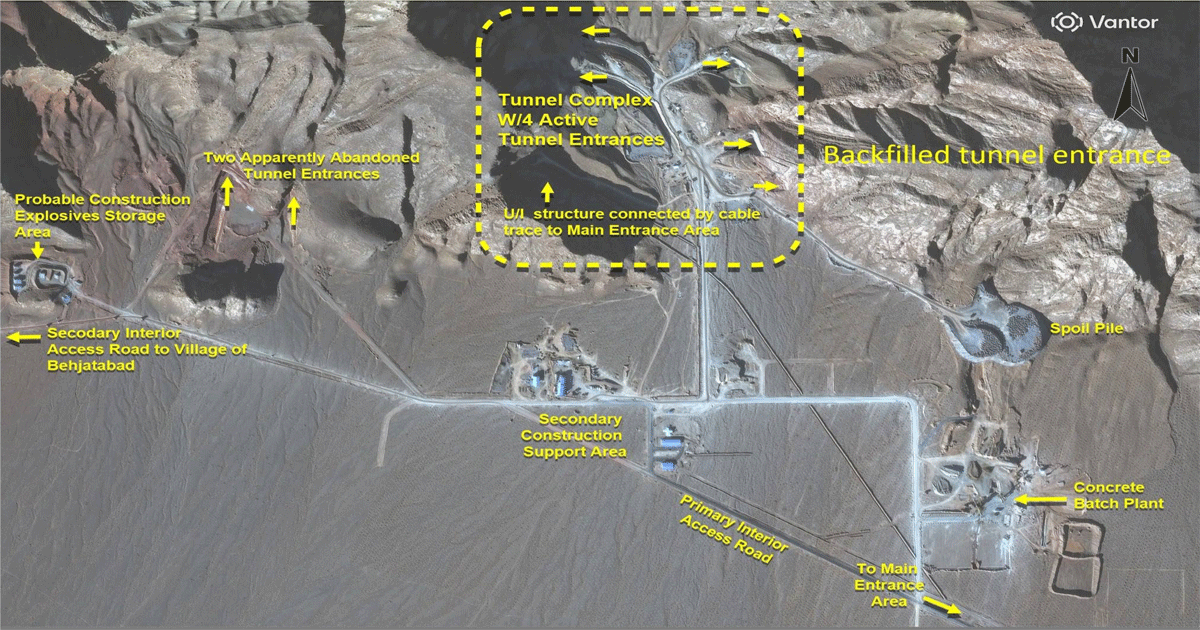
Satellite images analysed by the Washington-based Institute for Science and International Security (ISIS) reveal extensive construction activity at a site near Behjatabad, located approximately 62 kilometres from both the Isfahan nuclear complex and the Natanz nuclear facility.
The newly identified underground zone has drawn attention because of its strategic location, expanding tunnel infrastructure and extensive security arrangements. Researchers believe the facility could eventually serve an important military purpose, although its exact function remains unknown.
Satellite images reveal rapid construction
An examination of satellite imagery captured between December 2025 and November 2026 indicates that construction has progressed rapidly over the past year.
Initial work involved clearing land and developing access infrastructure. By early 2026, satellite images began showing the construction of roads connecting the surface facilities with the underground complex.
Subsequent images revealed excavation activity around two separate tunnel sections, accompanied by growing piles of excavated earth and rock. The latest imagery, captured on November 24, indicates further progress in tunnel development and preparations for an extensive security perimeter.
The proposed outer security zone could cover approximately 5,000 hectares, or nearly 49 square kilometres, highlighting the scale of the project.
🚨🇮🇷 Iran Building Massive Underground Military Complex Between Two Nuclear Sites at Breakneck Speed
New satellite imagery reveals Iran is constructing what appears to be a heavily fortified underground weapons facility at an alarmingly fast pace, carving deep into a mountain directly between the Natanz “Hammer Mountain” and Isfahan nuclear sites.
In less than a year, Iran has gone from clearing barren land to excavating two separate underground tunnel complexes. Satellite imagery from yesterday reveals construction has now begun on an enormous security perimeter that will enclose a staggering 50 square kilometers (19.3 square miles).
The US-based Institute for Science and International Security says the unusually rapid construction, extensive security infrastructure and Iran’s historical construction patterns point to a strategic military facility for the manufacturing of missiles and major weapons systems – and a direct connection to Iran’s nuclear program.
— C14 News | EN (@c14english) November 25, 2026
What is Iran building underground?
The facility’s intended purpose remains a major unanswered question.
According to nuclear security researchers, its location, underground construction and security arrangements suggest that it could be designed to protect sensitive military infrastructure from aerial attacks.
Possible uses include protected missile-related infrastructure, military storage facilities or installations associated with Iran’s broader nuclear programme.
However, satellite imagery has not established whether the complex will house uranium enrichment equipment, nuclear materials or weapons-related facilities. Its precise operational role has yet to be independently verified.
Isfahan and Natanz add to strategic significance
The new complex is particularly significant because of its proximity to two major Iranian nuclear-related locations.
The Isfahan nuclear complex houses important nuclear infrastructure, including facilities associated with uranium processing and the country’s enriched uranium stockpile.
Natanz, meanwhile, is one of Iran’s principal uranium enrichment centres. The nearby Pickaxe Mountain underground complex has also attracted international attention because of its extensive tunnel network and heavily protected construction.
Both Isfahan and Natanz were targeted during the US and Israeli military strikes against Iranian nuclear facilities in June 2025.
Since then, satellite imagery has indicated efforts to reinforce underground entrances, strengthen protective structures and secure sensitive infrastructure against potential future attacks.
The emergence of another major underground complex between these locations could further complicate international efforts to monitor Iran’s strategic activities.
Growing concerns over Iran’s underground network
Underground facilities offer significant protection against conventional airstrikes, making them increasingly important to countries seeking to safeguard sensitive military and strategic installations.
For the United States and Israel, Iran’s expanding underground infrastructure presents an additional challenge in assessing the country’s nuclear capabilities and military preparedness.
The latest satellite findings do not establish that Tehran is building another uranium enrichment facility or developing nuclear weapons at Behjatabad. Nevertheless, the speed and scale of construction have intensified scrutiny of Iran’s efforts to strengthen its underground infrastructure.
For now, one development is clear: Iran is building a substantial fortified underground complex between two of its most important nuclear-related sites. Whether it is intended for missile infrastructure, military storage or a future nuclear-related role remains uncertain.