by Ashis Sinha | Special Analysis
The Narendra Modi-led National Democratic Alliance (NDA) faces a crucial parliamentary test as it prepares to push through a Constitution Amendment Bill proposing a 50 per cent increase in Lok Sabha seats across all states and linking delimitation with the implementation of 33 per cent women’s reservation.
With the special sitting of Parliament scheduled from November 30 to December 3, the biggest challenge for the government is securing the constitutionally mandated two-thirds majority in both Houses. Although the NDA enjoys a simple majority in the Lok Sabha, the numbers required to pass a constitutional amendment are considerably higher.
NDA 40 votes short in Lok Sabha
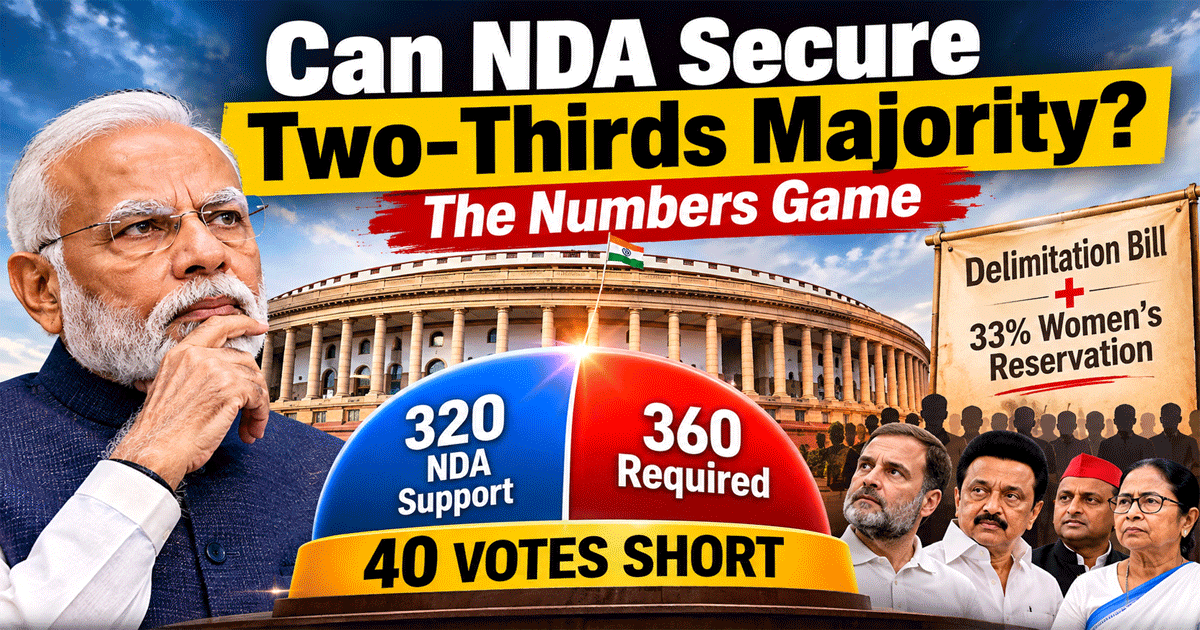
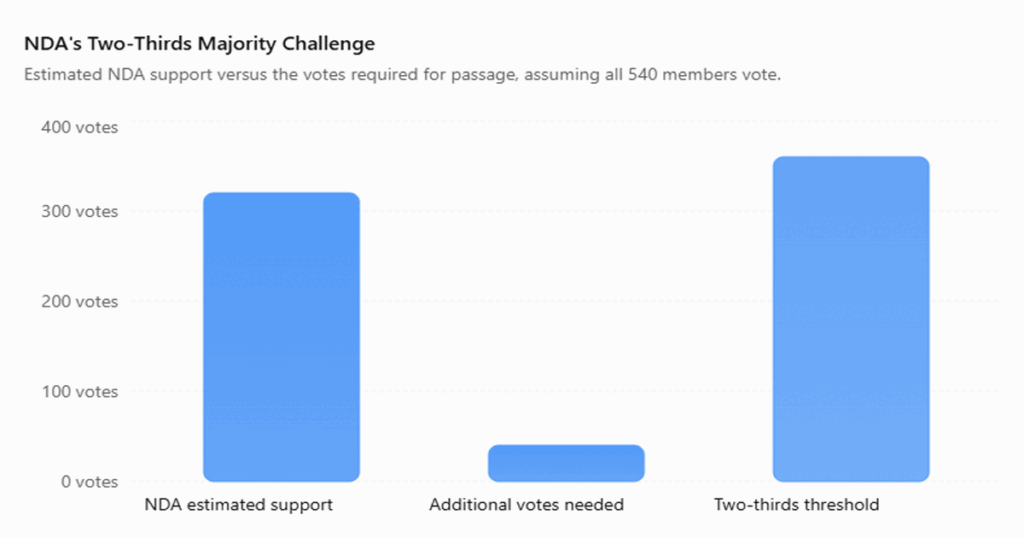
Based on the reported parliamentary strength, the NDA is estimated to have around 320 supporters in the Lok Sabha. Against an assumed effective House strength of 540, the government would need 360 affirmative votes if all members participate in voting.
This leaves the ruling alliance approximately 40 votes short of the required threshold.
The equation, however, could change with support from regional parties and smaller political groups. The DMK, NCP (Sharadchandra Pawar) and YSR Congress Party (YSRCP) could emerge as important players.
The DMK has 22 Lok Sabha MPs, the NCP-SP eight and the YSRCP four. If all three parties support the proposal, the government’s estimated tally could rise to 354, still six short of the 360-vote requirement.
The BJP is also reportedly reaching out to smaller parties and individual MPs to bridge the gap. Its broader target is believed to be around 380 votes, although support from every potential ally has not been formally confirmed.
The arithmetic: NDA still short of the magic numberLok Sabha voting scenario | Based on estimated figures as of November 27, 2026 NDA’s Two-Thirds Majority Challenge
Estimated NDA support versus the votes required for passage, assuming all 540 members vote.
 320 360
Estimated NDA support Required votes The gap: 40 votes. Even potential support from DMK (22), NCP-SP (8) and YSRCP (4) would take the estimated tally to 354, leaving the NDA six votes short if all 540 MPs vote. Editorial graphic: The figures are estimates, not confirmed voting commitments. |
Lok Sabha arithmetic: NDA’s estimated 320 votes against the 360 required for a two-thirds majority. Potential support from DMK, NCP-SP and YSRCP could take its tally to 354.
Regional parties hold the key
The DMK’s position is particularly significant because of its concerns over the impact of delimitation on southern states. Tamil Nadu and other southern states have argued that population-based redistribution could reduce their relative political influence despite their efforts to control population growth.
The government’s revised formula proposes a proportionate 50 per cent increase in Lok Sabha seats across all states, seeking to preserve their existing relative share of parliamentary representation.
Under this arrangement, Tamil Nadu’s 39 Lok Sabha seats could increase to around 59, while Uttar Pradesh’s 80 seats could rise to 120.
The NCP-SP is another potential supporter. Its parliamentary position could prove important in a closely contested vote. However, its final stand will depend on the details of the proposed legislation.
Rajya Sabha presents another challenge
Even if the government manages to secure the required numbers in the Lok Sabha, it must clear the Rajya Sabha hurdle.
A constitutional amendment requires a majority of the total membership of each House and at least two-thirds of members present and voting. With the Rajya Sabha’s effective strength estimated at around 244, the government would need approximately 163–164 affirmative votes if almost all members participate.
The NDA’s estimated strength in the Upper House remains below that threshold. Support from regional parties and smaller groups will therefore be crucial in both Houses.
Lessons from April’s setback
The government is attempting a fresh legislative push after its earlier Constitution (131st Amendment) Bill failed in the Lok Sabha on April 17.
The Bill received 298 votes in favour and 230 against, falling 54 votes short of the required 352 among the 528 members who participated in the voting.
The setback exposed the difficulty of passing a constitutional amendment without support beyond the ruling alliance. The government has since sought to expand its support base through discussions with regional parties and other parliamentary groups.
Opposition’s dilemma over women’s reservation
The proposed legislation also presents a political challenge for the Opposition. Most major Opposition parties have supported the principle of 33 per cent reservation for women but have questioned linking its implementation with delimitation.
The Nari Shakti Vandan Adhiniyam, 2023, already provides for women’s reservation in the Lok Sabha and state legislative assemblies. Its implementation under the existing framework is linked to a Census followed by delimitation.
The government’s revised proposal seeks to accelerate the process and facilitate implementation ahead of the 2029 Lok Sabha elections.
The Opposition’s concerns, however, extend beyond the women’s quota to the possible consequences of delimitation for federal representation and the balance between states.
Can abstentions change the outcome?
Attendance during voting could also influence the final arithmetic. Under Article 368 of the Constitution, a constitutional amendment requires both a majority of the total membership of each House and a two-thirds majority of members present and voting.
Consequently, abstentions and absences can lower the number of affirmative votes needed under the second condition. However, the separate requirement of a majority of the total membership remains mandatory.
The government could therefore benefit if some Opposition MPs abstain or remain absent, but relying on this possibility would be a risky strategy.
The numbers game
The NDA has improved its position since the April defeat, but its estimated strength alone is insufficient to guarantee passage. Even the combined support of the DMK, NCP-SP and YSRCP would leave it short of the assumed Lok Sabha threshold if all 540 members vote.
The final outcome will depend on the positions taken by regional parties, the support of smaller groups, attendance and the government’s ability to secure the required numbers in both Houses.
The proposed legislation is about more than expanding Parliament. It touches upon women’s political representation, the federal balance between states and the future distribution of political power.
For the Modi government, the special sitting will be a test of its ability to build a wider parliamentary consensus. The decisive question is whether the NDA can turn its political outreach into the two-thirds majority needed to pass the Constitution Amendment Bill.