
Sanjay Saxena | Senior Journalist, Lucknow
Akhilesh Yadav faces political questions over his opposition to the Delimitation Bill despite supporting women’s reservation. Explore the SP’s strategy, caste census demand and implications for UP politics ahead of the 2027 elections.

The issue of women’s reservation and delimitation has once again taken centre stage in Parliament, with the government appearing more determined than ever to secure the passage of the proposed legislation. Whether it succeeds remains to be seen, but the political picture is expected to become clearer by December 3.
Following the Union Cabinet’s approval on November 27, the government is preparing to introduce the Constitutional Amendment Bill on delimitation in the Lok Sabha on November 30. The move comes after a major setback in April, when the 131st Constitutional Amendment Bill was defeated in the Lok Sabha on April 17, securing only 230 votes in favour against 298 votes against it, thereby failing to achieve the mandatory two-thirds majority.
This time, the government has come forward with a fresh Constitutional Amendment Bill and the Delimitation (Second) Bill. The proposals envisage a 50 per cent increase in Lok Sabha seats across states and Union Territories, accompanied by a corresponding expansion of state legislative assemblies. The government’s argument is that the existing proportion of parliamentary representation among states will remain unchanged, with the exercise based on the 2011 Census. In other words, no state is expected to lose its relative share of representation.
Despite these assurances, the Congress, Samajwadi Party and several smaller parties are strongly opposing the proposed legislation, raising questions about its timing, methodology and political implications. The Samajwadi Party’s opposition, in particular, has intensified the political debate in Uttar Pradesh.
Uttar Pradesh Set for a Major Expansion
The proposed delimitation exercise could significantly reshape Uttar Pradesh’s political landscape. According to Deputy Chief Minister Keshav Prasad Maurya, the state’s Lok Sabha seats could increase from 80 to 120, while its Assembly constituencies may rise from 403 to approximately 605. This would mean 40 additional parliamentary seats and nearly 200 additional Assembly seats. The Assembly figure, however, remains an estimate, with the final numbers to be determined by the Delimitation Commission.
If one-third reservation for women is implemented across the expanded legislatures, Uttar Pradesh could see approximately 40 Lok Sabha seats and around 200 Assembly seats reserved for women. This prospect has prompted Chief Minister Yogi Adityanath to appeal to all 80 Lok Sabha MPs from the state to support the proposed legislation.
The Modi government appears determined to push the Bills through Parliament. However, the political consequences of this exercise will extend well beyond the immediate parliamentary contest, particularly in the run-up to the 2027 Assembly elections in Uttar Pradesh and the 2029 Lok Sabha elections.
Opposition Unity Begins to Show Cracks
The Opposition’s unity over the proposed legislation appears considerably weaker than before. While Samajwadi Party chief Akhilesh Yadav has openly opposed the delimitation exercise, the DMK has expressed support for the government’s move. The Aam Aadmi Party, meanwhile, is demanding equitable representation.
BSP chief Mayawati has also welcomed the Centre’s decision in a post on X, but her support comes with important conditions. She has demanded a separate provision for women belonging to Scheduled Castes and Scheduled Tribes within the proposed 33 per cent reservation. In April, she had similarly raised the demand for a separate quota for Dalit and OBC women.
Mayawati has also expressed concerns about possible irregularities in determining constituency boundaries and the allocation of seats during delimitation. Her position, therefore, is not one of unconditional support. Rather, she has welcomed the principle of women’s reservation while questioning aspects of its implementation.
However, the BSP’s limited parliamentary strength means that its position is unlikely to have a decisive impact on the numbers in the Lok Sabha.
Why Is Akhilesh Yadav Opposing the Bill?
The Samajwadi Party’s position carries greater political significance. After the Congress, it is one of the largest constituents of the INDIA alliance in the Lok Sabha, with 37 MPs.
Akhilesh Yadav maintains that the Women’s Reservation Act, passed in 2023, should be implemented without further delay. However, he has rejected the proposed delimitation exercise, arguing that the government is unnecessarily linking women’s reservation with the redrawing of constituencies.
He insists that the SP is not opposed to women’s reservation but objects to the manner and haste with which the government is pursuing delimitation. He has even described the move as the BJP’s biggest political mistake. According to party sources, Akhilesh has compared its potential political consequences with those of demonetisation.
But what exactly is driving the Samajwadi Party’s opposition?
An examination of the political circumstances suggests three major considerations.
First, the Census and caste enumeration issue.
Akhilesh Yadav argues that the proposed delimitation exercise is being undertaken on the basis of 2011 Census figures, despite the absence of a fresh Census. He believes that a new Census would inevitably revive demands for caste-based enumeration, an issue central to the Samajwadi Party’s political strategy.
The party’s PDA (Pichhda, Dalit, Alpsankhyak) formula, representing backward classes, Dalits and minorities, is at the heart of its electoral mobilisation. The SP questions how women from backward communities will receive adequate representation if their population share is not taken into account while determining the reservation framework.
The demand for a separate quota for SC and ST women, raised by Mayawati, also forms part of this wider debate over social representation and the distribution of political power.
Second, a lack of trust in the delimitation process.
Akhilesh has alleged that the BJP, apprehensive about electoral defeat, wants to influence election outcomes through possible irregularities in delimitation and the revision of electoral rolls.
The SP leadership does not view the exercise merely as an administrative process to increase the number of constituencies. Instead, it sees it as a question of political representation, social justice and the balance of power among states.
The party also suspects that the timing of the proposed exercise, ahead of the 2027 Uttar Pradesh Assembly elections, could provide the BJP with a political advantage.
Third, the uncertainty surrounding electoral arithmetic.
There is another dimension to the SP’s opposition, although it has not been formally articulated as an official party position. The delimitation exercise will involve redrawing constituency boundaries, while the implementation of women’s reservation could alter the electoral prospects of existing MPs and MLAs.
Reserved constituencies may shift following delimitation, potentially affecting established political strongholds and the electoral calculations of different parties. For a party whose support base is concentrated in particular regions and social groups, such uncertainty could carry considerable political risks.
Political observers believe that these factors may also be influencing the SP’s calculations.
Political Risks for the Samajwadi Party
The Samajwadi Party’s opposition is not without risks. The BJP is likely to portray its position as anti-women, particularly when the proposed legislation promises a substantial increase in women’s representation in Parliament and state assemblies.
Akhilesh Yadav, therefore, is attempting to counter this narrative by maintaining that his party supports the immediate implementation of the Women’s Reservation Act, 2023, without unnecessarily linking it to delimitation.
The SP would like to turn the issue into a major electoral question in the 2027 Uttar Pradesh Assembly elections: if Parliament has already passed a law providing 33 per cent reservation for women, why has it not been implemented yet?
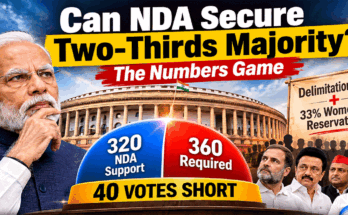
The parliamentary numbers are equally important. The Congress has claimed that the NDA has 322 votes and is attempting to break the Opposition’s ranks to reach the crucial two-thirds majority of 360 votes. Against this backdrop, the SP’s position will also test the durability of Opposition unity.
The government’s argument is that the proposed expansion will preserve the existing proportional representation of states, increase the number of elected representatives and pave the way for women’s reservation from 2029. The SP, on the other hand, insists that without a fresh Census and caste-based data, the exercise cannot be considered sufficiently transparent or equitable.
Parliament’s decision after November 30 will determine whether the government can secure the required two-thirds majority. Equally important will be whether Akhilesh Yadav’s political strategy strengthens his party’s position or ultimately proves counterproductive.
Ultimately, the controversy exposes a larger political dilemma. While women’s reservation has broad political acceptance, the process through which it is to be implemented has become a contentious battleground. Akhilesh Yadav appears to be attempting to balance his support for women’s empowerment with opposition to the government’s delimitation strategy. Whether this position safeguards the Samajwadi Party’s political interests or weakens its credibility on women’s representation remains to be seen.