Beijing: China has taken another major step in its ambitious quest to build an Artificial Sun, announcing the successful completion and testing of the world’s largest superconducting fusion magnet—a key component required for producing clean, virtually limitless energy through nuclear fusion. The breakthrough strengthens China’s position in the global race to commercialise fusion power, often described as the ultimate source of carbon-free electricity.
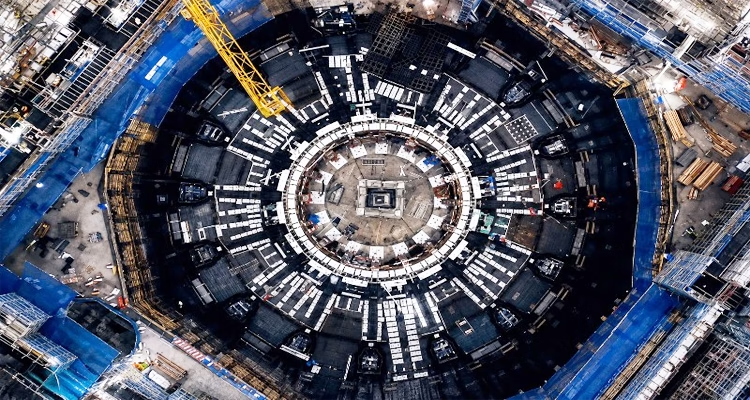
Developed by the Institute of Plasma Physics (ASIPP) under the Chinese Academy of Sciences (CAS), the giant toroidal-field superconducting magnet has successfully passed all performance and acceptance tests. Measuring 21 metres long, 12 metres wide, and weighing 582 tonnes, it is the largest superconducting fusion magnet ever built for a tokamak reactor.
China gets closer to ‘artificial sun’ after successfully testing world’s largest fusion magnet
The 582-ton magnet is key to a reactor that could one day produce clean, nearly unlimited energy
It’s a major step toward China’s goal of generating fusion electricity by ~2030 pic.twitter.com/FqVH7I5Ggp
— RTVisual (@RT_Visual_on_X) July 28, 2026
Key component for nuclear fusion
The D-shaped magnet is designed to generate an extremely powerful magnetic field capable of confining plasma heated to nearly 100 million degrees Celsius—temperatures several times hotter than the Sun’s core. Such magnetic confinement is essential because the superheated plasma cannot be allowed to touch the reactor walls during fusion experiments.
Scientists say nuclear fusion, the same process that powers the Sun and other stars, has the potential to deliver abundant electricity without carbon emissions and with significantly less long-lived radioactive waste than conventional nuclear power.
Bigger and more powerful
According to the research team, the new superconducting magnet has 1.3 times the volume and stores three times more magnetic energy than comparable magnets built for the International Thermonuclear Experimental Reactor (ITER), the multinational fusion project under construction in France.
Researchers also successfully tested a high-temperature superconducting central solenoid coil, widely regarded as the “heart” of a fusion reactor. Similar to a spark plug in a car engine, the coil initiates and sustains the plasma needed for continuous fusion reactions.
Built entirely with Chinese technology
Chinese scientists said both the superconducting magnet and the central solenoid were designed and manufactured using indigenous technology, materials and engineering capabilities.
The six-year programme produced 47 patents and established 25 industry standards, marking another milestone in China’s drive for technological self-reliance in advanced energy systems.
Engineers designed the magnet to operate for nearly 60 years at temperatures close to minus 269°C, while carrying electrical currents exceeding 100,000 amperes with almost no energy loss. It is also engineered to withstand intense radiation and enormous mechanical stress inside future fusion reactors.
Builds on EAST’s record
The achievement follows another landmark in China’s fusion programme earlier this year, when the Experimental Advanced Superconducting Tokamak (EAST)—popularly known as China’s Artificial Sun—set a world record by maintaining plasma at approximately 100 million degrees Celsius for 1,066 seconds. The feat demonstrated the ability to sustain the extreme conditions required for practical fusion energy over an extended period.
Eyes on fusion power by 2030
China has outlined an ambitious roadmap to commercialise fusion energy. The country plans to complete its Burning Plasma Experimental Superconducting Tokamak by 2027, paving the way for its first fusion-based electricity generation around 2030. The longer-term goal is to build the China Fusion Engineering Demonstration Reactor (CFEDR), which could become one of the world’s first demonstration fusion power stations.
Challenges remain
Despite the latest engineering breakthrough, scientists caution that commercial fusion remains a formidable challenge. Future reactors must consistently produce more energy than they consume while operating safely, reliably and economically over long periods.
Even so, the successful completion of the world’s largest superconducting fusion magnet marks a significant advance in fusion technology and brings China a step closer to turning its vision of an Artificial Sun into a practical source of clean, sustainable energy.